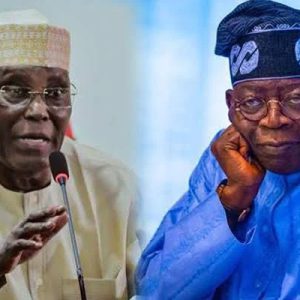
•Tinubu, Atiku and Peter Obi
With less than 18 months to the 2027 general elections, the political landscape across Nigeria is witnessing realignments that could redefine power equations, particularly for the opposition bloc.
The Labour Party (LP) and its 2023 presidential candidate, Peter Obi, who once stirred the imagination of a new generation of voters, now face mounting challenges that threaten his prospects in the next contest, reports The Guardian.

The most recent blow to the opposition’s strength came with the defection of Enugu State governor, Peter Mbah, from the Peoples Democratic Party (PDP) to the ruling All Progressives Congress (APC).
Mbah’s exit, analysts say, has effectively collapsed the PDP’s last stronghold in the South-East, a region that had been the party’s political fortress since 1999.
Mbah’s defection not only consolidates the APC’s inroads into the region; it also further weakens both the PDP and LP, the two platforms competing for the opposition space in the South. Currently, APC controls three out of the five states in the region, leaving Anambra to the All Progressive Grand Alliance (APGA) and Abia to the Labour Party.
But besides that, governors of Anambra and Abia are also said to be favourably disposed to President Bola Tinubu and invariably the ruling APC ahead of the 2027 polls.
For Obi, whose 2023 surge largely rested on South-East and South-South sentiments, the development narrows his base, complicating his pathway to rebuild a pan-regional coalition ahead of 2027.
Within the PDP, the crisis is deepening as prominent members and stakeholders are reportedly urging former President Goodluck Jonathan to return and lead the party’s ticket in 2027. The move, insiders said, is aimed at reviving the PDP’s southern appeal and countering Atiku Abubakar’s dominance in the northern caucus.
However, this call underscores the party’s internal fracture and its indecision over zoning, issues that could further polarise its structure before the next polls.
For instance, the Jonathan gamble will face stiff resistance within the PDP, especially as some stakeholders are already pushing for Governor Seyi Makinde of Oyo State to fly the party’s presidential ticket in 2027, while others believe that the former president may also face a serious legal battle over whether he will be constitutionally eligible to contest again.
It is also being speculated that two more governors from the South-South region are planning to defect to the APC and align their structures with President Bola Tinubu, a development that could further weaken the chances of the former president should he decide to run again.
In the same vein, Atiku’s political footing in the North may also face turbulence with indications that two key governors from the zone, Agbu Kefas of Taraba (PDP) and Abba Yusuf of Kano of the New Nigeria Peoples Party (NNPP) , are being courted by the APC.
Should the defections materialise, they would not only diminish Atiku’s northern network but also erode PDP’s organisational presence across the North-Central and North-West zones, which may leave the former vice-president politically isolated within his own region, especially Kano, which used to have the largest number of voters.
Obi’s Labour Party is in disarray, crippled by defections, leadership feuds, and loss of public enthusiasm, with analysts warning that the “Obidient” wave that reshaped Nigeria’s 2023 elections may be collapsing under weak structures and indecision.
From the National Assembly to state legislatures, Obi, the once-rising “third force” whose personality mobilised millions of young voters, civil society groups, and members of the Christian faith community, is losing members and political relevance.
No fewer than 12 of LP’s 35 federal lawmakers have defected to other political parties, mainly the ruling All Progressives Congress (APC) and the African Democratic Congress (ADC).
At the state level, about 24 of its 38 lawmakers have also switched camps, citing “leadership crisis,” “internal wrangling,” and “directionless opposition.”
Although the LP and Obi finished third in the 2023 presidential election, their performance was historic. Obi polled 6,101,533 votes, trailing Atiku Abubakar of the Peoples Democratic Party (PDP), who scored 6,984,520 votes, while President Bola Tinubu of the APC won with 8,794,726 votes. The LP also won 12 states and the Federal Capital Territory (FCT), secured eight Senate seats and 34 House of Representatives seats, and produced the Governor of Abia State, Dr Alex Otti.
Specifically, Obi won in Lagos, the FCT (Abuja), Plateau, Nasarawa, Delta, Edo, Cross River, Anambra, Enugu, Ebonyi, Imo, Abia, and Benue states, a spread that reflected his national appeal and the cross-regional reach of the “Obidient Movement.”
However, barely two years later, the party’s momentum appears to have stalled. Defections and internal disputes have weakened its national presence, while Obi himself seems increasingly detached from the platform that once symbolised a generational shift in Nigerian politics.
Faltering leadership and the broken ‘Obidient’ dream
After the 2023 elections, Peter Obi’s Labour Party became embroiled in a bitter leadership tussle between National Chairman Julius Abure and a faction led by Lamidi Apapa. The dispute, which later spilt into the courts, crippled post-election coordination and alienated many supporters, including some close to the presidential candidate.
A recently defected LP lawmaker from Enugu, Victor Okechukwu, said: “The party has no direction. Since our election, there’s been no caucus meeting, no engagement. Everyone just fends for himself.”
Beyond the internal feud, Obi’s failure to build institutional cohesion or sustain the momentum of the “Obidient Movement” has deepened the party’s disarray. Unlike President Bola Tinubu, Atiku Abubakar, or even the SDP’s candidate, Prince Adewole Adebayo, who maintained contact with their political structures after the polls, Obi has not consolidated his support base.
Many of his supporters feel abandoned. Since 2023, he has neither convened meetings with LP lawmakers nor initiated structured engagements with state chapters or allied groups.
Organisations such as the apex Yoruba and Igbo socio-cultural bodies, Afenifere and Ohanaeze Ndigbo, as well as PANDEF, the Southern and Middle Belt Leadership Forum (SMBLF), the National Consultative Front (NCFront), the Yoruba Ronu Leadership Forum, and several human rights activists who once endorsed him are gradually pulling back, saying they have not been consulted since the elections.
“Obi had the goodwill and a movement that could have matured into a strong political force,” a former LP campaign coordinator said. “But he mistook social enthusiasm for political structure.”
Obi’s indecision and ADC flirtation
The former Anambra State governor’s political future remains uncertain. He has been sighted at meetings of an ADC-led coalition but has been noticeably absent from key Labour Party events, fuelling speculation about an impending defection. While he has not formally left the LP, he has also not reaffirmed his loyalty to it.
When recently asked about his next move, Obi said: “What matters is a platform that unites Nigerians around competence and character. Party labels don’t solve our problems; values do.”
Many interpret this as a sign that Obi may be seeking a new political platform, a risky move given Nigeria’s volatile political landscape. Analysts warn that repeated defections, weak institutional grounding, and his preference for loose alliances could render him unelectable under any credible party by 2027.
A political scientist, Dr Emeka Umeagbalasi, observed: “Obi’s greatest mistake was failing to transform a protest vote into a permanent political structure. Nigerians rallied behind him, but he did not rally a party behind them.”
Loss of labour roots and South-East retreat
The Labour Party’s identity crisis has deepened following an open disagreement between the Nigeria Labour Congress (NLC) and the party’s national leadership. NLC President Joe Ajaero recently lamented that “what exists today is not the Labour Party founded by workers,” suggesting that the Congress might support a different platform if the rift continues.
The division has distanced the LP from its traditional labour base and eroded its credibility as a workers’ party.
Even in the South-East, where Peter Obi enjoyed his strongest support during the 2023 elections, the party is rapidly losing ground. In Enugu, eight of the LP’s 14 assembly members have defected to the APC.
In Abia State, Governor Alex Otti’s growing independence has reportedly created a cold relationship between him and the LP national leadership. His spokesperson, Ferdinand Ekeoma, explained that “Governor Otti’s focus is governance, not internal wrangling. LP remains his home, but service to Abians is his priority.”
Many of those who supported Obi in 2023 now lament that the LP presidential candidate has gone quiet, giving the APC and ADC room to penetrate the South-East, his strongest base in the last election.
As one supporter observed, “Obi is not giving purposeful leadership. He needs to invest resources to maintain structure and engage people, not just rely on social media talk. Political structures are not built on social media. He must learn from President Tinubu and Atiku.”
Why Obi may not be on any credible ballot in 2027
Obi’s major undoing lies in his strategic indecision, weak institutional loyalty, and failure to manage success. His unwillingness to invest in party-building, reconcile feuding factions, or sustain ideological engagement has alienated potential allies.
By oscillating between the Labour Party and the African Democratic Congress, he risks losing the confidence of both. The Peoples Democratic Party and the All Progressives Congress see him as politically expendable, while emerging coalitions consider him unpredictable.
Moreover, Obi’s over-reliance on online movements, without translating them into enduring grassroots structures, has diminished his relevance.
Many of his 2023 supporters now prioritise survival amid economic hardship, while his messaging has become muted and reactive.
Political observers also argue that his posture of moral superiority, once an asset, has become a liability. It isolates him from Nigeria’s transactional political elite and denies him the coalitional pragmatism required to win power.
Former Deputy National Chairman of the Peoples Democratic Party, Chief Bode George, expressed disappointment over Obi’s political trajectory. He said the man many once regarded as Nigeria’s potential saviour has squandered the goodwill he earned in 2023.
George wondered why Obi had been “moving around with the same kind of desperation Atiku Abubakar has been displaying,” stressing that had Obi remained in the PDP, “this would have been his best chance as a southern candidate on the party’s platform.”
He faulted Obi’s alignment with the ADC and said he could not understand what Obi went to discuss with former President Goodluck Jonathan, describing it as a political miscalculation. “That singular move cut him off from the youths, who believe there is no difference between those populating the ADC and the APC,” George said.
According to him, if Obi still nurtures presidential ambition, his path to recovery must begin now and be grounded in realism, not sentiment.
“First, he must choose a political home and commit to it. The indecision between LP and ADC has portrayed him as politically uncertain. He needs to stabilise one base, rebuild its structures, and reconcile all factions under a common vision. No credible platform will entrust its ticket to a leader perceived as inconsistent,” George added.
Also faulting Obi’s post-2023 political approach, elder statesman and Afenifere chieftain, Senator Femi Okurounmu, said it would be difficult for the LP presidential candidate to win any of the South-West states again in 2027.
“Without sounding biased, it would be difficult for the LP presidential candidate to win any of the South-West states again in 2027, not Lagos, where he dusted President Tinubu. The dynamics of politics have changed drastically between 2023 and now. He failed to consolidate on his success,” Okurounmu said.
Although he confirmed that he supported Obi in 2023, Okurounmu added: “For now, I don’t see Obi defeating Atiku, not to talk of unseating President Tinubu. I learnt he met with Afenifere recently, during which he was giving stringent conditions of how he must be supported, but for me, I’ve left the faction of Afenifere that backed him in 2023 and currently belong to the Pa Reuben Fasoranti side, which supported President Tinubu.”
Okurounmu urged Obi to rebuild bridges with the NLC and re-anchor the LP to its workers’ roots, describing the labour movement as a “moral and grassroots force” that could help restore his identity and funding.
“If he returns to the PDP or insists on staying with the ADC, he may not get the ticket of either party,” he warned.
However, the spokesman for the LP presidential candidate, Dr Tanko Yunusa, said Obi is aware of the sentiments surrounding his 2027 prospects.
“We are doing everything possible to put the structure in order before 2027,” Yunusa assured, adding that Obi will take decisive steps soon to reposition himself ahead of the next general election.
Speaking on why Peter Obi may not replicate his 2023 electoral success, the LP National Deputy Youth Leader (South), Barry Avotu Johnson, said Obi’s current political moves, including his reported links with the ADC and PDP, could weaken his chances.
Johnson noted that Obi’s 2023 momentum was driven by public frustration with the Buhari administration and a hunger for new leadership, but warned that his flirtation with other parties might damage his credibility. He urged Obi to return fully to the LP, insisting it remains his strongest platform for 2027.
Similarly, political analyst Olalekan Ojo of Platinum & Taylor Hill LP stated that Obi’s success depends on building a solid platform, a strong coalition, and voter trust.
He observed that while the 2023 campaign energised young Nigerians, sustaining that enthusiasm requires party unity and organisational strength, elements that currently appear lacking in the LP.
Ojo added that Obi still commands significant credibility and influence, but must consolidate his base under one credible platform to remain relevant. A fragmented opposition, he warned, could dilute Obi’s message and limit his impact in 2027.