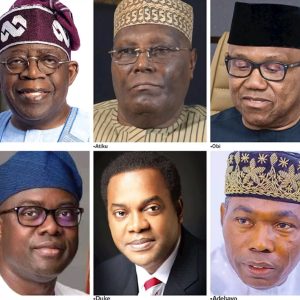


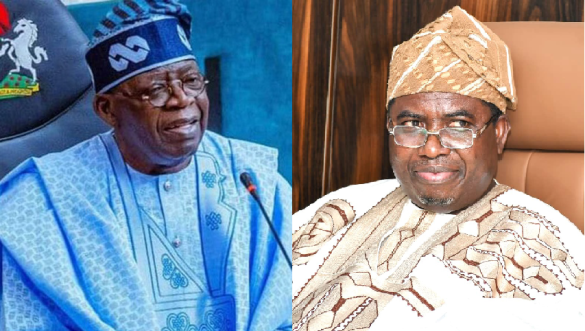
•Tinubu and INEC chairman, Amupitan
Nigeria’s long march to 2027 has crossed a quiet but decisive threshold. What began as a shadowy contest of whispers, consultations, and strategic ambiguity has now entered a more concrete — though no less opaque — phase. Nomination forms have been bought, deadlines have closed, and the first major line in the sand has been drawn, reports Saturday Independent.
Yet, even as the process formalises, the deeper reality remains unchanged: the real battle for power is still being fought behind the scenes.

At the centre of this unfolding drama is the All Progressives Congress (APC), which has taken an early and commanding lead in structuring the 2027 race.
With the official sale of nomination forms running from late April into early May, and submission deadlines now effectively closed, the ruling party has moved from speculation to action — forcing the pace of national politics.
The most consequential development in this regard is the formal entry of President Bola Ahmed Tinubu into the race. Having now secured his presidential nomination form, the incumbent has transformed what was once a presumptive ambition into a confirmed candidacy. The symbolism is unmistakable: the race is no longer hypothetical. It is active, procedural, and irreversible.
Tinubu’s early move does more than signal intent — it reshapes the political timetable. By stepping in ahead of rivals, he has effectively compelled both allies and opponents to recalibrate their strategies. Within the APC, it consolidates his grip on the party machinery. Beyond it, it places pressure on opposition figures to declare their positions sooner than they might have preferred.
“Once an incumbent formalises his ambition this early, the race becomes asymmetrical,” said Dr. Hadiza Sule, a governance analyst.
“He is no longer just a participant; he becomes the reference point around which all other calculations revolve.”
Across the country, aspirants at various levels — governorship, senatorial, and House of Representatives — have followed suit, quietly purchasing nomination forms in a flurry of activity that has largely escaped the glare of public scrutiny.
In states such as Lagos, Ogun, Rivers, Nasarawa, and Borno, credible reports confirm that multiple aspirants have secured forms, either personally or through political sponsors. Yet even this visible activity masks a deeper, more strategic contest — one in which the purchase of a form is merely the opening move.
Preliminary intelligence suggests that while dozens of aspirants have purchased nomination forms across the APC, only a fraction are expected to survive the screening process, with party insiders pointing to loyalty, governor backing, and delegate control — not mere eligibility —as the decisive factors.
This emerging reality has begun to reshape how the race is understood within political circles.
For many aspirants, the real contest is no longer about entry, but survival. The shift from form acquisition to screening represents a transition from financial qualification to political validation — where influence, alignment, and acceptability become the true currency.
“Screening is where ambition meets structure,” noted Dr. Akinwale Ojo, a political scientist at the University of Ibadan. “You may have the resources to buy a form, but without the backing of key stakeholders — particularly governors and national leaders — your chances diminish significantly.”
Indeed, the role of state governors has come into sharper focus in recent days, amid growing reports that some are exerting considerable control over who ultimately progresses.
In several states, aspirants have privately raised concerns that nomination processes are being subtly managed to favour preferred candidates, often through informal channels that leave little trace.
“Governors remain the most influential gatekeepers in Nigeria’s party politics,” observed Professor Zainab Abubakar.
“Their control over local structures and delegates gives them disproportionate power —not just in primaries, but even at the screening stage.”
This concentration of influence has given rise to what insiders describe as a “two-tier contest.” On one level are the visible aspirants — those who have purchased forms and declared interest. On another are the invisible power brokers who determine which of those aspirants are viable. Between these layers lies a fluid space of negotiation, alliance, and, in some cases, quiet elimination.
In this context, categories of aspirants are becoming clearer. There are those widely expected to scale through screening — candidates aligned with dominant blocs, backed by governors, or integrated into the party’s strategic calculations.
In the South-West, for instance, aspirants linked to established political networks are viewed as relatively secure, reflecting the region’s centrality to the APC’s internal balance.
Conversely, there are those whose prospects remain uncertain — figures operating in politically volatile states or lacking strong institutional backing.
In places like Rivers and parts of the North-Central, outcomes are likely to hinge less on formal criteria and more on the interplay of local power structures.
Then there is a third category: aspirants who may pass screening but are not necessarily expected to contest to the end. Often described as bargaining actors, these individuals enter the race to negotiate influence, secure appointments, or align with stronger candidates at a later stage.
“Not everyone who buys a form intends to win,” said Dr. Emmanuel Eke, a political sociologist.
“For some, it is a strategic investment — a way to gain visibility, relevance, or leverage within the system.”
While the APC advances through this structured yet complex process, the opposition remains in a state of recalibration. The Labour Party (LP), despite its grassroots momentum in recent elections, has yet to demonstrate comparable organisational readiness.
There is still no verifiable evidence of widespread nomination form purchases within the party, suggesting that internal consolidation remains a priority.
Similarly, the African Democratic Congress (ADC) continues to position itself as a potential coalition platform. High-profile figures such as Atiku Abubakar are actively engaged in consultations, but have not yet translated that activity into formal participation in the nomination process.
This lag in formal engagement has implications. While the APC is already filtering its field, opposition parties are still defining theirs. The result is an asymmetry that could shape not only candidate selection but also campaign momentum in the months ahead.
“Timing is critical in electoral politics,” Dr. Sule emphasised. “When one party is already screening candidates and another is still negotiating alliances, the difference in preparedness can become a strategic advantage.”
Yet, beyond party structures and timelines, the deeper questions raised by the current phase of the race remain unresolved. The high cost of nomination forms continues to limit access, effectively narrowing the field to those with substantial financial backing or elite sponsorship.
Meanwhile, the opacity of internal processes raises concerns about transparency and fairness.
For many observers, these dynamics reflect enduring features of Nigeria’s political system — where formal democratic procedures coexist with informal networks of influence.
The challenge, they argue, is not simply to conduct elections, but to ensure that the processes leading to those elections are inclusive and credible.
“Democracy does not begin on election day,” Professor Abubakar noted.
“It begins with who is allowed to contest, and under what conditions.”
As the APC moves toward its primaries, scheduled to commence in mid-May, the coming days will prove decisive.
Screening outcomes will narrow the field, alliances will crystallise, and the contours of the race will become clearer. For aspirants, it is a moment of reckoning. For the political system, it is a test of credibility.
What began as a shadow race has now entered a more visible phase — but the shadows have not disappeared. They have simply shifted, from the act of form purchase to the processes that determine who moves forward. In those processes —quiet, complex, and often contested — the true shape of Nigeria’s 2027 election is being forged.
For now, the forms have been bought. The real contest is who survives what comes next.