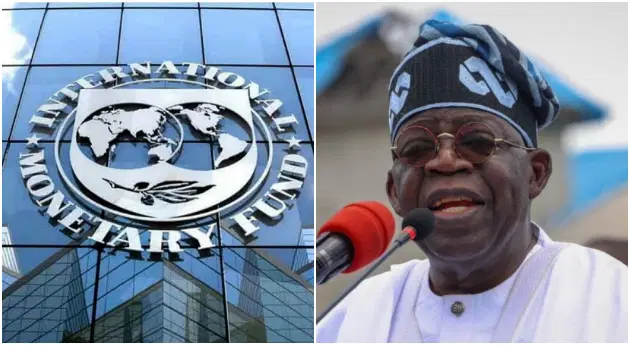
•Tinubu and IMF logo
Nigeria’s external debt service obligations are climbing at an alarming rate, underscoring growing concerns over the country’s debt sustainability and fiscal resilience.
According to the latest figures from the Debt Management Office (DMO), the Federal Government of Nigeria (FGN) spent approximately $1.4 billion in servicing its external debt in the first quarter (Q1) of 2025, marking a 24 percent year-on-year (y/y) increase.
This upward trend continues a worrisome trajectory: since 2020, Nigeria’s annual external debt service payments have expanded at a compound annual growth rate (CAGR) of 32 percent, reports Daily Independent l.
The pace and scale of this growth are increasingly sparking debate about whether the country can balance its development financing needs with long-term fiscal sustainability.
A Debt Profile Tilted Towards Multilateral Creditors
The structure of Nigeria’s external debt reveals some important nuances. Out of the $1.4 billion in debt service payments made in Q1, around $961 million went to non-market-related obligations, while $432 million was used to service market-related debts.
According to analysts at FBNQuest in a note on Monday, “This distinction is more than accounting. It speaks to the heavy concentration of Nigeria’s external borrowings in concessional multilateral and bilateral sources, which now represent 61.9 percent of the FGN’s total external debt stock. Of this, multilateral lenders such as the World Bank and the African Development Bank account for approximately 49 percent”.
Interest and fee payments to multilateral lenders amounted to $137 million in Q1, translating into an annualised cost of borrowing of 2.5 percent—a relatively modest figure that highlights the concessional nature of these loans. For comparison, interest payments to the World Bank alone reflect an annualised rate of 2.0 percent.
“While this concessional funding is helpful in reducing Nigeria’s borrowing costs, it does not eliminate the fundamental pressures associated with a growing debt stock—particularly when principal repayments kick in and when new borrowings continue to mount”, the analysts said.
Market-Linked Debt Still Costlier
Despite accounting for just 38 percent of the FGN’s external debt stock, market-related debt poses a significantly higher financing burden, with interest costs averaging around 10.2 percent. These market-linked debts—typically raised through Eurobonds and other capital market instruments—expose the country to higher refinancing risks, especially in periods of tightening global liquidity or rising interest rates.
Although international financial conditions have slightly eased in 2025, aided by a roughly 9 percent decline in the U.S. dollar, Nigeria’s position remains precarious. A key vulnerability is the risk of further naira depreciation, which would increase the domestic cost of repaying external debts denominated in foreign currencies.
More Borrowing On The Horizon
The fiscal strain may only deepen. In June, the Senate approved President Bola Tinubu’s external borrowing plan amounting to $21.5 billion for the period between 2025 and 2026.
Though spanning fewer than two years, the magnitude of this borrowing is striking: it represents nearly 47 percent of Nigeria’s current external debt stock, suggesting that the FGN’s external debt exposure could almost double if executed in full.
Government officials argue that the borrowing is necessary to fund critical infrastructure projects and to close the country’s widening fiscal gaps. However, economists warn that the timing and scale of this borrowing raise serious questions about debt sustainability, particularly in the absence of significant improvements in revenue mobilisation.
The Revenue Challenge
Perhaps Nigeria’s most persistent fiscal constraint is its abysmally low revenue-to-GDP ratio, which currently hovers below 10 percent —bone of the lowest among peer economies.
This weak revenue base severely limits the government’s ability to service debt, fund social services, and invest in capital projects without resorting to more borrowing.
“Debt service is consuming a growing share of Nigeria’s budget, and unless revenues improve substantially, we will reach a point where borrowing to service debt becomes a vicious cycle,” one Abuja-based macroeconomist noted.
The federal government has recently introduced several tax reforms, and new tax bills—passed and signed into law earlier in 2025—hold promise for improving domestic revenue collection.
However, most of the provisions will not take effect until 2026, meaning they offer no near-term relief for the FGN’s current fiscal pressures. This lag between policy action and impact underscores the need for fiscal prudence in the short term, especially regarding external borrowing, which is more susceptible to currency, interest rate, and geopolitical risks.
Between Currency Mismatch And External Shocks
The naira remains under pressure despite the Central Bank of Nigeria’s (CBN) recent FX reforms. A weaker naira directly affects the local currency cost of servicing external debt. Every depreciation in the exchange rate amplifies the fiscal burden of foreign-denominated debt service, squeezing funds available for domestic priorities such as education, healthcare, and infrastructure.
In the past, Nigeria’s overreliance on oil exports has made the economy vulnerable to external shocks. While efforts to diversify the economy continue, oil still accounts for the bulk of foreign exchange earnings. A sustained drop in oil prices or a disruption in global demand could reduce Nigeria’s FX inflows, making it more difficult to meet external debt obligations.
Moreover, with global interest rates still at relatively high levels, especially in major economies like the U.S., the cost of market-based borrowings may remain elevated, even as monetary policy begins to shift toward easing.
Debt Sustainability In Focus
The DMO, in its periodic Debt Sustainability Analysis (DSA), has consistently flagged Nigeria’s limited fiscal space and the need to increase domestic revenue generation. International institutions like the IMF and World Bank have echoed this advice, warning that without urgent revenue reforms, Nigeria’s public debt could reach unsustainable levels.
To mitigate these risks, analysts suggest that the government consider phasing external borrowings, prioritising concessional funding, and tying debt to verifiable capital projects with high economic returns. Transparency in project implementation and loan utilisation is also essential to ensure that borrowed funds deliver measurable development outcomes.
“Borrowing isn’t necessarily a bad thing, but it must be strategic and matched with capacity to repay. Otherwise, we risk mortgaging the future,” said a Lagos-based development economist.
Walking The Fiscal Tightrope
As Nigeria edges closer to record levels of external debt service, the balancing act between development finance and fiscal prudence grows more delicate. While concessional loans offer a temporary cushion, the rising debt burden —exacerbated by market-based borrowings and a sluggish revenue base — threatens to undermine Nigeria’s long-term economic goals.
In this environment, every new borrowing decision must be weighed against its real and opportunity costs. For a country with immense development needs but limited fiscal headroom, the path forward must be paved with careful planning, transparent execution, and above all, a steadfast commitment to building a stronger, more resilient revenue base. Only then can Nigeria finance its future without compromising its financial sovereignty.