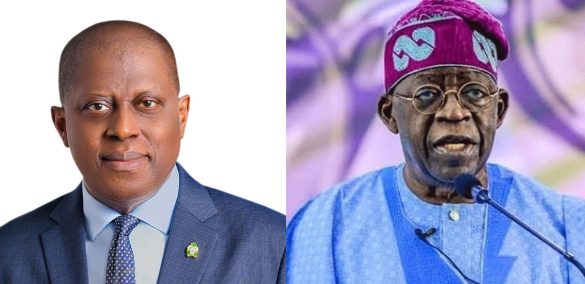
•CBN Governor Yemi Cardoso and Tinubu
For many, Nigeria’s economy may be growing on paper, but on the ground, cash is a rumour, trust is fragile, and survival has become its own kind of policy. This is the story of those who live inside the gap between Gross Domestic Product (GDP) reports and daily life — where a pensioner’s alert can’t buy medicine, a market woman’s basket shrinks while growth is announced, and a mother counting coins knows that the real politics happens not in budgets, but on rain-soaked streets, reports Saturday Independent.
Time. 8:00am, Berger Junction, Abuja. The city is fully awake, but Amaka is already exhausted. Not from the weather, but from the queue forming around her POS stand.
Overnight rain has left puddles along the roadside. Commercial buses are dropping off commuters heading into the city centre, and more than thirty people are waiting before she even powers on her machine.
She keeps the POS terminal wrapped in black nylon because Abuja’s rainy season does not give warnings. One heavy downpour is enough to flood the roadside and shut business for hours.
A middle‑aged civil servant carrying a hospital prescription slip pushes a ten‑thousand‑naira note toward her makeshift table.
“Mama, help me with change. My wife dey hospital.” Amaka barely looks up. “No cash. Transfer only.” The man sighs heavily. Not the sigh of annoyance, but the sigh of someone running out of options.
Weeks after the federal government announced that GDP grew by 3.89 percent in the first quarter of 2026 and that the Nigerian Education Loan Fund had disbursed over N184 billion to more than one million students, Amaka still lives inside the shadow of the cash scarcity era.
For the government, Naira Politics is a spreadsheet.
For Amaka, it is the day a customer fainted outside her kiosk because the bank app displayed “daily withdrawal limit exceeded” while his daughter needed emergency medication and the ATM at a nearby bank branch had been empty for days. We are told Nigeria remains a viable project.
The Secretary to the Government of the Federation stood before cameras and congratulated citizens on 27 uninterrupted years of democracy.
He spoke of economic resilience, fiscal reforms and tax laws designed to strengthen public revenue. He cited statistics from the National Bureau of Statistics.
He spoke about social protection, healthcare expansion and renewed hope.
The Renewed Hope Conditional Cash Transfer, he said, was targeted at fifteen million households and had already reached three million vulnerable homes as of August 2025. He spoke of healthcare priorities, of the National Health Insurance Authority Act expanding legal coverage, of resources provided to more than eight thousand primary healthcare centres with plans to push to thirteen thousand. All true on paper. All necessary.
But paper does not buy food in Dutse Market when traders insist on cash and the network is down. Paper does not calm a pensioner standing in line outside a bank branch in Garki when his hypertension drugs have run out and the ATM is empty again.
Amaka was a hairdresser before 2023. She knew how to braid hair and how to talk clients through heartbreak. Then the naira redesign came, the banks went quiet and the ATMs became monuments to frustration. People needed cash to live and cash became a rumour.
Amaka bought her first POS machine with money borrowed from her sister in Benin City. The commission was two hundred naira per ten thousand then. Now it is five hundred, sometimes a thousand, depending on desperation. She is not a banker. She never attended banking school. But she is the Central Bank for this corner of Berger.
Customers call her “Mama Bank”.
Children run errands for her because they know she will give them sachet water and biscuits. Elderly women trust her more than they trust bank officials because she does not ask them to download applications they do not understand.
The new middlemen were not born. They were made. POS agents. Cash vendors. Bank staff who suddenly discovered they had “connections.”
Amaka’s phone rings repeatedly before noon. Some calls come from customers searching for emergency cash. Some come from officials asking questions about transaction charges.
She has learned to smile at everyone.
She has learned to hide emergency cash in places strangers cannot find. She has learned that helping a nursing mother can be risky and that protecting herself can be risky too. The law says one thing. The street says another. The street always pays faster.
Baba Sule is seventy‑two. He retired from the Ministry of Works in 2014. His pension is supposed to arrive every month. In 2023, his pension stopped being money and became a notification. He would receive an alert and spend days trying to withdraw it. His blood pressure medication costs eight thousand naira. During the worst of the scarcity, he went nearly a week without it.
His daughter found him dizzy on the floor of his one‑room apartment in Kubwa. She rushed him to a private clinic. The clinic accepted transfers. The transfer failed three times. Network problems. By the time the fourth attempt succeeded, the doctor was already talking about the possibility of a stroke.
Baba Sule does not read GDP reports. He reads his body. His body told him the country was broke even when television said the economy was growing.
Mama Caro sells tomatoes and pepper at Dei‑Dei Market. She has traded there since 1999. She knows the price of scarcity. When cash disappeared, customers disappeared too. People would select tomatoes and pepper, then say, “Aunty, I go transfer.” Her banking app would freeze. Power would fail. The customer would abandon the goods and walk away. She lost three days of sales in a single week. Three days she could never recover. She could not pay rent. She could not replenish stock.
“The government says the economy is growing,” she told me. “But my basket is shrinking.” She laughed when she said it.
It was the kind of laugh that carried no joy.
Trust collapsed before inflation did. That is the part the numbers do not capture. Nigerians adjusted faster than the economy.
We adjusted to mistrust. We adjusted to the idea that money in our bank accounts was not really ours until a POS agent decided it was. We adjusted to alerts that meant nothing if there was no network.
We adjusted to a new mathematics where one hundred thousand naira in the bank was worth less than eighty thousand naira in the hands of a trusted agent. The government fought scarcity with policy.
Nigerians fought it with adaptation. Adaptation won first.
Now look at 2026 and the conversations ahead of 2027. Democracy Day gathers statesmen, activists, labour leaders and political actors to discuss poverty, insecurity and the credibility of future elections. Important conversations. Necessary conversations.
But on the streets where Amaka works, people are asking a simpler question. If cash can disappear overnight, can votes disappear too? If institutions can restrict access to your own money, what guarantees access to your voice? The connection is not logical. It is emotional.
And politics in Nigeria has always travelled on emotion before logic. The winners of the scarcity era are easy to identify.
Fintech companies expanded. POS operators multiplied. Agents like Amaka now earn far more than they did before 2023. She has trained her sixteen‑year‑old daughter to identify fake alerts, detect fraud and recognise the difference between desperation and deception. The losers are also easy to identify.
Rural traders without smartphones. Elderly citizens who trust paper more than screens. Communities where network coverage appears and disappears like a visitor.
The Renewed Hope Cash Transfer reached three million households.
That matters. But millions more are still waiting. In politics, three million votes can win an election. Millions of disappointed citizens can change one. Amaka does not vote anymore. She says she is tired.
Every government arrives with promises and departs with explanations. Yet she knows every politician who quietly came to her kiosk to obtain cash during campaigns.
She remembers who tipped generously and who argued over transaction fees. She understands something many political strategists do not.
Naira Politics is not really about currency. It is about access. Control access to cash and you control movement. Control movement and you influence participation.
Control participation and you shape outcomes. Three months later, I returned to Berger Junction. GDP has grown again. Another report says the economy is resilient.
Amaka’s queue is still there. Her daughter now operates a second machine. A customer arrives seeking cash for his mother’s burial. Amaka gives him part of what he needs and asks him to transfer the balance later. The man begins to cry.
Not because of the burial. Because he feels powerless. Amaka lowers her voice and tells him:
“We are all powerless until the system remembers we are human.” She says it softly. Like a prayer.
Naira changed. Nigerians changed even more. We learned new verbs. We learned to “settle” an agent. We learned to “sort” bank staff. We learned to “manage” with half our money. We learned how to survive policy. The question now is whether policy can survive us. Whether trust can be rebuilt faster than it was broken.
Whether the numbers announced in Abuja can translate into breathing space in Berger, Kubwa, Maiduguri, Benin and every other place where a mother is counting coins and praying the network does not fail her.
The economy may be growing. But growth that people cannot feel is simply noise. Noise does not pay school fees. Noise does not buy medicine. Noise does not restore trust. Only action does. Only memory does. Nigerians remember the scarcity. We remember the queues. We remember the helplessness.
We will carry those memories into 2027. Politicians will speak about democracy, reforms and resilience. But Amaka and Baba Sule and Mama Caro will remember how it felt when their money became a rumour and their country became a test.
This is Naira Politics. Not the politics of budgets and bills. The politics of daily life.
The politics of a POS machine wrapped in nylon beside a rain‑soaked roadside. The politics of a pensioner waiting for an alert to become medicine.
The politics of a market woman watching tomatoes spoil while a network signal struggles to appear. It is messy. It is painful. It is human. And it may shape more elections than any manifesto ever written.