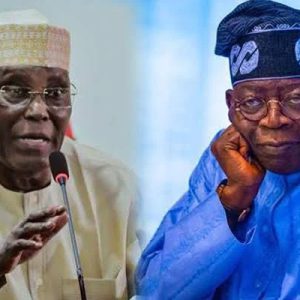
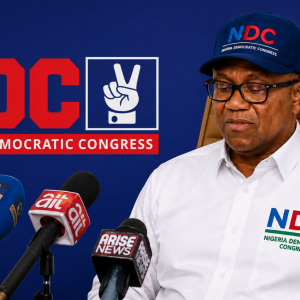
•Tinubu and ADC logo
The African Democratic Congress (ADC) has condemned what it described as “the cavalier manner” in which Rivers State Governor, Sim Fubara, was suspended and reinstated by President Bola Ahmed Tinubu.
Last March, Tinubu declared a state of emergency in Rivers State, suspending Governor Fubara, Deputy Governor Ngozi Odu, and all elected members of the State House of Assembly for an initial period of six months, reports Nigerian Tribune.
In a subsequent national broadcast, Tinubu appointed Ibokette Ibas, a retired vice admiral, as Administrator “to take charge of the affairs of the state in the interest of the good people of Rivers State.”
The Rivers State governor and his deputy resumed office yesterday, alongside the previously suspended lawmakers.
In a statement signed by its National Publicity Secretary, Bolaji Abdullahi, the ADC said it was dismayed by President Tinubu’s attempt to disguise political brinkmanship as statesmanship, adding that the President’s action in Rivers State would define his political legacy.
The full statement read:
“On Wednesday, September 17, Nigerians witnessed a curious spectacle: President Tinubu directing the Governor, Deputy Governor, and members of the State Assembly in Rivers State to ‘resume’ duties after serving his six-month suspension from office.
“The president’s decision to arrogate to himself the power to suspend and recall elected officials in Rivers State, as he has done, is whimsically autocratic and should be recognised and condemned as a threat to our democracy.
“The African Democratic Congress (ADC) reiterates that what has happened in Rivers State over the last six months is a brazen manipulation of constitutional provisions to serve narrow political interests.
“We harbour no doubts that the situation that served as the pretext for declaring the state of emergency was a clear act of political contrivance that only required the president’s unbiased intervention. Instead, the president chose to serve the will of demagogues in his government, deploying constitutional powers to attack what he should have protected.
“For six long months, the will of the people of Rivers State was set aside. Their elected leaders were, in effect, suspended — not by a court of law, but by a president who himself was elected. Now, with the wave of a hand and the stroke of his pen, the same president has decided to ‘allow’ other duly elected officials back to work, as though they were his political appointees.
“Let us be clear: Governors and legislators in a democracy do not derive their legitimacy from Aso Rock. They derive it from the people who elected them. Only a competent court can remove or restrain them — not a press statement or presidential proclamation. The president is not a headmaster, and governors are not his pupils to be sent home and recalled at his discretion. Yet, we recall that this president once claimed to be a federalist who, as a state governor, fought to protect the autonomy of his state.
“However, with this action, the president and his men have achieved their goals — and that goal was not to ‘restore peace’ to Rivers State. They now have a thoroughly pacified government in Rivers State, which has learnt its hard lesson: that its primary loyalty is not to the people of Rivers State, but to Abuja. More importantly, the Rivers experience now serves as a clear warning to other state governments across the country to ‘behave themselves.’
“In keeping with their well-worn propaganda, presidential aides announced that the president had cut short his vacation to attend to the worsening security situation in the country. This claim is laughable. It is now clear that the president did not return because Nigerians are being killed, or because life has become unbearable for the majority. He returned for one reason only — to personally oversee the return of Fubara to office and bask in the glory of the dictatorial powers he had assumed for himself.
“By removing a sitting governor and now personally directing his return, the message could not be clearer: ‘I removed you, and I alone can bring you back.’ This was not about law, justice, or governance. It was about control. It was about reinforcing the idea that, in today’s Nigeria, institutions may exist, but they remain subordinate to the will of one man.
“For the avoidance of doubt, Section 305 of our Constitution — which provides for emergency powers — was never intended to be used as a tool for settling political scores or exerting unconstitutional control over a state. It exists for moments of genuine public danger, such as floods, epidemics, or insurrections, not for political convenience.
“The ADC, therefore, calls on the judiciary, especially the Supreme Court of Nigeria, to take a clear position on this matter, which has set a dangerous precedent. In moments like this, the judiciary cannot maintain silent indifference, or history will record them as collaborators in the subversion of our democracy.”