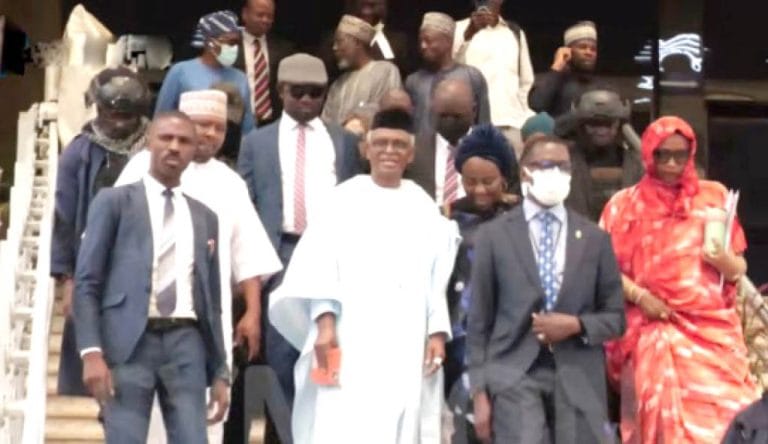
•Embattled former Kaduna State governor, Nasir El-Rufai escorted by officials of the Department of State Services after his arraignment at the Federal High Court in Abuja yesterday.
A former governor of Kaduna State, Nasir El-Rufai, has spent at least 126 days in custody over charges bordering on alleged abuse of office, money laundering, and wiretapping, amidst difficulty in meeting what is described as “stringent bail conditions” given to him by different courts.
If he remains in custody until the next adjourned date, September 22, 2026, he will have spent 217 days, beginning from the date of his detention on February 16, 2026. It would however be recalled that he was released for two days to bury his mother, reports Daily Trust.

A Federal High Court in Abuja, on Tuesday, adjourned the ex-governor’s trial for alleged wiretapping of the telephone of the National Security Adviser (NSA), Nuhu Ribadu, till September 22.
Our correspondent reports that El-Rufai’s detention began on February 16, after he honoured an invitation by the Economic and Financial Crimes Commission (EFCC).
He was grilled by crack detectives of the commission and was later released to the Independent Corrupt Practices and Other Related Offences Commission (ICPC).
His detention and arraignment followed a failed attempt by the security operatives to arrest him at the Abuja airport when he returned to the country from Egypt, where he had lived for months.
On Wednesday, February 18, reports filtered in that operatives of the Department of State Services (DSS) took El-Rufai into custody.
But on Thursday, February 19, the ICPC, in a terse statement by its spokesman, John Odey, confirmed that the former governor was in its custody. He has remained in detention since then.
He was arraigned on April 23 for allegedly intercepting the phone conversations of the telephone line of Ribadu – a charge to which he pleaded not guilty.
The DSS had, in the further amended charge, marked: FHC/ABJ/99/2026, preferred a five-count charge against the former governor.
On May 18, he was granted bail by Justice Joyce Abdulmalik, but he could not meet the conditions.
As part of the conditions attached to the bail, the judge ordered that the surety must reside in either Maitama or Asokoro districts of Abuja, and must deposit the original Certificate of Occupancy of a landed property at the court’s registry.
The surety, according to the judge, must be a federal civil servant not below Grade Level 17 and must also provide evidence of salary payments for at least three months, authenticated by a letter from the manager of the bank within the jurisdiction of the court.
Besides, the surety is to depose an affidavit of means, enter into a bail bond, and submit a recent passport photograph to the court’s registry.
Trial continues September 22
Yesterday, the DSS closed its case against the former governor and chieftain of the African Democratic Congress (ADC) after calling just two witnesses.
The two witnesses, who gave evidence against the former governor, included a personnel of the DSS, who testified last month and an Abuja-based lawyer and activist, Deji Adeyanju, who gave evidence on Monday following a court summons.
When the matter came up yesterday, the prosecution counsel, Oluwole Aladedoye, a Senior Advocate of Nigeria, informed the court that the prosecution had called all its witnesses in the matter and would be closing its case against the defendant.
El-Rufai’s lawyer, Paul Erokoro (SAN), informed the court that the defence intends to file a no-case submission, arguing that the prosecution had not been able to establish sufficient evidence against the defendant.
Erokoro subsequently prayed the court to give him two weeks to file the no-case submission. The prosecution also requested the same timeframe to respond to the no-case submission.
Unmet bail conditions
During the proceedings, El-Rufai, through his lawyer, urged the court to vary some of the conditions attached to his bail, saying his request was based on the stringent nature of the conditions, and that they are difficult to meet.
The senior lawyer cited the requirements for level 17 civil servants with properties in Maitama or Asokoro, as well as verification and attestation letters from the Kaduna State traditional council, which was constituted by the successor of El-Rufai, Uba Sani.
But the prosecution opposed the request, arguing that qualified public officers who meet the conditions exist and urged the court to refuse the application.
After the arguments, the trial judge, Joyce Abdulmalik, declined to vary the bail conditions, insisting that the applicant did not provide cogent reasons that would warrant the variation of the bail conditions.
Justice Abdulmalik, in a short ruling, agreed with the prosecution, adding that there are civil servants who own properties at the said location.
The judge subsequently adjourned to September 22 for the filing of the no-case submission and continuation of the trial.
Doctor worried El-Rufai is developing prostate cancer – Family
In an interview with our correspondent last night, a member of El-Rufai’s family, who preferred anonymity, disclosed that a medical doctor at the National Hospital, Abuja, said the former governor may be developing prostate cancer.
“You know when you are not active, he is beginning to have prostate problems now, and the oncologist at the National Hospital is very concerned that he’s at the risk of … From what I’m reading, it appears cancer is developing,” the source said.
The relative explained that the ICPC allows the family to take food to him while in custody, just as the commission takes him to the hospital.
“The family can access him. We do see him. The ICPC allows us to bring food to him. We do see him. The ICPC has been taking him to the hospital even though his condition has deteriorated badly now,” he added.
‘We can’t find civil servant with houses in Maitama or Asokoro’
The family member said all the bail conditions had been met, except the level 17 federal civil servant requirement.
According to him, the family members have moved around in order to get a director with such criteria, but could not find one since May 18, when the bail conditions were given.
He said, “There are four cases against El-Rufai. Three in Kaduna, one here in Abuja, and the bail conditions being given in these four different courts are basically the same. So, it shows there is a plan; that is why all the judges are doing the same thing.
“It is unusual for four different courts, four different judges to give identical bail conditions. In Kaduna, they said they want a surety who has a house in a highbrow GRA. The judge even used the words ‘highbrow GRA’ worth N200m. How many houses are worth N200m in Kaduna?
“Then, the surety must get an attestation from the council of chiefs, which is a council that was constituted by Uba Sani, El-Rufai’s successor, who is against him.
“The condition in Abuja is that the surety must be a level 17 officer, who is a director and lives in their own house in Maitama or Asokoro and must have a C of O. The director must also obtain a letter recommending El-Rufai for bail from his immediate Head of Department.
“That means it is either a permanent secretary or the minister. We went around and most of the directors said none of them live in Asokoro. Houses in Asokoro are worth billions of naira. They said they didn’t have any.
“But the prosecution said those houses were sold to the directors then. When did Obasanjo sell those houses? Was it not in 2000? All those directors are dead now. That was like 20 years ago. Any civil servant living in Asokoro should be taken to the Code of Conduct Bureau or ICPC.
“Supreme Court justices, where do they live? A lot of justices live in Garki, Area 11. The High Court judges live in Gwarinpa or Lugbe. Even in Wuse, Utako, Jabi and other areas, all the directors we approached said they didn’t have houses there.
“Secondly, even if they had houses there, they would not stand bail for him (El-Rufai) because he is a critic of the federal government and they may suffer victimisation.”
NBA faults stringent bail conditions
Section 165 of the Administration of Criminal Justice Act states that “the conditions for bail in any case shall be at the discretion of the court with due regard to the circumstances of the case and shall not be excessive.”
Relying on this provision, the President of the Nigerian Bar Association (NBA), Afam Osigwe, raised concerns over what he described as increasingly stringent and punitive bail conditions imposed by courts and security agencies across the country.
Osigwe, SAN, while speaking at a meeting with the Inspector-General of Police, Olatunji Disu, in Abuja on Tuesday, said bail was increasingly being administered in a manner that effectively denied suspects the opportunity to regain their freedom.
“I will use this opportunity to note that bail has become a punitive thing, that in our police stations, in our courts, in EFCC offices, ICPC offices, bail is being given with the intention that the people should not enjoy it. So we deny bail by pretending to give it,” he said.
According to him, one of the most troubling practices is the insistence by some police officers that suspects produce directors or senior civil servants as sureties.
“The worst part of it is that it seems to be becoming normal that in some police stations, when bail is granted, they say you must bring a director or senior civil servant. And sometimes it is only the directors acceptable to the investigating officers that can stand as sureties,” Osigwe said.
He argued that the practice had created a “black market in suretyship,” where individuals who have no relationship with suspects offer to stand as sureties for a fee.
“These directors who don’t know the suspects now agree to become sureties for a fee. So a great financial burden is thereby imposed on the person in detention, his family and his friends,” he said.
Osigwe called for a return to reasonable bail conditions aimed solely at ensuring that suspects appear whenever required by investigators or the courts.
The NBA president also called on the Nigeria Police Force to ensure compliance with legal provisions requiring judges and magistrates to inspect detention facilities within their jurisdictions.
Osigwe said that despite provisions in the Administration of Criminal Justice Act, some law enforcement agencies, including the police, are reluctant to grant judicial officers access to detention facilities.
“There is presently a provision in the Administration of Criminal Justice Act which says that the Chief Judge shall direct judges and magistrates to visit detention facilities or centres within their jurisdiction to inspect.
“And even with this statutory provision, the police, and not only the police, but some law enforcement agencies also refuse and resist these efforts,” he said.