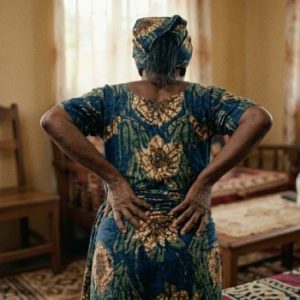
“As you can see, life has been very difficult for me. I am 30 years old, yet I look like a seven-year-old girl. I can’t walk for a distance; and I can’t afford to miss a step and fall down because the doctors said my bones are fragile. Growing up, I sustained several fractures, which necessitated my being enrolled in a special school. To be honest, I am just surviving a very difficult life as a victim of drug test.”
This is the story of Rukayya Salisu, a 30-year-old young woman who suffers from a strange illness that has stunted her growth as a normal child. She can’t walk without the support of a walking stick. The strange illness stopped her from growing as any normal child in her early years in life, reports Weekend Trust.
The promising young woman, who is a little over 4 feet tall, is one of the many victims of Trovafloxacin trial tests conducted on many children in Kano State in 1996.

The tests, administered by Pfizer, an American pharmaceutical company, which caused an uproar in the state and the country as a whole, were said to have led to the death of many children, while leaving many others shattered. Twenty-nine years later, not only have the lives of the children, who are now adults, remained shattered, many are traumatised, stigmatised and have found it difficult to move on with life as their families continue to bear the brunt of the costly vaccine trial while carrying the burden as they try to support the affected children.
In 1996, Pfizer, an American pharmaceutical company, conducted a trial of its antibiotic drug, Trovan, during an epidemic of meningococcal meningitis in Kano State. It was reported that the company administered the drug on two sets of children, whose exact number is not ascertained as at today. However, as a result of the vaccine test, most of the children died while many others survived, but with permanent disabilities.
It is also on record that before the commencement of the trial by Pfizer, the lead investigator had provided a letter of approval for human trial. But investigations found the letter to be falsified.
On the discovery that the company allegedly conducted the trial illegally, a group of lawyers and some activists, including few parents of the affected children, instituted several legal actions against the company. They did that under a pressure group with the name, Kano Trovan Victims Association (KTVA). The group and the Kano State Government filed criminal charges and civil claims against Pfizer, seeking over $2 billion in damages and restitution.
It is also on record that the legal action filed against the company alleged that some victims received a dose lower than recommended, leaving many children with brain damage, paralysis or slurred speech. But the US-based company had argued and maintained that meningitis and not its vaccine led to the death of 11 children and causing harm to dozens of others.
In a separate action, the Federal Government of Nigeria had also filed a legal suit against Pfizer and several of its employees, seeking nearly $7 billion in damage for the death of children involved in the Trovan drug trial.
The federal government informed the court that it had agreed with Pfizer to settle out of court; and subsequently, Kano State Government and Pfizer announced that they had reached an agreement on the broad terms of out-of-court settlement.
Pfizer and Kano State reached a final settlement in August 2009. The parties agreed to a settlement of $75 million, which was released to the state government in 2013. Ironically, when all was expected to have been completed in November 2013, 186 victims filed a new lawsuit in a Federal High Court in Kano, in which they argued that Pfizer is in breach of the 2009 settlement agreement for limiting the criteria for compensation.
While trying to iron it out with the victims, Pfizer constituted the Healthcare Meningitis Trust Fund to carry out part of the settlement agreement. However, the victims claimed that the constitution of the Trust Fund was most unfortunate as Pfizer selected persons who could serve and protect its interest rather than dispense justice. They stressed that Pfizer had found a willing ally in the then leadership of the Kano State Government, and as such, the victims collectively sued the Healthcare Meningitis Trust Fund, the then Kano State Government and other agencies in a High Court in Abuja.
The victims later considered the Healthcare Meningitis Trust Fund after receiving some consolation fee offered by Pfizer on the request for the victims to withdraw their two court litigations in Nigeria and America and settle the matter amicably. The victims agreed to carry out their own DNA test as requested, with the full understanding that it would be transparent and fair.
However, amidst these issues, the settlement fee was collected. It was expected that it would be broken down as follows: $35 million to establish a fund for people that participated in the drug trial, $30 million would underwrite health care initiatives in Kano, being the affected state, and $10 million would be allocated to pay the legal cost.
The settlement
Ahmad Mua’zu Lafa, who serves as the secretary of the Welfare Association of the Less Privileged Victims of Vaccine, Kano – parents of the victims of the Trovan clinical test in the state – said they were left with no option than to constitute an association that would serve as an umbrella body to fight for the right of the victims.
He explained that after the settlement was secured, victims were categorised into two groups and the agreed amount that each accredited victim ought to have received was slashed from one group while the other got more than what they ought to have been given.
“My daughter is one of the victims of the test; she is now deaf and dumb due to complications she suffered after the clinical test. There are other victims that completely ran mad, while many others are confined to wheelchairs as they suffered one deformity or another.
While filling the forms given to us by the pharmaceutical company, we were made to believe that each victim would receive $175,000 as settlement. That was what we signed, but unfortunately, when the time for payment came in 2013, we were told that we would be given $10,000 only. Even at that, they told us that banks and other charges had claimed part of the amount, so we received $7,000. That is what we have been fighting for over a decade,” he said.
He added that the group, where he belongs, had accredited 347 victims, saying that some of them have died while many others are battling to survive one form of deformity or another.
He also revealed that the group had written complaint letters to various organisations over the years without any response. He further explained that in the group’s bid for justice, they had hosted a town hall meeting facilitated by a media outlet in the country, just to draw the attention of the authorities concerned.
He said there was a need for government officials, especially Kano State, to know that the victims need justice.
“We have written and submitted all supporting documents to the Economic and Financial Crimes Commission (EFCC). We were made to believe that the commission was investigating the matter, but for years, we have not heard from them,” he alleged.
Similarly, the association’s assistant chairman, Malam Sharu Sanusi, said he lost his daughter due to the vaccine trial, adding that it is pathetic to see innocent adults battling to survive deformity caused by the vaccine injected into them.
“It is a trauma to see many innocent souls managing to survive alone. Some can’t do anything by themselves – they require the assistance of another person to even go to the toilet. For years, their parents have been managing them in that condition. Some of these victims are more or less dead, yet they are surviving,” he said.
Our lives 29 years after – Victims
A victim of the clinical test, 30-year-old Rukayya Salisu, who looks like a seven-year-old girl, said life had been difficult as she currently depends on the goodwill of her relatives since she lost both parents. However, Rukkaya went to school despite her situation. She attended the Kano State Polytechnic, where she obtained a National Diploma in Telecommunication Engineering Technology and is presently an undergraduate of the Federal University, Dutsin-Ma (FUDMA), where she is reading Fishery and Aquaculture.
According to her, due to her condition, she finds it very difficult to act like others as she suffered a series of fractures due to her fragile bones.
“Most of my age mates are married, while others are pursuing education. Some of them are either PhD or Master’s degree holders, but due to my situation, I could not cope with the pace.
“I grew up to see my parents suffering, just to take good care of me; and now that both of them are late, I solely depend on the goodwill of my relatives and friends. My friends in school are very understanding and helpful – they know I can’t carry either a bucket or dry my clothes – so they have taken the burden off my shoulders by always helping me. The main issue is my drugs. I have to take it; and that means spending money. There is no money, but I have to keep managing,” she said.
Rukayya pleaded with the authorities concerned to look into their plight, saying, “No amount of money will be able to repair the damage done to us, but at least, we need to survive. Some of us were not lucky to even survive the test. All we are asking is for the authorities to help us get what was meant for us so that we would continue managing our situation.”
Asma’u Isma’il Ibrahim is a 32-year-old victim of the vaccine test. Deformed as a result of the vaccine, Asma’u finds it difficult to move around without the help of a leg support specially designed for her mobility. Even at that, she cannot walk long distances without support.
Asma’u said she grew up appreciating her parents’ strong will in ensuring that she was taken care of in the best way possible. She doubts if she would ever be able to repay them for their efforts.
But despite being poor and deformed, she was able to get formal education up to secondary level. She also enrolled into a skills acquisition school where she was trained on graphic designing. She later got married, but after sometime her husband found it difficult to manage her condition and divorced her.
She said, “My parents are very strong-hearted people; they did everything possible to make me comfortable despite being poor. At a point in my life I got married, but you see, only your parents can endure your weaknesses and liabilities. When my former husband found it hard to manage my situation, he divorced me. However, life continues. My parents are the best thing I have. I keep praying for them. We are appealing to the government to help us recover our money from whoever is holding it,” she said.
Another 30-year-old victim of the 1996 vaccine trial, Aisha Sulaimanu, suffered deformity on one leg, forcing her to use a walking support to move around. Aisha said she found it very difficult to associate with people, especially at the initial stage of her situation; hence she always preferred to remain at home with her parents for fear of being ridiculed. She, however, said that with time she learnt to live with her permanent disability and love herself more by finding ways to move on with life.
Aisha said she would have loved to further her education, but she had to stop at secondary level because her parents could not afford to sponsor her beyond that.
“As you can see, moving around is very difficult for me. While growing up, I asked my mother why I could not walk like my sisters and brothers and she said I was a victim of a clinical test conducted by some Americans while I was just two years old.
“I have learned to live with my deformity, but it hasn’t been easy at all. To make it worse, what was agreed to be given us wasn’t what was given. That is why, for years we have been agitating for our right. And we will not stop because we haven’t started to stop halfway,” she said.
Nura Mohammad Shehu, a 33-year-old victim of the vaccine trial of 1996 can neither walk nor speak clearly. He has to be carried to the toilet and everywhere he needs to go because he is crippled and suffers mental disorder.
His presence at any public place makes people cry as it is believed that his life has been destroyed completely. He can’t help himself, let alone another person. His father has been attending to his needs, including feeding him like a baby and washing his cloths.
Also, Abba Ahmad Dan Keta, 31, has been confined to a wheelchair due to complications he suffered from to the Pfizer vaccine trial. Abba’s dream is to become an army officer but all that seems impossible as he is only able to attend secondary school and confined in a wheelchair.
“I am lucky to be alive today, unlike my brother who died a couple of days after receiving the vaccine. My parents tried their best to save my life, and to God be the glory that I survived but with a permanent deformity. I can only pray for my parents and thank them for enduring all the challenges of raising a crippled child like me. My dream was to become an army officer but all that was shattered. There are many of us whose long-life dreams were altered as a result of the vaccine we were given when we were younger. To make things hard for us, we were supposed to be given $175,000 but we ended up receiving only $7,000 in 2013. And no one is willing to tell us where the remaining money is. We want the Kano State Government to look into this matter and help us recover what is rightfully ours,” he pleaded.
Nura Musa, a 35-year-old man who is deaf and can speak with a lot of difficulty, is married with children. He said his case was a little better than those who lost their senses.
He said “What happened to us in 1999 should be in the records of the state government. Monuments and important places should be named after the victims of Pfizer vaccine, but unfortunately, no regard is given to us. The irony of it all is that even what we ought to have received as part of the out-of-court settlement was also reduced by some people. We are pleading with Governor Abba to look into our matter.”
Parents narrate ordeal
Malam Adamu Bello, the father to Habiba Adamu, currently a 31-year-old mother of four, said his daughter became deaf and dumb after receiving the Trovan vaccine in 1996.
He said that as parents they were managing her situation from childhood until she grew up and got married to a deaf and dumb man like her, adding that her husband is now late.
Recounting his ordeal, Bello said, “I was managing only her, but now, her husband is dead and she is back with her four children. I am an old poor man, so we are finding it very difficult to feed, not to talk of raising four kids and looking after their mother as well. That is why we have been seeking justice for the victims of the Trovan trial,” he said.
Malam Muhammad Shehu said his son is currently mentally retarded due to the vaccine he received in 1996. He added that on many occasions he would be called back home because his son became violent.
“All his brothers are afraid of him. He does not listen to anyone but me; that is why I have to spend more time attending to him. He can go naked if he is not carefully monitored. We were told he needed serious medical attention and we were hoping that the settlement balance would be paid, but we have waited for years without result. That is why we are appealing to the government to look into our matter for justice to prevail,” he said.
Furthermore, Hajiya Hajara Sule Koki said two of her sons were vaccinated and she lost one out of them while the other one is currently confined to a wheelchair. She added that God spared the life of the other one but with permanent disability, adding that they have been managing his situation as he requires to always take medication.
“We have spent everything we have. And getting his medication is now a huge problem. We need the Kano State Government under Abba Kabir Yusuf to, as a matter of life and death, look into our plight and help us get our money back to be able to continue managing these innocent souls,” she said.