•Tinubu
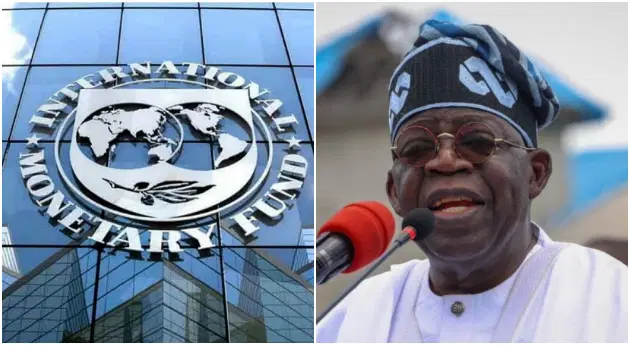
The International Monetary Fund (IMF) yesterday confirmed that Nigeria has fully repaid the $3.4 billion COVID-19 financial support it got under the Rapid Financing Instrument (RFI).
But despite the confirmation, the government is still indebted to the multilateral organisation to the tune of about $30 million, which is the Special Drawing Rights (SDR) charges, reports Daily Trust.
The $30m equivalent of N48.2bn would be paid annually over a period of four years as charges on the loan. This would amount to over N190bn.
The SDRs are supplementary foreign exchange reserve assets defined and maintained by the IMF which represent a claim to currency held by IMF member countries for which they may be exchanged.
There have been mixed reactions over the claim of the full repayment of the IMF loan which the presidency has widely celebrated.
Senior Special Assistant to the President, Otega Ogra had posted a widely circulated post on X (formerly Twitter) account sharing the good news of Nigeria’s exit from the IMF debtors’ list.
He said this was a signal of “Discipline, reform and strategic reset by the Tinubu-Shettima administration in restructuring our finances to enable us to be better placed for a prosperous future.”
The announcement was coming amidst criticism of the Bola Ahmed Tinubu-led administration over the rising domestic and external debts.
Nigeria’s total domestic and external debts amount to over N144.67 trillion as of December 2024, according to the Debt Management Office (DMO).
IMF clears the air
In a statement yesterday on behalf of the IMF’s Resident Representative for Nigeria, Mr. Christian Ebeke cleared the air on the repayment of the RFI loan facility, which was disbursed in April 2020 during the COVID-19 pandemic.
During the pandemic, the global economy was almost shut down resulting in sharp fall in oil prices, slowdown of the economic activities and drastic drop in revenues to the government.
Having cleared the principal amount, the federal government is now expected to pay the interests and charges on the loan estimated to be about N200bn.
IMF said, “As of April 30, 2025, Nigeria has fully repaid the financial support of about US$3.4 billion it requested and received in April 2020 from the International Monetary Fund (IMF) under the Rapid Financing Instrument to help alleviate the impact of the COVID-19 pandemic and the sharp fall in oil prices.”
It however explained that Nigeria would continue to make annual payments of approximately $30 million in SDR-related charges over the next few years.
These charges, it stated, accrued from the difference between Nigeria’s SDR holdings and its cumulative SDR allocation.
The statement added, “Nigeria is expected to honor some additional payments in the form of Special Drawing Rights charges of about US$30 million annually.
“In line with the IMF’s Articles of Agreements, these charges, levied at the SDR interest rate, which is updated at the beginning of each week, apply to the difference between Nigeria’s SDR holdings (SDR 3,164 million) (US$4.3 billion) and its cumulative SDR allocation (SDR 4,027 million) (US$5.5 billion) The net payment of the charges stops when Nigeria’s SDR holdings reach the cumulative allocation amount.”
Debt burden persists despite IMF’s loan repayment
As stated earlier, Nigeria’s public debt of N144 trillion as of December 2024 remains a source of concerns for stakeholders and observers.
This amount has been projected to grow significantly before the end of the year following the 2025 budget deficit of N13 trillion.
With the sharp drop in oil prices in recent times, there are indications that the federal government would borrow more to bridge the deficit.
Already, the federal government is indebted to many multilateral organisations like the IMF, World Bank, African Development Bank (AfDB), among others.
Last year, Nigeria spent $4.66bn on external debt servicing, a significant increase from $3.5bn in 2023 with the multilateral creditors accounting for the largest portion at $2.62bn or 56 per cent of the total.
In addition, Nigeria has continued to take fresh loans from the World Bank with over $8bn secured from the organisation alone.
‘Not yet Uhuru’
With the amount of loan facilities yet to be repaid and with more facilities in the offing especially with the World Bank, economic analysts say it is not yet Uhuru for the government.
They particularly cautioned against being carried away by the loan repayment with the IMF and stressed the need to double down especially on foreign loans to ensure debt and fiscal sustainability.
‘Nothing has changed’
Emeritus Professor of Economics, Ndubisi Nwokoma believes nothing has really changed as there were other loan facilities still hanging on the neck of the federal government.
He said, “That has not changed the big picture, the big picture is still not a good or desired position.
Government is still borrowing, we are indebted to many multilateral institutions, we are indebted to AfDB, World Bank, we are taking bilateral loans, so it doesn’t significantly change our debt profile and with the drop in the price of oil, it makes it more difficult for government to stay without borrowing, even though it has been made easier by the removal of fuel subsidy and the harmonisation of the foreign exchange market.
“This had made it easier for the government in terms of public finance and not to be under serious pressure, if there were still fuel subsidy the fall in price of fuel would have been a very big blow on public finance because basically we are talking about public finance, government has much money to play around with, so the triple down effect on the economy is not very strong, but in terms of fiscal sustainability for government, it’s an improvement.
“So nothing has changed on the part of the common man or the economy or inability to get the economy out of the woods but public finance, fiscal sustainability is being assisted with those earlier policies that took place in 2023 but drop in price of crude may make us go back to our borrowing ways, so not much has really changed.”
‘FG deserves commendation’
An economist at the African School of Economics in Abuja, Dr. Oluseye Ajuwon commended the government for clearing the IMF loan.
He stated that there is no nation that exists without borrowing. However, Nigeria must borrow “responsibly.”
“There is no nation that can do without borrowing, not even a developed country not to talk of a struggling economy like ours. However, we need to borrow responsibly.
“Borrowing responsibly simply means borrowing money for a project that will be able to repay the loan by itself, and spending the loan judiciously.”
‘We need to double down’
Dr. Muda Yusuf, Director/CEO, Centre for the Promotion of Private Enterprises (CPPE) said the repayment of the IMF loan signaled the commitment of the government to reduce its debt burden.
“However, I think we need to continue to double down on the reduction of our debts because given the current debt level and particularly given the current level of our debt service commitment and the amount of resources we are committing to debt service, I think it will help our fiscal sustainability, our debt sustainability if we work towards reducing the totality of our debt exposure especially external debt because from all indications, external debts are much more difficult to manage and service than domestic debts,” he stated.
According to him, the focus must be on doubling down both domestic and external debt.
“So the payment of these components of debt is a welcome development, it will in some sense reduce the burden of outstanding debts and we need to do a lot more of that and going forward, as much as possible we should reduce our exposures, especially to foreign debts.
“And utilisation of debts is also important, debts must be committed to projects that would enhance the productivity in the economy and that should be our priority and that is speaking largely to our infrastructure stock.
“We should prioritise infrastructure investment in our debt exposure, which is extremely important. I am also hoping that our fiscal consolidation objectives will also improve and will also be better achieved with the current tax reform.
“We expect that the revenue administration would be much more efficient without necessarily putting additional burden on the citizens or businesses. If we are able to do that, then the pressure to incur more debt would reduce. We need to ensure that the cost of domestic debts is as low as it can be as well.”