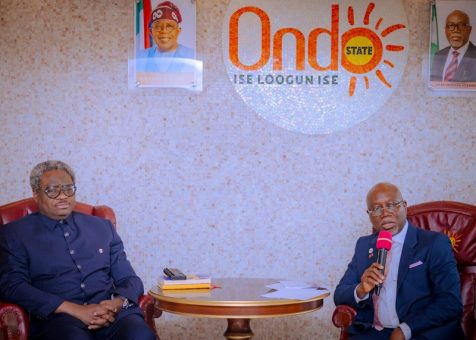
•Kola Adesina of Sahara Energy (L) and Governor Lucky Aiyedatiwa
Ondo State governor, Lucky Aiyedatiwa, has called for urgent action to revive a long-dormant oil asset in the state, saying delays in investment and infrastructure gaps could affect Nigeria’s efforts to boost crude oil production.
Aiyedatiwa made the call on Monday in Akure while receiving a delegation from Sahara Energy Group, where discussions focused on reactivating an oil field that has remained inactive since 1998, reports The Nation.

Nigeria is targeting an increase in crude oil output from about 1.6 million barrels per day to 2 million barrels per day.
The governor said Ondo State could strengthen its contribution to national output if its oil assets are fully developed and efficiently managed.
He cited a past fire incident at the facility as an indication of gaps in operational transparency and data management.
“I remember when there was a fire outbreak in that very well, and then I was in NDDC as the representative of the state. They claimed then that there was no operation in that place, that there’s no oil and I was like, how can a place with no oil be on fire? Is it water that is bringing out the fire?”
According to him, addressing leakages, upgrading infrastructure and deploying digital monitoring systems would be critical to improving production levels.
The governor said Ondo’s ranking among oil-producing states – at number 5 – could improve with renewed activity and stronger operational systems.
He stressed that production growth would depend on addressing structural and operational constraints, including leakages and outdated systems.
“If leakages are being blocked and the management of the production and the movement of products to the point where it can be calculated, the equipment, if they can digitalize it, remove some human errors and all that, maybe we’ll be able to hit that,” he said
Aiyedatiwa also assured investors of a secure operating environment, noting that the state government has begun dredging waterways to improve access to oil-producing areas.
Earlier, the Executive Director of Sahara Energy, Kola Adesina, said the asset has remained underutilised for decades, describing it as “stranded.”
“The asset we have here, the last time it was operated was 1998. Of course, it simply means that’s a stranded asset that has not been unlocked fully to the advantage of the people.
“The last time it was operated was in 1998, which means it has not been fully unlocked to benefit the people,” he said.
Adesina said the company is currently conducting technical integrity tests and assessments to determine the condition of the facility and the requirements for its reactivation.
He added that increasing Nigeria’s oil output would require sustained investment, technical capacity and stronger collaboration between operators and government institutions.