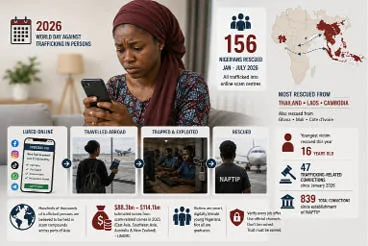
As Nigeria joins the world to mark the 2026 World Day Against Trafficking in Persons, concerns are mounting over the growing use of fake overseas job offers, social media and other digital platforms by criminal syndicates to lure young Nigerians into organised scam compounds across Asia and parts of Africa.
Authorities say what was once largely associated with sexual exploitation, forced labour and domestic servitude has evolved into a technology-driven crime in which victims are deceived with promises of legitimate employment in information technology, digital marketing, customer service, telecommunications and cryptocurrency trading, only to end up trapped in forced online fraud.
The National Agency for the Prohibition of Trafficking in Persons (NAPTIP) said traffickers now rely on social media, encrypted messaging applications, fake recruitment websites, cryptocurrency transactions and even artificial intelligence to recruit victims, making the crime faster, more sophisticated and increasingly difficult to detect.

The agency disclosed that all 156 Nigerians rescued between January and July this year were trafficked into organised online scam centres after being lured with false promises of employment abroad, reports Daily Trust.
Speaking in Abuja ahead of the 2026 World Day Against Trafficking in Persons, the Director-General of NAPTIP, Binta Adamu Bello, said many victims travel overseas believing they have secured legitimate jobs only to have their passports confiscated and their freedom restricted.
Instead of the promised careers, she said, they are forced to carry out online romance scams, cryptocurrency fraud and investment scams under threats, violence and psychological coercion.
According to Bello, most Nigerian victims rescued this year were trafficked to countries in the Mekong region, particularly Thailand, Laos and Cambodia, while others were rescued from Ghana, Mali and Côte d’Ivoire through collaboration with foreign law enforcement agencies and development partners.
Victims’ profile changing along methods
Beyond the changing methods, Bello said the profile of trafficking victims is also evolving.
Unlike in the past when traffickers mainly preyed on people with little education or employable skills, many of those now being recruited are educated, digitally literate young Nigerians.
“They are tech-savvy and brilliant youths. This is a shift from the usual scope of victims who were mostly uneducated without skills,” she said.
She disclosed that the youngest victim rescued by the agency this year was just 16 years old, underscoring concerns that traffickers are increasingly targeting teenagers and other young people online.
According to Bello, recruitment usually begins with fake advertisements on social media promising overseas jobs, scholarships or remote work opportunities.
Victims are subsequently moved to encrypted messaging applications where traffickers gradually build trust, process travel arrangements and convince them to leave Nigeria.
Upon arrival, however, their passports are confiscated and they are forced to work in heavily guarded compounds carrying out online scams targeting unsuspecting victims around the world.
Those who fail to meet daily targets are often subjected to torture, sexual violence and other forms of abuse.
Technology making recruitment easier
Cybersecurity expert, Japhet Johnson, told our correspondent that advances in technology have fundamentally transformed the way traffickers identify and recruit victims.
While traffickers previously depended on physical contacts and intermediaries, he said they now exploit social media platforms, messaging applications, fake recruitment websites and artificial intelligence-generated content to deceive job seekers.
“They create convincing online identities, advertise fake job opportunities, scholarships, modelling contracts or travel offers that appear legitimate. Some even use AI-generated images, fake company websites and cloned voices to build trust,” he said.
According to him, technology itself is not the problem.
“The challenge is that criminals are exploiting the same digital tools that legitimate businesses use every day.
“What once required physical contact can now happen almost entirely online. Criminals exploit targeted adverts, digital payment systems and cloud technology to manipulate and control victims long before they ever board a plane.”
Johnson said traffickers deliberately imitate legitimate employers and recruitment agencies, making fraudulent opportunities increasingly difficult to distinguish from genuine ones.
He identified Facebook, Instagram, TikTok, X (formerly Twitter), LinkedIn, WhatsApp and Telegram as some of the platforms commonly exploited to advertise fake overseas jobs and target potential victims.
Drawing from his own experience, he said he frequently receives overseas job offers through LinkedIn, many of which later prove to be fraudulent.
Some falsely claim to represent multinational companies, while others attempt to gain remote access to applicants’ computers during virtual interviews.
‘Victims deserve protection, not punishment’
Meanwhile, the Country Representative of the United Nations Office on Drugs and Crime (UNODC), Cheikh Toure, has said this year’s campaign theme, “Trapped Behind the Scam,” highlights the reality that many people operating inside online scam compounds are themselves victims of trafficking rather than willing criminals.
Similarly, the Chief of Mission of the International Organisation for Migration (IOM), Ms Dimanche Sharon, said survivors have reported torture, starvation, prolonged solitary confinement and sexual abuse.
“People trapped in scam compounds are victims of trafficking, forced to commit crimes through violence, threats and coercion. They deserve protection, not punishment,” she said.
Experts list warning signs
Johnson advised Nigerians seeking employment abroad to independently verify every overseas job offer before making financial commitments or travelling.
Among the warning signs, he listed recruitment messages sent through personal email accounts instead of official company addresses, requests to move conversations to encrypted messaging applications before formal documentation, demands for visa or processing fees to be paid into personal accounts or cryptocurrency wallets, and employers insisting on taking applicants’ passports upon arrival.
He urged job seekers to verify companies through official government business registries, contact employers using publicly available information and engage only licensed recruitment agencies.
“Never make life-changing decisions based solely on what you see online.
“Research the company thoroughly, verify the job through official channels, speak with people who have worked there if possible, and never allow urgency or attractive promises to override careful verification.
“In today’s digital world, information is easy to create, but trust must be earned. A few hours spent verifying an opportunity could save someone from becoming a victim of exploitation or human trafficking,” he said.
Johnson also called on technology companies to strengthen systems for detecting fake recruitment advertisements, improve identity verification for recruiters and deepen collaboration with law enforcement agencies.
“This is not a challenge that government can solve alone. It requires collaboration between regulators, technology companies, cybersecurity experts, financial institutions and civil society,” he said.
The UNODC representative, Toure, also stressed that combating trafficking requires more than arrests and prosecutions.
He said governments must address unemployment, expand vocational training, promote entrepreneurship and create opportunities for young people.
“Every job created, every skill acquired, and every young person empowered is one less person vulnerable to exploitation,” he said.
Meanwhile, Bello said NAPTIP has intensified cyber intelligence, digital investigations and collaboration with international partners to dismantle recruitment networks, rescue victims and prosecute traffickers.
She disclosed that the agency had also uncovered several planned trafficking-enabled scam centres within Nigeria, which she described as “fraud academies” where young people are trained in cyber-enabled crimes, including sextortion and financially motivated online extortion.
According to her, NAPTIP has secured 47 trafficking-related convictions since January, bringing the total number of convictions recorded since the agency was established to 839.
The IOM also warned that the problem extends beyond Nigeria, noting that hundreds of thousands of trafficked persons are believed to be held in scam compounds across parts of Asia.
Citing UNODC estimates, the organisation said scam-related crimes across East Asia, Southeast Asia, Australia and New Zealand generated between $88.3 billion and $114.1 billion in losses in 2025, underscoring the huge profits sustaining the criminal enterprise.