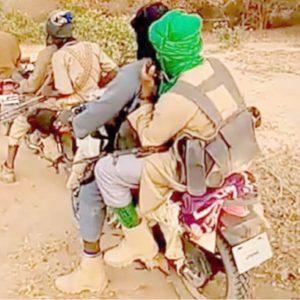
•Tinubu and terrorists
The killing of the 39-year-old founding leader of Boko Haram, Mohammed Yusuf, in Maiduguri, Borno State, was supposed to put paid to the 2009 insurgency uprising in the North-East; instead, the group has since morphed into one of the world’s deadliest terrorist groups, defying various counterterrorism measures.
Starting from the late President Umar Musa Yar’adua-led government, successive administrations have deployed strategic plans and allocated substantial amounts every fiscal year to stamp out terrorism, to no avail, reports Weekend Trust.

As at 2017, former Governor Kashim Shettima of Borno State disclosed that Boko Haram had killed 100,000 people and displaced over two million locals. The killings have surged afterwards as insurgents continue to unleash terror on residents.
During the Yar’adua administration, the police led the crackdown on what was then an emerging terror group, killing Yusuf in the process. Boko Haram became increasingly deadly under President Goodluck Jonathan, forcing the federal government to deploy full military force in the North-East.
Operation Restore Order, a Joint Task Force (JTF) comprising the military, police, State Security Service and other security agencies, was established in June 2011 to repel insurgents and restore law and order to Borno and other affected areas.
However, the measure was not enough to stop Boko Haram fighters from raiding Bama on May 8, 2013, killing more than 50 persons and freeing over 100 prison inmates. About 200 terrorists in buses and pickup trucks had carried out coordinated strikes on army barracks and a police station before breaking into the town’s prison.
In what he described as “extraordinary measures” to curb the growing violent onslaught, Jonathan declared a state of emergency in Borno, Yobe and Adamawa states one week after the Bama attack.
Earlier, on December 31, 2011, Jonathan had made a similar declaration in some local government areas in Niger, Plateau, Yobe and Borno states following a series of bombings by Boko Haram on Christmas Day that killed at least 37 people in a church. He also ordered the shutdown of Nigeria’s borders with Cameroon, Niger and Chad in the North-East.
In August 2013, the military changed Operation Restore Order to Operation Boyona, a blending derived from the top three insurgency-ravaged states. It was later renamed Operation Zaman Lafiya (peaceful living). The Jonathan administration also sought international support, including intelligence-sharing and equipment from the United States and Germany.
Yet, on the night of April 14, 2014, Boko Haram staged one of the most vicious raids to date, abducting 276 girls from Government Girls’ Secondary School in Chibok, Borno State. Worried by the raging attacks, Jonathan announced amnesty for Boko Haram members the following month.
Meanwhile, vigilante groups, Community Task Forces (CTFs), and the Civilian Joint Task Force (CJTF) have also been critical to fighting terrorism, especially in areas where formal security presence is either overstretched or absent.
The CJTF emerged in 2013 in Borno State when residents organised themselves to support the military in identifying and stamping out Boko Haram members from their communities.
Armed mostly with sticks, machetes and local intelligence, the CJTF played a decisive role in reclaiming neighbourhoods, even at great personal risk. Over the years, many of the CJTF members have been formally recognised and absorbed into state structures.
Buhari govt’s strategies
The inception of the administration of the late President Muhammadu Buhari, a retired general and former military head of state, in May 2015 gave impetus to the anti-terrorism war. Buhari restructured military command operations and moved the military headquarters to Maiduguri temporarily.
In July, the then Chief of Army Staff, Lt Gen Tukur Buratai, inaugurated Operation Lafiya Dole (peace by force) to replace Zaman Lafiya, vowing that the military strategy to deal with Boko Haram terrorists would be pursued by action rather than words.
A few months later, the fight against insurgency began to pay off. Troops embarked on heavy crackdowns and reclaimed several territories from terrorists. Subsequently, a breakaway faction of Boko Haram, Islamic State West Africa Province (ISWAP) emerged, weakening the strength of the group. For some time, the government boasted that Boko Haram had been “technically defeated.”
However, resurgence in terrorist attacks, which led to the death of hundreds of civilians and security agents, compelled the authorities to admit that the war was far from over. Buratai explained that the army needed to engage in spiritual warfare to counter Boko Haram propaganda, noting that “Boko Haram and the likes can not be defeated by kinetic military warfare alone.”
In 2016, a non-kinetic approach tagged Operation Safe Corridor was introduced to encourage voluntary surrender, de-radicalisation, rehabilitation and reintegration of repentant Boko Haram members into the society through vocational training and civic programmes. Though the initiative has recorded some success, terrorism threats remain considerably high.
In April 2018, the Nigerian Army introduced Operation LAST HOLD, a new offensive strategy targeted at “totally destroying Boko Haram locations in the Lake Chad Basin.” The operation involved deployment of six additional manoeuvre brigades and critical assets to Borno State.
“The operational end-state of Operation LAST HOLD is the total defeat of the Boko Haram terrorism sect. Strategically, the conduct of Operation LAST HOLD will facilitate the restoration of fishing, farming and other economic activities in the Lake Chad Basin. Additionally, it will facilitate the relocation of internally displaced persons from camps to their communities,” the then Chief of Training and Operations, Major-General David Ahmad had promised.
Three years later, in 2021, Buratai’s successor, Lt Gen Ibrahim Attahiru, renamed Operation Lafiya Dole to Operation Hadin Kai, signifying a shift in strategy to a collaborative approach in the fight against Boko Haram and ISWAP. Operation Hadin Kai extends to the Multinational Joint Task Force (MNJTF) operation in Nigeria, highlighting its broader scope beyond just the Nigerian Army. The federal government also acquired 12 A-29 Super Tucano fighter jets from the United States to bolster aerial offensives against the terrorists.
As at 2016, the Buhari administration was confronted with fresh security threats -banditry and farmer-herder clashes – especially in the North-West. Operation Whirl Stroke was launched in Benue, Nasarawa, Taraba and Zamfara states; Operation Safe Haven was focused on maintaining peace and security in Plateau State, Southern Kaduna and Bauchi State, while Operation Hadarin Daji (initially known as Operation Sharan Daji) was deployed to Katsina, Zamfara, Sokoto and Kebbi states.
Building on Buhari govt’s tactics
The President Bola Ahmed Tinubu government has largely maintained security policies of his predecessor, with emphasis on modernising intelligence and community policing. In 2023, the government announced plans to recruit more personnel into the police and military, deploy technology-driven surveillance and invest in multi-agency coordination to respond to the country’s shifting security threats.
The Joint Doctrine and Warfare Centre (JDWC) was launched recently to develop, coordinate and integrate joint military doctrine, operational concepts and warfare training across various branches of a nation’s armed forces or within a multinational alliance.
The centre is meant to promote collaboration among the various arms of the military, as well as allied countries in the multinational force fighting Boko Haram and ISWAP.
The Chief of Defence Staff, General Christopher Musa, said the JDWC provided facilities to analyse threats to national security and would empower the military and other security agencies.
Terrorism rages despite N12.607 trillion allocations
From 2009 till date, the federal government has allocated about N12.607 trillion to the Ministry of Defence alone, according to the annual budget records. Although Weekend Trust could not ascertain the actual amounts dedicated to prosecuting Boko Haram war, a large chunk of the allocations is believed to have been earmarked for arm procurement and warfare logistics.
Budget allocations for the Ministry of Defence from 2009 till date are as follows: 2009, N223.021 billion; 2010, N232.044 billion; 2011, N313.869 billion; 2012, N341.997 billion; 2013, N348.908 billion; 2014, N340.332 billion; 2015, N375.497 billion; 2016, N443.077 billion; 2017, N465.488 billion; 2018, N567.433 billion; 2019, N589.955 billion; 2020, N899.911 billion; 2021, N961.802 billion; 2022, N985.752 billion; 2023, N1.59 9trillion (including supplementary budget); 2024, N1.578 trillion and 2025, N2.341 trillion.
This is aside from foreign aid and the sum of $1 billion approved from the Excess Crude Account (ECA) by the Buhari government for the procurement of 12 Tucano jets and other critical equipment, including Navy Lynx helicopters.
Despite the measures adopted over the past 16 years, insecurity has persisted, raising questions over funding, operational efficiency, inter-agency rivalry, corruption and the lack of long-term socioeconomic solutions to terrorism.
On the back of government’s efforts to resettle displaced persons to their various neighbourhoods, Boko Haram has unleashed deadly attacks on Borno communities in recent times.
The Borno State governor, Professor Babagana Zulum, also lamented that Tumbus areas of Lake Chad and the Mandara hills within the Sambisa forest had become breeding grounds for terrorists, ascribing it to a setback in military operations.
“What we are facing now is that we do military exercises/operations and after some time we disengage. The Boko Haram and ISWAP members will again come and take over those areas that were hitherto regained.
“There was never a time since the insurgency started that operations were conducted on the shores of the Tumbus in Lake Chad. And it has been a breeding ground for the insurgents. They can get money, livelihoods and everything in that water.
“So, there is a need for us to see how military operations should be conducted in the waterway because all the terrorists that are operating in the North-West, North- Central and North-East will return to the Sahel and Tumbus in Lake Chad for their livelihoods. This is something that needs to be done,” Governor Zulum had said.
Notably, the Nigeria Security Report for the first half of 2025 published by an Abuja-based Beacon Security and Intelligence Limited (BSIL) highlighted fluctuating but persistently challenging security dynamics across the country.
The report noted that though June 2025 witnessed a notable de-escalation in overall security events compared to May 2025, civilian fatalities still remained high. It stated that the North-West and North-East regions continued to face persistent security challenges from non-state armed groups, including ideological insurgents (Boko Haram and ISWAP) and bandits.
“The first half of 2025 paints a concerning picture. A total of 4,672 incidents were reported nationwide. Compared to H2 2024, there was a 1.08 per cent decrease. However, compared to H1 2024, there was a 9.21 per cent increase in recorded security incidents.
“A staggering 6,800 fatalities occurred. This represents a 13.67 per cent increase compared to H2 2024 and a significant 19.11 per cent increase compared to H1 2024. Zamfara State recorded the highest number of fatalities at 1,088. A total of 5,402 individuals were abducted. This shows a 2.40 per cent decrease compared to H2 2024 but a substantial 30.43 per cent rise compared to H1 2024. Zamfara State also recorded the highest number of abducted persons at 1,755,” it added.
Security experts speak
Dr Kabiru Adamu, the managing director of Beacon Consults, the parent company of BSIL, said that despite the steady rise in Nigeria’s security budget, the country had continued to grapple with worsening insecurity due to what he called deep-rooted issues of corruption, weak institutional frameworks and a misdirected approach to combating threats.
“The major challenge is about accountability in both operational and financial aspects, as well as the complex and dynamic nature of the security challenge,” he said, warning against the “unrealistic expectation that kinetic force will solve the security challenge.”
Adamu pointed to systemic corruption within the defence and security sectors as a key factor undermining the impact of increased funding, saying, “A significant portion of the allocated funds is often diverted through corrupt practices,” leading to failure in acquiring modern equipment, training personnel, and strengthening intelligence operations.
He added, “There is often little transparency and weak oversight mechanisms regarding how defence budgets are utilised. This allows inflated contracts and kickbacks to flourish, resulting in substandard procurement.”
The security expert warned that criminal groups were becoming “increasingly sophisticated, using advanced weapons and communication technologies, often outpacing the capabilities of security forces.”
He also blamed Nigeria’s porous borders for enabling the influx of illicit arms and movement of armed groups.
On operational inefficiencies, Dr Adamu said many security agencies lacked adequate equipment and training despite the increased budgets. He attributed this to corruption in procurement, poor maintenance and the overwhelming scale of demand.
“Issues such as poor welfare, delayed salaries and inadequate insurance can lead to low morale among security personnel, desertion and a lack of motivation,” he said.
According to him, weaknesses in intelligence gathering, lack of coordination among security agencies, and human rights abuses further complicate the situation.
“Allegations of human rights abuses by security forces can erode public trust and make intelligence gathering more difficult,” he also said.
Adamu also outlined the role of socioeconomic factors in fuelling insecurity, cautioning that Nigeria’s current focus on military responses without addressing underlying causes might be counterproductive.
“High rates of youth unemployment and poverty create a fertile ground for recruitment into criminal and extremist groups. There is often insufficient attention and funding given to addressing the root causes of insecurity, such as poverty, inequality, social exclusion and mis-governance,” he added.
He called for a more holistic approach to security, stressing the need for transparency, community engagement and accountability.
“While more money is being allocated to security, the effectiveness of this spending will be severely undermined unless it is tied to comprehensive reforms,” he further said.
A senior security manager at Sticmirac International Ltd, a security consultancy firm, Dr Steve Okwori, described the strategies adopted by successive governments against Boko Haram as largely ineffective and repetitive.
He said the government continued to rely on a top-to-bottom approach to security management without addressing the root cause or changing tactics despite glaring failures.
He noted, “The same strategy has been applied since 2009: deploying troops after an attack, withdrawing them after a few weeks and leaving the community vulnerable again. It is a cycle that keeps repeating itself.”
According to him, persistent attacks on rural communities, military bases and civilian populations indicate that the current method has failed.
Okwori recommended a shift towards a bottom-to-top security strategy that empowers local communities.
He said establishing a dedicated local securities structure could help secure rural areas and prevent criminal elements from using forests as hideouts, and stressed the need to leverage modern technology.
“Our rural communities are the most vulnerable. Criminals hide in forests, kidnap people and keep them there until ransom is paid. Even a retired General was kept in a forest for 56 days. We need a force that can police these areas effectively, not just respond after the danger is done.
“The 2025 budget for defence and security is N4.91 trillion, yet military bases are attacked because they lack surveillance equipment,” he said.
The security analyst called on the National Assembly to strengthen its oversight function to check insufficiencies and expose corruption in security spending.
“We cannot continue to appropriate huge amounts without accountability. If military or police officers are found diverting funds meant for national security, they should be held accountable,” he suggested.
The chief executive officer of Security Watch Africa Initiatives, Patrick Agbambu, said from late 2022, the tempo of the military response had slowed down, pointing out that one of the biggest failures in the fight against terrorism was the inability to secure the total support of the populace.
He lamented that lack of basic infrastructure in many rural communities enabled terrorists and bandits to hold sway.
“There are no access roads, schools and health centres in some of these areas. Non-state actors easily take control because the government is simply not there. The government must make itself visible in all the parts of the country, not just during elections,” he added.
He noted that while the military is gradually adopting modern warfare tools, such as drones and unarmed surveillance machines, these technologies are expensive and beyond the military’s control without political support.