•Governor Umo Eno
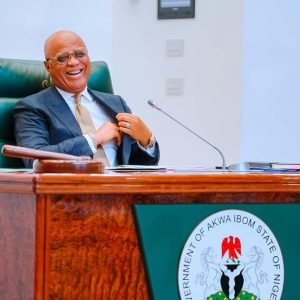
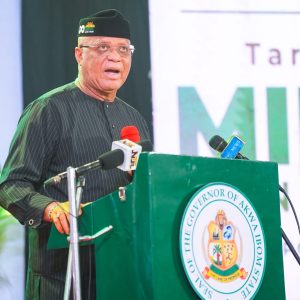
When Governor Umo Eno recently declared that his administration would not commit state resources to completing the long-abandoned Science Park project, many expected the familiar political response. After all, politicians are often rewarded for saying what people want to hear, not necessarily what they need to hear.
Gov Eno chose a different path.
Rather than making promises he may not be able to keep, he spoke with unusual candour. The Science Park, he said, is not among the State’s immediate priorities. If private investors are willing to take it up, government would gladly support such an initiative, but scarce public resources must presently be directed elsewhere.
That statement may not satisfy everyone. It is, however, one of the most honest assessments of governance that Akwa Ibom people have heard in recent times.
The question before us is not whether a Science Park is desirable. Of course it is. The real question is whether the government can responsibly pursue every desirable project at the same time.
The answer is obvious.
Every government operates under finite resources and unlimited expectations. Leadership therefore becomes an exercise in choice. Every naira allocated to one project is a naira unavailable for another. Economists describe this as opportunity cost; citizens simply experience it as prioritisation.
As someone who studied economics, I recall that opportunity cost was one of the foundational concepts taught in both micro and macroeconomics.
It is therefore impossible for me not to recognise its clear and practical application in Governor Eno’s current approach to governance.
This is precisely where Governor Eno’s position deserves a fair hearing.
Ironically, the governor is making this decision while presiding over what may be the most ambitious programme of project continuity in the State’s history. Hence, he has earned the right to speak on abandoned projects.
Across Nigeria, abandoned projects have become symbols of political transition. Successive administrations routinely discard the priorities of their predecessors, leaving taxpayers to bear the cost of incomplete investments.
The Science Park itself became a casualty of that culture.
Gov Eno has chosen a different approach.
Instead of abandoning inherited projects, he has continued and expanded many of them. Today, work is completed on the Smart International Terminal Building and associated airport infrastructure VAIA, attracting full status of an Internal Airport. The 200-room International Hotel, the 5,000-capacity International Conference Centre, and the Shopping City within the Tropicana complex are all receiving attention.
The state is aggressively pursuing the Ibom Deep Seaport project, arguably the single most transformative economic infrastructure on the horizon.
Beyond these are dozens of inherited projects across the State that have continued to receive funding and attention under this administration. Roads, bridges and public infrastructure that could easily have been abandoned for political reasons are instead being completed for the benefit of the people.
This commitment to continuity is significant because development is not measured by the number of projects announced; it is measured by the number completed.
At the same time, the state is investing heavily in healthcare, security, tourism, maritime development and transportation infrastructure.
The ongoing 350-bed International Hospital, the doctors’ residential quarters, the Oron Maritime Hub, shoreline protection projects, waterways security infrastructure, the Command and Control Centre, and several strategic government facilities are all competing for the same public resources.
Tourism infrastructure is also receiving unprecedented attention through the remodelling of Ibom Hotels and Golf Resort and the development of the Arise Park Resort, a world-class leisure destination rising from what was once a dangerous ravine.
These are not proposals on paper. They are active projects demanding funding today.
Against this backdrop, Governor Eno’s position becomes less controversial and more practical.
A Science Park may indeed be valuable, but is it more urgent than a deep seaport capable of transforming the state’s economic fortunes? Is it more strategic than strengthening the international airport and its supporting infrastructure? Is it more critical than expanding healthcare access through primary healthcare facilities across the 31 LGA’s and a world-class international specialist hospital in the horizon? What about renewed investment in stable and reliable power supply which the governor recently announced, should all these be abandoned for a Science Park? Is it more urgent than modern security architecture, waterways protection, and investments aimed at safeguarding lives and property? How low is the fruit from the Science Park, can a market woman benefit from it directly? What about our farmers, civil servants, and even retirees whose gratuities backlog the Governor is determined to clear? And where does it stand against roads, bridges, tourism assets, and other low-hanging economic fruits already creating jobs and attracting investment across the state?
These are not easy choices, but they are the choices leadership demands. Government cannot fund everything at once. The real challenge is determining which investments must come first and which can responsibly wait.
More importantly, the governor is not rejecting innovation or youth development. He is simply pursuing them differently.
Through the proposed Youth Development Centres across the 31 local government areas, the administration is taking digital skills, ICT training, creative enterprise and innovation directly to communities. This approach reflects an understanding that the nature of technology has changed dramatically over the last two decades.
When the Science Park concept first emerged, innovation was largely centralised. People travelled to specific locations to access technology, training and opportunities.
That world no longer exists.
Today, innovation is increasingly decentralised. A young person in Uruan, Mbo, Ini or Obot Akara can learn coding, design, animation, artificial intelligence or digital entrepreneurship from anywhere with the right tools and connectivity.
One Science Park creates a destination.
Thirty-one Youth Development Centres create access.
Seen from this perspective, Governor Eno’s position is not a rejection of the future. It is a recognition that the future has changed.
Ultimately, what stands out in this debate is not the Science Park itself but the character of the leader making the decision.
Gov Eno has developed a reputation for speaking plainly, even when the truth may be politically inconvenient. He does not pretend that resources are unlimited. He does not promise every project to every constituency. He says what he believes, explains his reasoning and accepts the public scrutiny that follows.
In a political environment often crowded with grand declarations and unrealistic promises, that level of honesty is refreshing.
The Science Park remains a worthy vision. Perhaps one day, with private-sector participation and a stronger fiscal environment, that vision will be realised.
For now, however, the governor has chosen to focus on completing critical economic infrastructure already on the table.
Reasonable people may disagree on where priorities should lie. What is difficult to dispute is the logic behind the choice.
Sometimes leadership is not about saying yes to everything.
Sometimes leadership is having the courage to say, “Not now.”