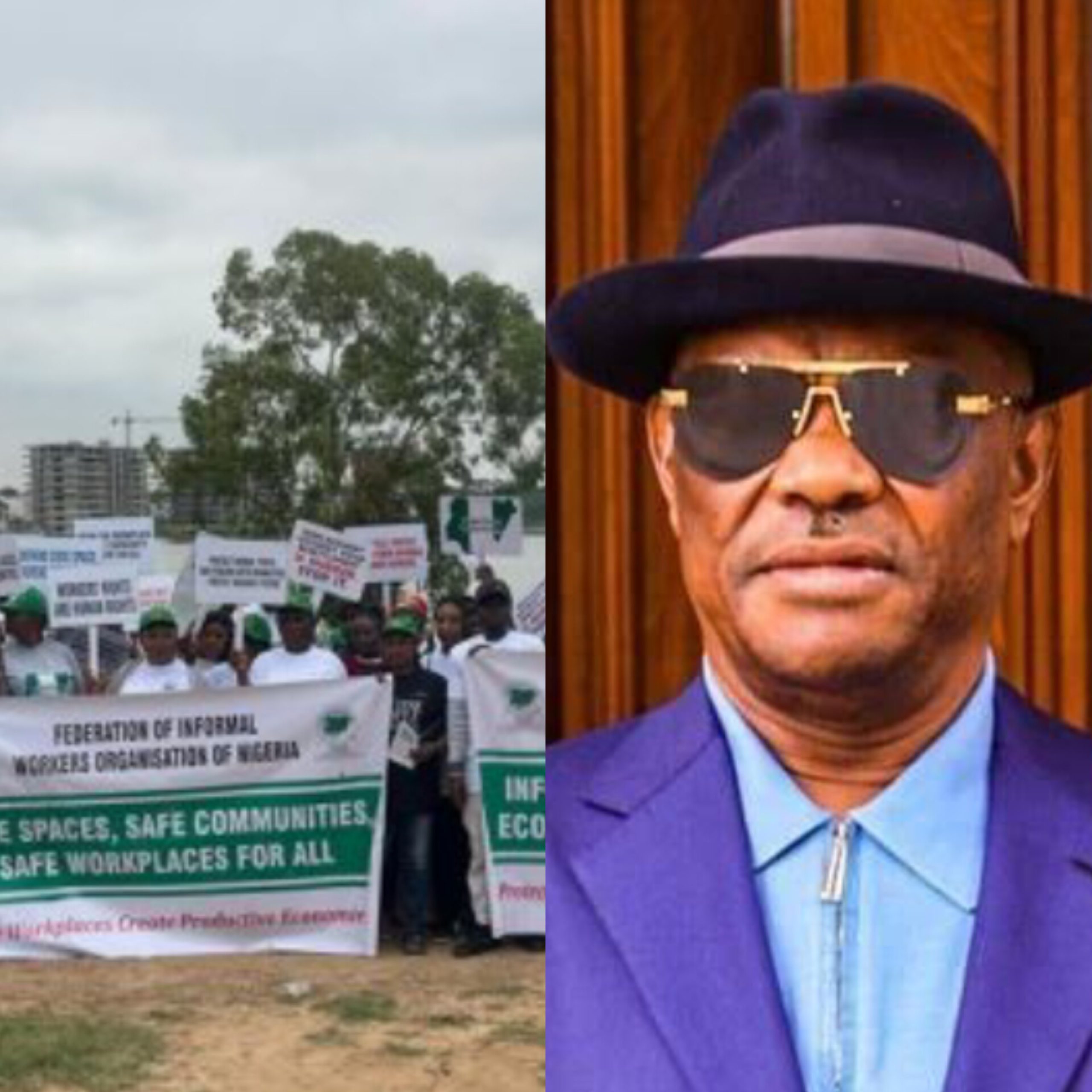
The protesters and Wike
A coalition of civil society organisations has called for greater transparency in the Federal Capital Territory Administration’s (FCTA) redevelopment of Jabi Lake and immediate protection for hundreds of informal workers whose livelihoods have been disrupted by the project.
The coalition, which is led by Accountability Lab Nigeria, in collaboration with the Federation of Informal Workers’ Organisation of Nigeria (FIWON), the Solidarity Center and other advocacy groups, insisted they were not opposed to the redevelopment of the park but called on the FCTA to suspend ongoing demolition, fencing and construction activities pending comprehensive stakeholder consultations, disclosure of project agreements and compensation for affected traders. EITIValidation Support.
Their position follows the signing of a Memorandum of Understanding (MoU) in February 2026 between the FCTA, under the leadership of the Minister of the Federal Capital Territory, Nyesom Wike, and Akida Hills Limited, as well as Suburban Broadband Limited, to redevelop the Jabi Lake Recreational Park as part of the administration’s urban renewal programme, reports The Nation.
The FCTA has maintained that the project is designed to transform the park into a world-class leisure and tourism destination capable of attracting investment, boosting tourism and creating employment opportunities.
However, the coalition expressed concern over what it described as a lack of transparency in the concession process, the absence of public consultation, and the impact of the redevelopment on traders, artisans, transport workers, waste pickers, and other informal workers who have depended on the park for their livelihoods for nearly two decades.
Speaking during a peaceful protest yesterday in Abuja, the Country Director of Accountability Lab Nigeria, Friday Odeh, said the coalition’s demands were driven by the need to ensure that development does not come at the expense of ordinary Nigerians.
“We are not against the development of this park. We are saying there should be a social protection plan for the informal workers. They have a right to be consulted because this park has been their source of livelihood for many years,” he said.
Odeh called on the FCTA to publish the Memorandum of Understanding it signed with the developers, arguing that Nigerians have a constitutional right to access information about public assets.
“Everybody has a right to know. Nigerians have the right to know. Publish the Memorandum of Understanding so citizens can understand what has been agreed and engage in an informed conversation,” he said.
According to him, the coalition has submitted several Freedom of Information requests seeking details of the agreement but has yet to receive any response from the FCTA.
“As law-abiding citizens, we have followed the legal process by filing Freedom of Information requests. We expect the government to respond because citizens have a legal right to access public information,” he added.
He warned that without transparency and public participation, one of Abuja’s few remaining free recreational spaces could become an exclusive destination beyond the reach of ordinary residents.
“This is public land that belongs to ordinary people. We are not against development. We are against doing it in secret and at the expense of the poor and informal workers,” he stated.
Also speaking, FIWON representative, Blessing Yusuf, demanded the immediate suspension of all demolition, fencing and construction activities until meaningful consultations are conducted with affected stakeholders.
“Our demand is the immediate suspension of all demolition, fencing and construction works until there is full public consultation, legal review and transparency around the project,” she said.
Yusuf urged the FCTA to publish the MoU signed with the developers, conduct and release an independent Environmental Impact Assessment before further construction, guarantee that the park remains affordable and accessible to the public, and compensate traders and small business owners displaced by the redevelopment.
She stressed that any urban renewal initiative should incorporate adequate social protection measures for informal workers whose businesses have been affected.
Describing Jabi Lake Recreational Park as one of the Federal Capital Territory’s few remaining public recreational spaces, Yusuf noted that since its inauguration in 2007 under the Abuja Master Plan, the park has served residents, tourists, families, fitness enthusiasts and hundreds of informal workers.
The coalition also disclosed that it had submitted a formal petition to the Minister of the Federal Capital Territory, seeking full disclosure of documents relating to the redevelopment and urging the administration to adopt a transparent and inclusive approach that protects public access while balancing development objectives with the welfare of affected communities.