The trend of Nigerians seeking greener pastures abroad, often referred to as ‘Japa,’ has become a pervasive trend.
It is no longer news that the mass exodus has had far-reaching implications across various sectors.
Sadly, the healthcare system seems to be the hardest hit, reports Sunday Vanguard.

This is because the departure of skilled healthcare professionals, particularly doctors, has left a gaping hole in Nigeria’s already strained medical infrastructure.
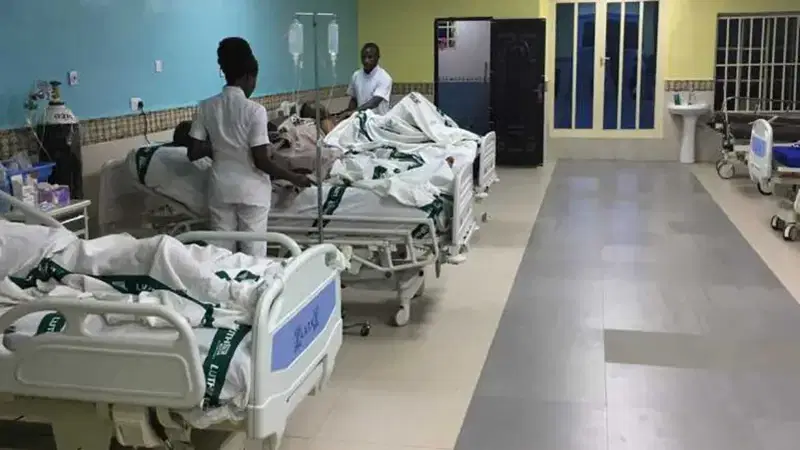
Today, in some states like Lagos, where a doctor sees over 100 patients a day before the emergence of Japa, the ratio has doubled in some hospitals while some clinics are longer functioning because specialists are not available to run them.
The allure of higher salaries, better working conditions, and advanced medical facilities in developed countries has driven countless Nigerian doctors to seek opportunities overseas.
This brain drain has had a devastating impact on the nation’s healthcare system.
One such doctor, a young paediatrician who recently left Nigeria for the United States, admits that it was a difficult decision for her.
“I love my country and my patients, but the challenges were overwhelming. The long hours, the poor working conditions, and the lack of resources made it nearly impossible to provide the level of care I wanted to give”, she told our correspondent.
However, the departure of healthcare professionals like the young paediatrician has had a profound emotional impact on those who remain.
For instance, a nurse, who works at a public hospital in Lagos, shared her frustrations with our correspondent anonymously.
She said: “We are overworked and underpaid. Many of my colleagues are leaving, and it’s taking a toll on our mental health. It’s disheartening to see patients suffer because we don’t have enough staff.”
Massive shortage
It is no longer news that there is a massive shortage of medical professionals.
For instance, the departure of doctors has exacerbated an already critical shortage of healthcare workers in Nigeria.
This shortage has led to longer waiting times for patients, overcrowded hospitals, and a decline in the quality of care.
For states like Lagos, according to the state Commissioner of Health, Prof Akin Abayomi, there’s a shortage of 30, 000 healthcare professionals in Lagos.
Sadly, many Nigerians, especially those living in rural areas, struggle to access basic healthcare services due to the lack of qualified doctors.
The gap has been widened and may be contributing to a rise in preventable diseases and maternal and child mortality rates.
Also, the departure of skilled medical professionals has also hindered the development and maintenance of healthcare infrastructure. Compounded by the economic situation including the skyrocketing cost of drugs, and medical supplies, some hospitals and clinics lack essential equipment, medicines, and well-trained staff, further compromising the quality of care.
Today, Nigeria has significant challenges as health indices show.
The country currently has very high maternal mortality and high infant mortality.
Nigeria also has neonatal mortality, one of the worst in the world.
According to Abayomi (Lagos State Commissioner for Health) at an event, recently, more shocking is that 16 per cent of Nigerian children suffer from obesity and data suggests that over 30 per cent are abstentive.
Direct impact
The Japa syndrome has had a direct and significant impact on patients.
Many Nigerians have been forced to travel long distances or seek alternative, often less reliable, healthcare options.
This can lead to delayed diagnosis, improper treatment, and even preventable deaths. Additionally, the financial burden of seeking medical care abroad can be overwhelming for many families, especially now there is foreign exchange crisis.
For instance, W.H.O’s ratio for Nigeria is one doctor to every 1, 000 citizens or residents but in Lagos, it is one doctor to every 4, 000 patients, a situation that is better than other states across the country.
This is because there was a dearth of health professionals even before the emergence of brain drain.
Further findings revealed that apart from doctors, the same thing applies to nurses, pharmacists, medical lab scientists and dentists among others.
A case in point is the situation at the Lagos University Teaching Hospital, LUTH, where members of the House of Representatives Committee on Health, on a visit, raised the alarm that five wards comprising 150 beds had been shut down following massive migration of doctors.
Although the Chairman of the committee, Dr Amos Magaji, described the situation as at November last year as worrisome, the situation is still the same across hospitals in Nigeria.
Findings show that more doctors are willing to leave the country.
According to the Coordinating Minister of Health and Social Welfare, Prof Ali Pate, in March, Japa Syndrome has deprived Nigeria of its top talents in the health sector, with no fewer than 16, 000 doctors leaving the country in search of better opportunities abroad.
Pate, who spoke on national television, also disclosed that, in the last five years, the country lost about 15, 000 to 16, 000 doctors to the Japa syndrome.
He said there are about 300, 000 health professionals in all cadres, including doctors, nurses, midwives, pharmacists, laboratory scientists, and others, serving over 200 million Nigerians.
“We did an assessment and discovered we have 85,000 to 90,000 registered Nigerian doctors. But there are 55,000 licenced doctors in the country”, Pate said.
Reasons doctors are leaving
According to the President of the Nigeria Medical Association, NMA, Professor Bala Abdul, the number of medical doctors leaving the country has continued to increase and it is affecting the healthcare delivery in the country as the few ones left do the work of the ones who have gone.
Lamenting that Nigerian doctors are now over-stressed, Abdul said the single most important reason Nigerian doctors were leaving the country was their welfare.
He said once their take-home pay is addressed, the country would have addressed more than 90 per cent of the problem.
The NMA President said there is also the issue of job satisfaction, which means providing all that is necessary for doctors to work and for young doctors to train for their postgraduate.
Abdul also noted the issue of security, adding that security was an important factor.
“Doctors and all the healthcare professionals need to improve security. The security of their lives and public health is very important”, the NMA leader said.
Continuing, Abdul said, currently, doctors who have stayed back in Nigeria are experiencing burnout as a result of excess workload.
Abdul said: “Even though they have remained behind to sustain the quality of healthcare because that cannot be compromised, the quality of healthcare is being maintained as much as possible.
“But the number of those who have remained behind cannot cater for the number of patients who are trooping to the hospitals, both the public sector and the private sector.
“What the NMA is doing to cushion this effect is to talk with governments because governments are the largest employers of healthcare professionals to deliver healthcare to patients in this country which we know is a corporate social responsibility of governments to the citizens.
“So we know that the federal government has enacted a policy to improve the retention of doctors and also to some extent ensure that the number of doctors going out of the country is reduced and, hopefully, that even some of those who are out of the country may decide to actually come back.”
Bringing back retired doctors
Meanwhile, in Lagos, the state government has come up with the policy of bringing back retired medical professionals.
The initiative has gained momentum, with many healthcare professionals expressing their support.
Commenting on the policy, the Chief Medical Director (CMD) of Lagos State University Teaching Hospital, LASUTH, Professor Adetokunbo Fabamwo, told Sunday Vanguard that it was a step in the right direction but the government should be selective about it.
”You don’t say that because a doctor retired, you want to fill in gaps. And you just bring everybody back whether they are still fit mentally or physically to practice or not. So fitness to practice must be determined”, the CMD said.
Fabamwo said he has always believed that 60 years was actually a young age for a public service doctor to retire.
His words: “If you go abroad, you’ll find very much older physicians still practicing in the public sector, especially in the UK.
“So I believe that even if we retain the retirement age of 60, people who are still fit mentally and physically to carry out their clinical duties can be brought back to work.
“I know for a fact that this is already happening in Lagos State.
“There are quite a number of retired consultants giving contract appointments, you know, and they do one, two, three, four years before they finally go back to rest. So I support it.”
Addressing the issue of Japa syndrome, he said in LASUTH there are four categories of staff that are affected.
”You have nurses, young doctors, other paramedicals like pharmacists, physiotherapists, especially medical lab scientists.
”Then you have, on a very low scale, the consultants. So now, LASUTH has not been too badly hit by this exodus and the reason is simple.
”We have been able to perfect the established system of automatic exit replacement.
“LASUTH has been able to perfect it such that on a quarterly basis, effortlessly, we are able to recruit staff to replace those who left in the previous quarter. We are able to do that effortlessly.”
He said they are recruiting people at entry level, adding that even though they may not really match the experience of those that have left.
Fabamwo pointed out that as long as there are people in place to do the work, the newly recruited professionals would learn on the job and also acquire their own experience as they go on.
‘Average of two doctors resign every month’
On his part, Dr. Moruf Abdulsalam, Chairman of the Medical Guild (an umbrella body of doctors employed by Lagos State government), expressed concern that, on average, two doctors resign from their positions at the state’s secondary facilities each month.
Lamenting the prevalence of ‘Japa’, Abdulsalam highlighted the worsening economic conditions, poor remuneration, lack of work incentives, and insecurity as contributing factors to this trend.
He noted that many doctors who have not migrated abroad now opt for private facilities due to the excessive workload in government healthcare facilities.
The Medical Guild Chairman also alerted that doctors from other states with worse (working) conditions are increasingly migrating to Lagos, turning the state into a transit camp to ‘Japa’.
“Lagos drains other states and serves as a transit camp before the eventual journey out of the country,” Abdulsalam stated.
“The migration has had significant negative impacts on healthcare services. Gross understaffing has led to longer waiting times for patients, reduced quality of care, increased workload for remaining doctors, and higher rates of burnout.
“The Medical Guild has submitted a position paper to the state government outlining ways to limit this migration.
“Some of their suggestions are being implemented, such as the provision of housing units at a 40% discount and the bridging of salary disparities with federal counterparts”.
While the state government has been proactive in increasing the number of horsemanship spaces, Abdulsalam emphasised the need for further measures to retain medical professionals.
His words: “For instance, the Medical Guild was able to extract some housing units from the government at a 40% rebate from the market price for our colleagues to pay on a mortgage basis.
“Efforts are still being intensified to expand this to involve more members.
“Also, the salary disparity between us and our federal counterparts has been bridged through payment of the recently adjusted Commess allowance at the federal level.
“We are also still engaging the government on tax exemption for our professional allowances which form the bulk of our take-home pay.
“We are also witnessing increasing retention of personnel who recently retired being reabsorbed on a contract basis to continue to provide services due to the shortage of manpower.”
”The government has increased the number of horsemanship spaces significantly to shore up the number of available personnel. Lagos presently attracts the highest number of interns doing house jobs across the country”.