

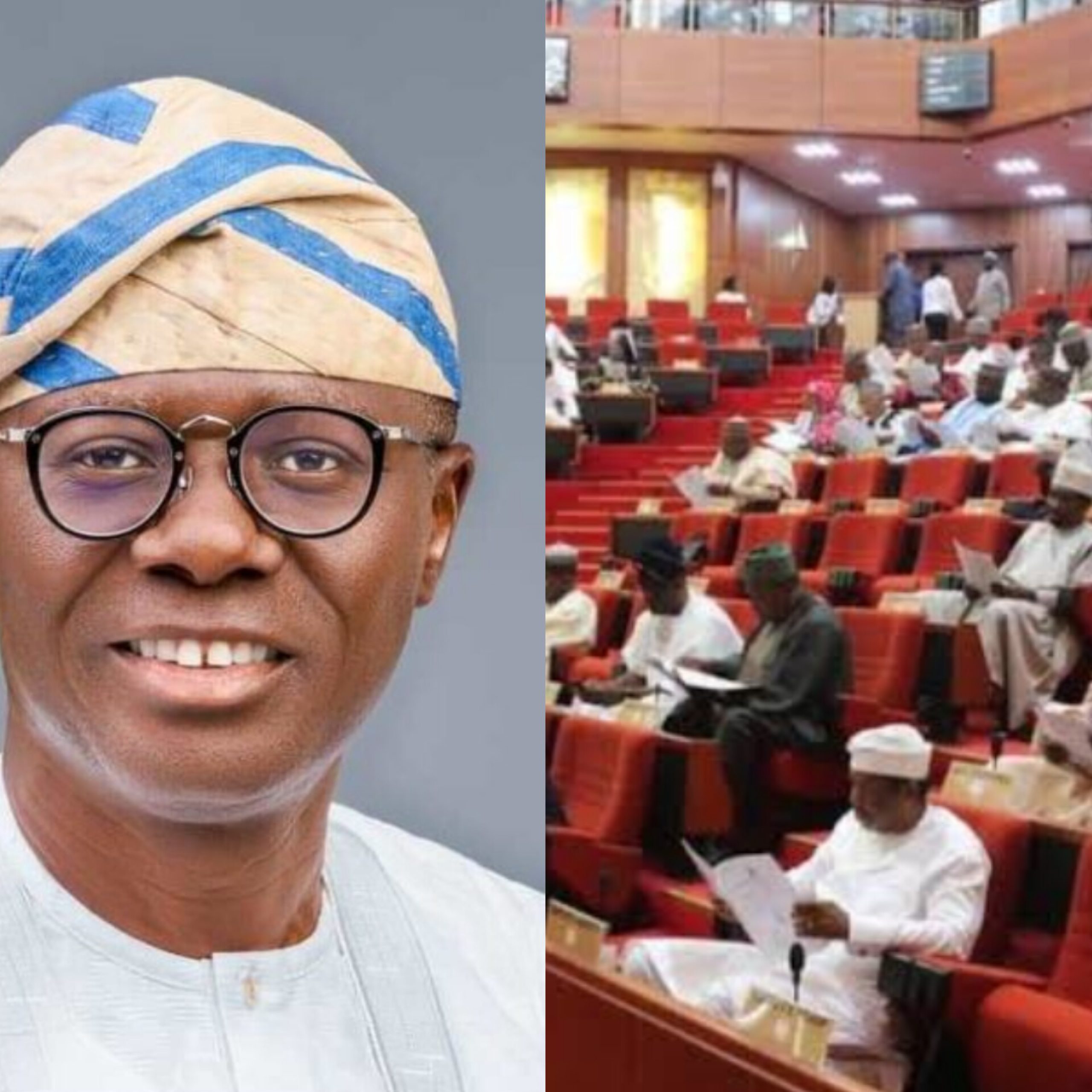
•Governor Sanwo-Olu of Lagos State and the Nigeria Senate
The Lagos State Government has accused the National Assembly of attempting to subvert the Nigerian Constitution and a binding Supreme Court judgment through the proposed Central Gaming Bill, warning that the move could plunge the country into a fresh constitutional crisis.
Speaking at a press briefing in Alausa, Ikeja, today, the Attorney-General and Commissioner for Justice, Mr. Lawal Pedro, SAN, addressed “The Proposed Central Gaming Bill and the Supreme Court Judgment in Suit No. SC/1/2008 – AG Lagos & 22 ORS v. AG Fed & ORS.”

He declared that the Bill, which seeks to regulate all forms of online and remote gaming across the country, constitutes “legislative overreach and a direct violation of the Constitution.”
Pedro reminded lawmakers that the Supreme Court had, on October 13, 2024, in a landmark ruling involving Lagos and 22 other states, affirmed that gaming, lotteries and betting are residual matters exclusively within state jurisdiction, except in the Federal Capital Territory (FCT).
“The Supreme Court, our apex court, has declared that the power to regulate gaming, betting and lotteries belongs solely to the states. The National Assembly lacks the competence to legislate on these matters for the entire country,” Pedro stated.
The court, he recalled, also issued a perpetual injunction restraining the Federal Government and its agencies from enforcing the National Lottery Act or similar legislation within the territory of any state.
Pedro warned that the proposed Bill, if passed, would not only defy that judgment but also “undermine the foundation of Nigeria’s federal structure.”
“Any attempt to legislate again on the same subject amounts to defiance of the Supreme Court, a violation of the Constitution and an invitation to constitutional chaos,” he said.
The Attorney-General dismissed arguments by proponents of the Bill that “online or remote gaming” automatically falls under federal control due to its cross-border nature.
“Online does not mean federal. If online activity automatically becomes federal, then the United Nations should regulate it globally.
The use of technology does not alter the legal character of gaming, which remains a state matter whether done physically or virtually,” he said.
He further cautioned that a national gaming law could open the floodgates of gambling operations even in states where religious or cultural values forbid such practices, warning that the social consequences could be severe.
“If the Bill becomes law, it will allow operators to set up gaming businesses across all states, including those where gambling is forbidden by religion or tradition. This could create social tension and conflict,” he cautioned.
Pedro described the National Assembly’s effort as a contradiction of its ongoing campaign for devolution of powers to states.
“It will be a contradiction of spirit and purpose for the same National Assembly that is canvassing devolution of powers to now attempt to reclaim powers already affirmed by the Supreme Court to belong to the states,” he added.
The Lagos Attorney-General reaffirmed that Lagos, alongside the 22 other states that were parties to the suit, will resist any legislative or executive act that undermines the integrity of the Supreme Court’s decision.
“This is not about Lagos State alone. It is about Nigeria; it’s about protecting the integrity of the Supreme Court and preserving the federal structure as guaranteed by the Constitution,” he stressed.
He urged the National Assembly to immediately withdraw the proposed legislation “in the interest of constitutional order and national stability.”
“The rule of law is the soul of democracy. Our democracy will remain strong only if we respect the Constitution and the finality of Supreme Court decisions,” Pedro said.