•Kashim Shettima
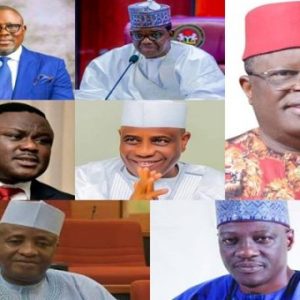
Despite the festering insecurity in many parts of the country, Vice President Kashim Shettima, state governors and some ministers rose from the National Economic Council (NEC) meeting yesterday without discussing the issue of State Police.
Answering questions from State House reporters after the NEC meeting presided over by the vice president, Bayelsa State Governor Douye Diri said they could not consider the issue of State Police because of the many presentations entertained by council, reports Daily Trust.
He, however, promised that the issue would be exhaustively deliberated upon in their next meeting.
Asked while none of those who addressed the press spoke about state police, Diri said. “For your information, state police was part of our agenda today, unfortunately because of time demands after a very long meeting. You know we have been here for a very long time, because of the presentations, we were unable to get to that.
“But I can assure you that in our next meeting, that issue will be exhaustively discussed,” he said.
This is not the first time that NEC will be differing deliberation on state police.
In December, after all the 36 states have submitted their positions on State Police, with a majority agreeing on the need for state police to tackle insecurity, the deliberation on the issue was differed.
This is the third time that the issue will be shifted in spite of the prevailing insecurity in the country.
In February this year, the Deputy Governor of Kaduna State, Dr Hadiza Balarabe while briefing State House correspondents after the meeting also said the deliberations had been shifted.
In February last year, the idea of state police was raised after a meeting between President Bola Ahmed Tinubu and state governors, following widespread insecurity in many parts of the country.
Addressing State House correspondents after the meeting, the Minister of Information and National Orientation, Mohammed Idris explained that the process is still in its infancy and would only take shape after more deliberations between stakeholders.
Governors raise panel to work with security chiefs
Meanwhile, the Nigeria Governors’ Forum (NGF) has resolved to constitute a sub-committee that will work with heads of security agencies as part of efforts to end insecurity in the country.
Governor Hope Uzodinma of Imo State announced this in the early hours of Thursday while reading a communique issued after the NGF’s second meeting held late Wednesday night in Abuja.
The communique was signed by the forum’s Chairman, Governor AbdulRahman AbdulRazaq of Kwara State.
Uzodinma noted that the governors’ decision was as a result of their admiration for technology-driven solutions presented by the Chief of Defence Staff (CDS), General Christopher Musa who made a presentation at the meeting.
In an interview with newsmen at the meeting, Kaduna State governor, Uba Sani, advocated the adoption of a non-kinetic approach in tackling insecurity in the country.
He, however, urged security agencies to step up their game, explaining that governors have a limited role to play according to the constitution of the country.
A former Comptroller-General of the Nigeria Immigration Service, Muhammad Babandede, has advised the federal government to create a pool of retired generals as a think-tank to advise it on how to tackle the security challenges facing the country.
Babandede, in an interview with journalists in Abuja, argued that many of the retired generals are still agile and fit to bring to an end the current spate of killings if they are carefully assembled, saying they received sound training with huge resources.
Military kills 1,770 terrorists in 3 years across Northwest states – CDS
Relatedly, the Defence Headquarters said yesterday that for the past three years, the Nigerian Armed Forces eliminated no fewer than 1,770 terrorists and arrested 3,070 across the five Northwest states.
The Chief of Defence Staff (CDS), Gen. Christopher Musa made the disclosure at a sensitisation exercise, organised for Katsina communities.
The CDS was represented by Brig.-Gen. Dahiru Abu-Mahawashi, the Deputy Director, Defence Media Operations.
The CDS explained that the military had also seized more than 1,000 different types of weapons, as well as 12,000 different bullets from the criminals.
He said more than 2,515 victims were rescued during various operations within the period in Katsina, Kaduna, Kebbi, Sokoto and Zamfara States.
According to him, the army is doing its best in fighting the security situation, as a series of successes have been recorded, not only across the northwest states, but the country as a whole.
Counterterrorism: Nigeria adopts technology to secure Sahel region
Similarly, Nigeria has adopted the Counter Terrorism Technology (CT-TECH+) initiative to enhance its capacity to secure the country and the Sahel region.
The Coordinator of the National Counter Terrorism Centre, Office of the National Security Adviser (NSA), Maj.-Gen. Adamu Laka, made this known at the official kick-off of the CT TECH+ initiative, organised in collaboration with UN Office for Counter Terrorism (UNOCT), on Thursday in Abuja.
The event was also in collaboration with Interpol and funded by the European Union.
CT TECH+ is a two-year joint initiative that aims to strengthen the capacity of partner states, including Nigeria, to respond effectively to the growing threat of terrorism facilitated by new and emerging technologies.
In his remarks, the European Union Ambassador to Nigeria, Mr Gautier Mignot, said security agencies have to be more clever, more internationally coordinated than the terrorists themselves who are also enhancing their coordination.
Mignot said the UN and its national organisations were committed to playing pivotal role to support the CT-TECh+ initiative with a grant of 4.9 million euros.
Also, the UN Resident Coordinator in Nigeria, Mr Mohamed Fall, said that CT TECH+ would over the next two years, work to review and assess Nigeria’s law enforcement capabilities to tackle technology-enabled terrorism.
The CT TECH was launched on Feb. 10, 2022 at a virtual event attended by over 150 officials from the Permanent Missions to the United Nations, Member States’ capitals, United Nations entities and regional organisations.