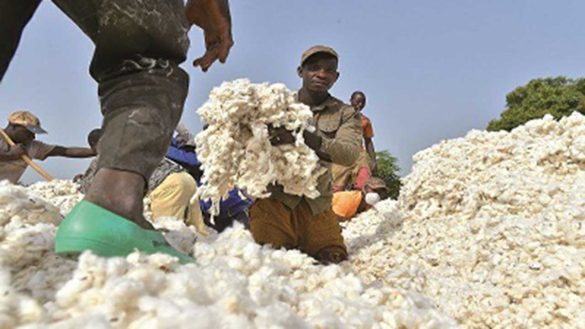
•Cotton farmers
Nigeria’s cotton, textile and garment (CTG) sector remained under severe strain in 2025, with stakeholders warning that without urgent, coordinated and long-term reforms, one of the country’s most job-rich industries risk further decline despite its proven capacity to drive industrialisation, conserve foreign exchange and support livelihoods.
Stakeholders in separate interviews with our correspondent are of the view that the Nigeria’s cotton and textile challenges are rooted not in farmer inefficiency, but in policy inconsistency, weak market protection and inadequate production financing.

They pointed out that sustainable solutions lie in deliberate investment in domestic production systems that reward farmers, support industry and secure the country’s industrial future, rather than recurring emergency imports, reports Daily Independent.
The industry experts also said that the sector’s challenges are not new, but persistent structural weaknesses, policy inconsistency and the withdrawal of key interventions have continued to erode gains made in previous years.
Ado Sule, Director of Administration, National Cotton Association of Nigeria (NACOTAN), noted that one of the most critical constraints facing the sector is the lack of high-yielding, locally adapted hybrid cotton seeds.
This, according to him, has resulted in low farm productivity and high production costs, leaving Nigerian cotton far below global yield benchmarks and increasingly uncompetitive.
He said that earlier interventions showed the sector’s potential, that under the Central Bank of Nigeria’s Anchor Borrowers’ Programme (ABP), seed cotton production rose significantly, leading to the revival of about 26 ginneries and the reactivation of segments of the textile value chain.
However, the absence of a sustainable transition framework after the programme was withdrawn triggered a sharp decline in output.
By the 2023/2024 season, national seed cotton production had dropped to an estimated 15,000 metric tons, while output for 2024/2025 was projected not to exceed 20,000 metric tons — levels far below what is required to keep ginneries and textile mills running sustainably.
Beyond production financing, Sule identified deep-rooted structural constraints across the CTG value chain, including weak funding for cotton seed research, high costs of imported machinery and spare parts, limited access to affordable long-term financing, and the absence of internationally recognised High Volume Instrument (HVI) testing facilities.
The lack of such facilities, he said, results in quality discounting of Nigerian lint in export markets.
He also pointed to power supply challenges, high operating costs, and the persistent smuggling and dumping of textile products as factors undermining local production.
To reverse the decline, Sule called for a coordinated, long-term strategy to restore confidence and scale.
His recommendations included sustained funding for research institutes, particularly the Institute for Agricultural Research (IAR), Zaria, to develop competitive cotton varieties; incentives to build a domestic cotton seed industry; and large-scale land preparation and clearing by agencies such as the National Agricultural Land Development Authority (NALDA) to support mechanised farming.
Other proposals included mechanisation support schemes for smallholder farmers, removal of tariffs on ginning and textile machinery, establishment of HVI laboratories, provision of single-digit, long-tenor financing across the CTG value chain, and the creation of a private-sector-driven CTG Board to coordinate policy and align fiscal and monetary interventions.
From the ginning sub-sector, Samuel Oloruntoba, Secretary of the Cotton Fammers Association of Nigeria, described 2025 as a year of further contraction.
He said the sector recorded no significant improvement, as some textile companies that were operating before 2025 shut down, while others were sold outright. Similar outcomes, he added, were recorded among ginneries.
According to Oloruntoba, the few ginneries still in operation are running at less than 20 percent of their installed capacities due to low cotton production.
He also noted that over 80 percent of cotton produced in Nigeria is exported, with exporters facing challenges that could have been avoided if local textile mills were functional.
He warned that the sector faces possible extinction if drastic measures are not taken, stressing that any intervention must be holistic and address cotton farming, processing, textile manufacturing and garment production together.
Oloruntoba advocated a 10- year development programme to revive the sector and urged the implementation of the Cotton, Textile and Garment Board (CTGB), which was approved by the National Economic Council, last year.
He said the board could help address many of the sector’s challenges if fully operational.
He further emphasised that future agricultural and textile interventions must incorporate all stakeholders, including the federal and state governments, research institutes, organised private sector groups, agro-commodity associations and cooperatives, to ensure the synergy needed for success.
He projected that sustained growth in staple crops could help stabilise food prices and provide affordable raw materials for industries.
He also called for intensified mechanisation across the country, improved subsidies for farm inputs such as fertilisers and high-yielding seeds —particularly for cotton farmers — massive investment in irrigation infrastructure to mitigate climate change impacts, and concerted efforts to address insecurity affecting farming communities.
He identified opportunities in the newly approved CTGB, noting that its effective implementation could revive cotton production, resuscitate comatose textile mills and stimulate growth in the garment sub-sector, with significant employment and GDP benefits.
Anibe Achimugu, President, National Cotton Association of Nigeria (NACOTAN), described 2025 as a year of steady but still below-potential performance.
He said the sector showed resilience despite difficult economic and security conditions, noting that agriculture remained a major pillar of the economy, contributing not less than 30 percent of GDP in the third quarter of 2025, even as the broader economy grew by over three percent year-on-year.
Achimugu stressed that agriculture cannot be ignored and called for deliberate, collaborative interventions to ensure the sector consistently performs above expectations.
He observed that government actions are increasingly shifting from statements to systems building, mechanisation, structured input delivery, improved farmer data integrity and stronger coordination with states and development partners.
However, he cautioned that deliberate engagement with commodity associations driven by smallholder farmers must not be overlooked.
He also highlighted the need to link cash crops such as cotton to food security, advocating intercropping models that strengthen rural livelihoods by providing access to food staples alongside cash income.
According to him, food security is ultimately about household resilience.
Achimugu pointed out that the full establishment and effective execution of the CTG Development Board’s mandate would ensure proper coordination of the cotton, textile and garment value chain—from access to quality seed and extension services to offtake, ginning and mill revival.
He said this would drive job and wealth creation, reduce imports, strengthen rural incomes and support inclusive growth objectives.