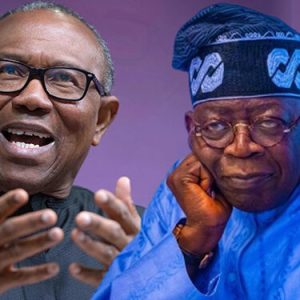
•Peter Obi, Tinubu and Atiku
By mid 2025, Nigeria’s opposition has coalesced into the African Democratic Congress (ADC), aiming to unseat President Bola Tinubu in the 2027 polls.
At its helm are two heavyweight figures: Atiku Abubakar, PDP stalwart with decades of political experience, and Peter Obi, Labour Party’s youthful and urban centred maverick, reports Sunday Independent.
As internal dynamics play out, one question dominates: who, within this coalition, emerges as the preferred standard flag bearer for the opposition?
The ADC is obviously positioning itself on the platform of unity — the idea that only a united opposition can defeat the entrenched APC stronghold. Atiku brings northern leverage and party structures built over decades.
Obi commands youth, Christian and urban middle class appeal, especially strong in the South East, Lagos State and Abuja; the three areas where the Labour Party ran nearly uncontested in 2023.
Yet fissures run deep: internal PDP rifts involving former Rivers State Governor, Nyesom Wike, and former party chairman, Iyorchia Ayu, have weakened Atiku’s base, while the Labour Party is beset by leadership disputes over Obi’s coalition role.
Aware of the optics, ADC leadership aims to select its presidential candidate by mid 2026, with a tilt toward a southerner — to respect the unwritten North/South rotational convention.
Yet, Atiku remains a veteran of Nigerian politics. He served as Vice President under Olusegun Obasanjo, has run for president six times, and holds an unmatched national network. His strength lies in the PDP’s machinery, especially in the North and parts of the South-West.
However, cracks have emerged. Factionalism within the PDP has grown deeper since 2023. Some governors and high-profile figures have defected, and disputes over the party secretary position signal a party struggling with internal cohesion.
Tension In ADC
Tensions are quietly escalating within the opposition coalition as former Kaduna State governor, Nasir El-Rufai, and former Vice President Atiku Abubakar increasingly find themselves on opposing sides of the ADC’s power alignment. Though both men share a common goal of unseating the APC in 2027, El-Rufai — who recently aligned with the ADC after falling out with the Tinubu administration —has been critical of Atiku’s leadership style, accusing him of clinging to outdated political strategies and failing to galvanize younger, reformist forces within the coalition. El-Rufai is said to be lobbying for a technocratic, policy-driven candidate, and insiders suggest he views Atiku’s repeated presidential ambitions as a liability that could fracture the coalition’s appeal, especially in the North.
In private meetings, El-Rufai has also reportedly floated Peter Obi or a “neutral third force” as better suited to lead the ADC ticket, subtly positioning himself as a kingmaker within the emerging power structure. This growing divergence has unsettled the coalition’s delicate balance, as Atiku’s loyalists view El-Rufai’s influence as both opportunistic and disruptive.
With regional leaders and youth blocs increasingly divided between the old-guard PDP structures and El-Rufai’s reformist wing, observers warn that unless a compromise is brokered, the El-Rufai–Atiku rift could pose a serious threat to the coalition’s unity ahead of the 2026 convention.
Obi’s Edge
Peter Obi captured over 6.1 million votes in the 2023 presidential election—most of it from young people, professionals, and Christians in the South-East, South-South, and Lagos. His campaign’s anti-establishment tone, clarity on fiscal responsibility, and emotional connection with voters created a strong base.
However, Labour Party’s lack of structure remains a handicap. The party has one governor; Alex Otti of Abia State, 35 members of the Federal House of Representatives, 5 Senators; 2 from Anambra, 2 from Enugu and 1 in FCT.
Its internal wrangling has dented its credibility. Obi, popular as he is, lacks the political infrastructure to deliver nationwide without coalition partners.
Obi’s participation in the ADC coalition is also controversial within his party. The Julius Abure faction of the Labour Party has rejected Obi’s role, while the Lamidi Apapa faction claims to support it — highlighting deep divisions that may end up in court.
Atiku Abubakar’s exit from the Peoples Democratic Party (PDP) has triggered significant tremors across Nigeria’s political spectrum, prompting the party to swiftly recalibrate its 2027 strategy. Shortly after Atiku’s departure — reportedly due to mounting frustrations over internal party wrangling and lack of consensus around his 2027 ambition — the PDP’s National Executive Committee (NEC) moved to zone the party’s presidential ticket to the South.
While party insiders deny that the decision was a direct reaction to Atiku’s exit, observers say it was a strategic move to reclaim momentum, appeal to Southern stakeholders, and project a forward-looking image in the face of mounting defections and dwindling public confidence.
The PDP now faces a delicate balancing act: repositioning itself as a truly national party without alienating its Northern power base, which had long rallied behind Atiku’s candidacy. By zoning the ticket to the South, the party is signalling its commitment to rotational justice and inclusivity, a stance that has been well received in parts of the South-East and South- South.
However, the move also risks emboldening alternative northern-led coalitions including Atiku’s own ADC faction and could deepen internal fractures if not carefully managed. With the 2026 convention looming, PDP’s challenge is no longer just electoral, it’s existential.
Kwankwaso: The Northern Maverick
While Atiku and Obi dominate headlines, Rabiu Musa Kwankwaso is quietly positioning himself as a formidable force within the opposition camp. The former Kano governor and NNPP leader has consistently maintained a strong grassroots base in the North-West, and analysts say his next move could tilt the scales in a tightly contested three-way race.
As Atiku exits the PDP and the party pivots South, some strategists within the opposition see Kwankwaso as the only viable Northern counterweight in any coalition aiming for national balance.
Kwankwaso’s 2023 presidential run earned him over 1.4 million votes —mostly from the North-West— and insiders say he has been in discreet talks with political stakeholders, including elements within the Labour Party and disenchanted PDP loyalists. With a fractured opposition and regional loyalties in flux, Kwankwaso could either emerge as a consensus candidate or negotiate a power-sharing alliance that cements his influence in a post-Atiku realignment.
An analyst familiar with the situation described it succinctly: “Atiku anchors the northern support; Obi drives southern youth enthusiasm — but there’s apprehension: whose brand will define the coalition?”
What Party Members, Stakeholders Are Saying
Among Labour Party supporters, many view Atiku as part of the “old order” that must be retired.
“We don’t want a recycled politician in 2027,” said Chika Okeke, a Labour youth coordinator in Enugu. “Obi is the only one with clean hands.”
But PDP loyalists push back: “Politics is about structure and national spread. You don’t win the presidency with Twitter fans,” said Alhaji Mohammed Sani, a party delegate from Kano. “Atiku is the only one with what it takes to defeat the APC.”
Civil society groups and polling organisations remain skeptical. A recent Afrobarometer report shows that less than 40% of Nigerians believe the opposition can unite behind one candidate before 2026. Trust in their ability to manage egos and avoid fragmentation is low.
Who Will Get The Ticket?
Scenario A: Obi Emerges As Candidate
If the coalition agrees that 2027 should rotate to the South, and the Labour Party mends fences, Obi’s clean image and growing national appeal could be hard to ignore. Atiku might be persuaded to step aside as elder statesman or take a kingmaker role.
Scenario B: Collapse Of Consensus
If neither man is willing to step down, the coalition may fracture, forcing multiple opposition candidates to run against Tinubu in a split-ticket contest. This would likely hand the APC an easy path to re-election.
The 2027 Equation
As Nigeria approaches 2027, the battle between experience and structure (Atiku) versus momentum and mass appeal (Obi) remains finely balanced. While Atiku enjoys the political architecture necessary for a national campaign, Obi represents the desire for new leadership, especially among young Nigerians, professionals, and disillusioned voters.
Whether the opposition can unite behind one candidate, or fall into another fragmented contest, remains to be seen. But for now, the favour is fluid, and both men are still very much in the race.
The question now is, can Labour Party factions reconcile around Obi’s vision?
Will ADC enforce a strict selection timetable before 2026?
Will Rabiu Kwankwaso remain in NNPP or align with the ruling party?
Will the opposition unveil a common manifesto or regional zoning pact?
Can either Atiku or Obi make meaningful inroads in the North-West and South-West battlegrounds?
Until these questions are answered, the battle for supremacy in the opposition remains open-ended.
But one thing is certain —only one can lead. And for Nigeria’s opposition, the clock is ticking.