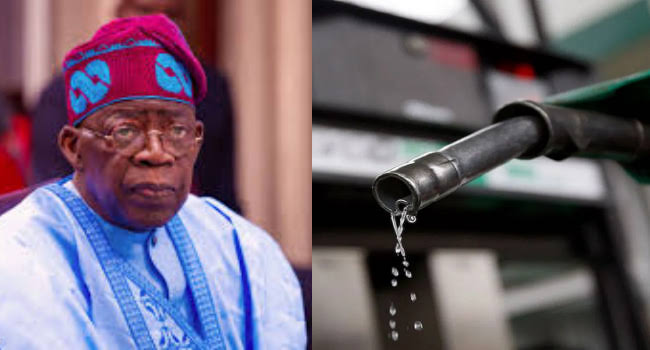
•Tinubu and fuel pump
The Association of Nigeria Refineries Petroleum Marketers (ANRPM) has urged the Tinubu-led federal government to consider a temporary subsidy on petroleum products to cushion the impact of rising global oil prices triggered by the ongoing conflict involving the United States, Israel and Iran.
National President of the association, Comrade Nwozuzu Chigozie, said the escalating tensions in the Middle East have significantly disrupted global energy markets, leading to sharp increases in crude oil prices and, by extension, domestic fuel costs, reports The Guardian.
The Middle east crisis has affected major oil transit routes such as the Strait of Hormuz, a key global supply corridor, worsening volatility in energy prices.
Chigozie noted that Nigeria, despite being a major crude oil producer, remains vulnerable to external shocks due to its pricing structure, which is tied to international market dynamics.
He warned that allowing distant geopolitical conflicts to dictate local fuel prices places undue pressure on citizens already grappling with economic hardship.
He stressed that the current situation presents an opportunity for the government to prioritise domestic needs by supporting local refining, particularly through increased crude supply to facilities such as the Dangote Refinery, to stabilise supply and reduce dependence on imports.
He said: “This is the best time to Nigerianise our price, considering that we produce crude in large quantities, and, with God-given Dangote Refinery, that has the capacity to sustain our consumption, Federal Government ought to have made immediate provisions to supply Dangote needed crude to refine and to supply to Nigeria market exclusively.
“This is because self sufficiency is key and what our nation should navigate towards and believe me there are dangers of allowing unfavourable market forces, especially during wars in faraway nations, to determine the price we purchase of Petroleum products.”
The ANRPM president argued that a temporary subsidy would serve as a buffer for Nigerians as global oil prices continue to surge amid the conflict, with reports indicating significant spikes in fuel costs across several countries.
While advocating policy intervention, he also called for strict standardisation in the operations of modular refineries to prevent substandard petroleum products from entering the market and posing risks to consumers and the environment.
Chigozie maintained that a combination of targeted subsidy, local refining support and regulatory oversight would help Nigeria mitigate the impact of global oil shocks and protect the welfare of its citizens.
“Therefore, we plead the federal government to speedily intervene, and allow our system to profit the nation. Best time to temporarily subsidise. Let us situationalize how much average Nigerian buys their petroleum products”, he said.