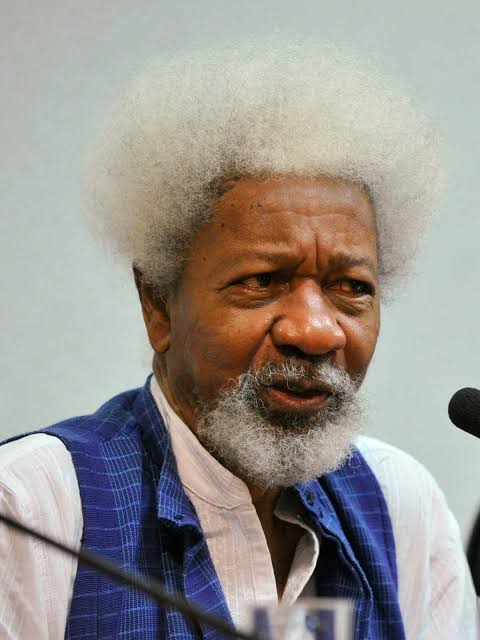
•Prof Wole Soyinka
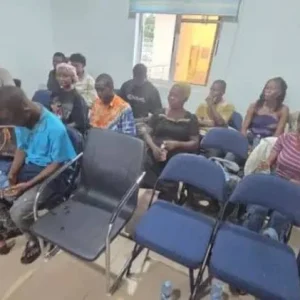
The Wole Soyinka Centre for Journalism (WSCIJ) on Thursday February 15, 2024, launched a report, which revealed the shocking gender disparity in newsrooms in Nigeria, demanding intentional bridging of these gaps.
The report, tagged, “Who leads the newsrooms and news? A report on women’s representation newsrooms and news leadership in Nigeria,” brings to the fore, the reality of the ongoing conversations across the globe on issues relating to gender disparity in the media industry.

The report presents findings from a study that examined the extent of gender representation in newsrooms and news leadership roles across various Nigerian media organisations.
The study was carried out with funding support from the Bill and Melinda Gates Foundation, under the Report Women! News and Newsroom Engagement project as a tool of engagement with the staff and management of media houses.
An excerpt of the report states thus: “The study revealed that women’s representations in media leadership are low across the four media genres. Women accounted for 25.7% of leadership positions, while men dominated with 74.3%. Print and online platforms exhibited the lowest representation of women at 4.6% and 5.5% respectively, while radio and television showed slightly better representation at 9.2% and 6.5% respectively
“Geographically, the Southwest and North-Central had the most women in leadership positions, but they ranked lowest in percentage representation. The Northwest and South-South led in gender-balanced leadership with 31.2% and 28.5% representation respectively.”
Similarly, in terms of news representation, the study discovered that women were inadequately represented. Only 24% of anchors and authors were women, with men making up 76%. Men also dominated as expert resource persons or guests, comprising 87.9%, while women constituted just 12.1%. Furthermore, only 7.1% of news focused on women, while 92.9% covered other angles.
According to the WSCIJ, “To foster a more diverse and equitable media landscape, proactive measures are needed to enhance gender inclusivity and empower women within the industry.”
The Director of Daily Trust Foundation, Dr Theophilus Abbah, who reviewed the 90-page research document, opined that it provided evidence of the lop-sidedness in the media industry, stressing that “it holds a mirror to the face of media owners, media executives, and newsroom leaders, showing an error that needs to be corrected and mistake of gender imbalance in the news business. A mistake because there are no gender norms in the media business. Nowhere are we told what roles are reserved for men or women in the media business, unlike in other areas in our cultural experiences.”
Speaking on the way forward to the concerns raised in the report, Abbah stated: “The research has made several recommendations, which are relevant. It’s a call on media organisations to be deliberate in ensuring that more women are given leadership roles in the newsroom, and more female newsmakers are sourced and featured in the news. Other recommendations are to implement gender parity policies, improve representation of women in news reporting, increase female expert sources, promote gender-sensitive reporting and engage stakeholders.”
Abbah also recommended that qualitative research should be conducted to explore why the numbers are lopsided, without which, it might be difficult to solve the problem of gender imbalance in the newsroom.
He added: “For instance, it is good to know the following, How did the 32% in leadership positions in the media climb the ladder up? What can other women and media organisations learn from them? Why do boards of media organisations appoint more males than females to leadership positions? Why do editors feature more male newsmakers than female newsmakers in their publications?
“What kinds of training must women be exposed to qualify for leadership positions in the newsroom How do pressures for the roles women play in their homes affect their growth prospects in the newsroom?
“Some of these questions could be answered through other research methods, separate from numerical data. Interviews and focus group discussions could bring out a lot more information that could complement the outcome of this research, to change the imbalance in female representation in the newsroom.”
He urged the WSCIJ to circulate the report as widely as possible to media organisations. “Like every other kind of advocacy, the struggle for gender equity in the newsroom should not end with one activity; there must be multiple activities on diverse fronts until the change for equity becomes irresistible,” Abbah emphasised.
The Deputy Editor of The Eagle Online, Ms Juliana Francis, a member of the team of journalists and media managers who collected data on the gender composition of the board and management of 111 media organisations that gave birth to the report, said she was proud to be part of it, despite challenges encountered while gathering the data.
She opined that the very detailed report was designed to push for an increased representation of women in news coverage and newsroom leadership.
She further said: “This report is a reality of what many of us have been debating for years now, the under-presentation of women, not just in our newsrooms, but leadership positions. This report can now be used to engage the leadership of media organisations, pushing for an increase in the representation of women in news coverage and newsroom leadership.
“The report and data therein can be used to enrich and validate stories on gender disparity in our newsrooms. More women in leadership positions will encourage other female reporters to aspire to excel, rather than many feeling that no matter how hard they work or do not work, they’ll never go beyond reporters and presenters.”
She also urged women to speak out against erroneous beliefs that hinder women’s promotions to leadership positions, which is that women are difficult and tiresome as bosses. Another erroneous belief being perpetrated is that most women do not like speaking to journalists, let alone as expert sources.
She advised journalists to cultivate habits of seeing female reporters who have covered a beat for years as expert sources and speak to them as such.
She further advised media organisations to be very deliberate in their policies to catapult women into leadership positions and put them on beats usually reserved for their male counterparts.
“Leadership positions should not be seen or perceived as exclusively reserved for the boy’s club,” said Francis.
The Executive Director of Media Career Development Network, Mr Lekan Otufodunrin, reacting to arguments that there are not enough women in the newsrooms and management positions because of the job demand, especially working late hours, said technology has taken care of mundane excuses.
He said: “We need to begin to see how we can demystify newsroom work and leverage technology. During COVID-19, many newsrooms ran their newsrooms without being in the newsroom. If we make use of what technology makes possible, we’ll realise that it’s not about being present in the newsroom, but being able to deliver.”
He argued that with technology, a female journalist can work from anywhere as a manager. “Being a media manager doesn’t mean staying late in the office or working till 2:am. Media organisations need to begin to make use of what technology has made possible by holding virtual meetings and working remotely. If we do that, we’ll eliminate the argument of women managers not readily being available to work,” said Otufodunrin.
He noted that one major problem confronting the media industry concerning the underrepresentation of women in the newsroom is that of having many females in mass communications classrooms across schools, yet such numbers are not reflected in newsrooms. He described the situation as “a crisis.”
Otufodunrin, who lectures at the Nigerian Institute of Journalism (NIJ) in Ogba, Lagos State, said that many female students studying mass communication, do not have the intention of becoming journalists.
He recalled that a manager of a radio station told him that when their organisation conducted an interview recently, it was discovered that many ladies applied to be broadcasters, thinking in terms of being On Air Personalities (OAP), not thinking of news writing or editing.
He added: “I also think part of the problem is that sometimes it’s the way we reinforce old information. Some lecturers inform these students that there’s no money in the media. Many of them don’t know what has changed. We need to talk about what has changed. What is available? Ironically, many students who do not study Mass Communication are doing better in that field than those who studied it.
“Maybe we need to become liberal about looking for people who are coming into the media. They don’t have to be those who studied Mass Communication. We need to be more strategic and provide equity, not necessarily equality. Equity means to let everybody have a fair chance, let our policies be friendly.”
The Executive Director of WSCIJ, Mrs. Motunrayo Alaka explained that the report, ‘Who leads the newsrooms and news? A report on women’s representation in newsrooms and news leadership in Nigeria’ is the fifth done by the Centre on issues relating to gender.
Her words: “This is our fifth report on this issue. Aside from monitoring, we’ve done a report checking the status of leadership in the newsroom in 2017. We went ahead to do reports on policies and practices in the newsroom, which showed us a major issue why women cannot stay as leaders in the newsroom.”
According to Alaka, these reports have been used to engage media leaders, especially under WSCIJ’s House-To-House, which entails going to media houses with the reports.
She revealed that the current report will also be taken to media houses, not just on the reality of disparity in the reportage of women and girls issues, but on the realities of what beats they cover.
“We realise that news leaders do not have enough time for reflection, they are busy chasing deadlines and trying to run the business. We’ve taken it upon ourselves to reflect for the news media and present this reflection, which is needed for growth, sustainability and dynamics,” said Alaka.
She urged media owners and managers to begin to look around newsrooms, board rooms and editorial boards and make conscious decisions to recruit females to become members, especially if it is an all-male composition.
She added: “There are competent women out there who can do the work. We hope everyone circulates this report and have a conversation concerning it in their circles. We’re training female leaders and we have trained 84 up to date, who are fellows of the Report Women Programme. We are also putting together a platform of female experts across some sectors that journalists can use as a base to know that there are females who are competent in all sectors. This report is not just about leaders in the newsroom, it’s about the leadership of the news, women being on the front pages and leading stories because they do have a voice.