

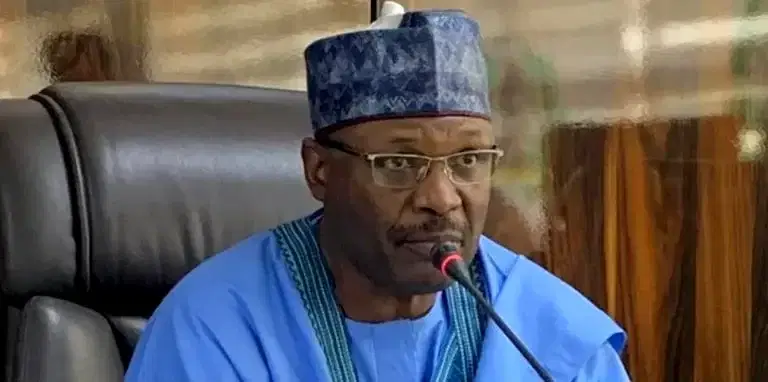
•INEC chairman, Prof Mahmood Yakubu
The growing concern in some quarters over the inability of Nigeria’s Independent National Electoral Commission, INEC, to conduct free, fair and credible elections again gained gravitas last week in the wake of Ghana’s successful presidential elections.
Without prejudice to the introduction of technology (card reader and co) by the Professor Attahiru Jega-led INEC which conducted the general elections of 2011 and 2015, and the outcomes of those elections, Nigerians have largely expressed disappointment at the elections conducted in 2019 and 2023, as evidenced by the barrage of pre- post-election litigations, reports Vanguard.

Apart from the 2015 presidential election which saw incumbent President, Goodluck Jonathan, conceding defeat, almost all presidential election results in Nigeria have suffered the embarrassing discounts of distrust and lack of integrity.
Last week in Ghana, even before the completion of final collation of results of its presidential election, incumbent Vice President and candidate of the ruling New Patriotic Party, NPP, Mahamudu Bawumia, called his opposition candidate, John Mahama, to concede defeat.
Madam Jean Mensa is the chairperson of Ghana’s Electoral Commission and she announced the results later.
Based on wide-range consultations and interviews, seven major issues have been codified as reasons BVAS may not work in Nigeria as it does in Ghana.
The critical difference between elections held in Ghana and Nigeria using BVAS:
Integrity of electoral managers
Ghana: The integrity of electoral officials in Ghana is a cornerstone of the country’s success with the Bimordal Voter Accreditation System, BVAS.
Transparent practices, accountability, and a genuine commitment to credible elections have ensured the smooth implementation of the system. The leadership prioritizes the credibility of elections over personal or political interests.
Nigeria: In Nigeria, the human factor has been a significant hindrance. Electoral managers have often been accused of bias, corruption, and complicity in sabotaging the BVAS process. These failings erode public trust and compromise the efficiency of the system.
Appointment of non-partisan officials
Ghana: Electoral officers in Ghana are appointed based on merit and neutrality, ensuring that those overseeing the electoral process are not influenced by political affiliations. This reduces the likelihood of human interference in technological operations like BVAS.
Nigeria: In contrast, Nigeria frequently appoints individuals with political affiliations or connections to influential politicians. Some are card-carrying members of political parties or relatives of political office holders. This blatant partisanship creates an environment where BVAS can be intentionally misused or sabotaged.
Retention of proven characters
Ghana: Ghana values continuity and institutional memory, retaining proven leaders who have been conducting credible elections and whose know-how are applied to future ones, fostering trust in electoral management.
A typical case in Ghana was Kwadwo Afari-Gyan, who was the first substantive chairman of the commission from 1993 and was retained up to 2015 because of his track record of honesty and integrity which has eventually transformed the Ghanaian electoral landscape.
At the 25th anniversary of the Institute for Economic Affairs, IEA, in Ghana, in 2014, Professor Jega said: “We in Nigeria have a lot that we owe to Dr. Afari Gyan. No doubt he was the longest-serving electoral commissioner on the continent of Africa and…He’s done a lot to restore stability in the electoral system in your country (Ghana).
“We (Nigerians) have learned a lot listening to him, understanding the challenges he faced, how he addressed them and how we could do better than he had done because it was very important for us to be able to do that.”
Nigeria: In Nigeria, electoral officials, with a reputation for integrity, are often removed or sidelined. Between 1993 and 2015, for instance, several chairpersons of the Independent National Electoral Commission, INEC, who resisted undue influence were replaced. Such as Humprey Nwosu, to other known Resident Electoral Commissioners, RECs, who were known names for integrity but were immediately sidelined because of their impeccable character.
This disrupts institutional growth and undermines public confidence in the system. There is the issue of tenure which can be dealt with. But institutional memory fostered by retention of officers with impeccable record is alien to the Nigerian system.
Accountability and penalties for compromising the system
Ghana: Electoral malpractice is met with severe consequences in Ghana. The fear of repercussions serves as a deterrent, ensuring that electoral officials prioritize fairness and transparency in their operations.
Special courts are sometimes set up to handle electoral offenses expeditiously, ensuring justice is not delayed.
Nigeria: Here, accountability is weak. Known compromises by election officials are rarely punished. Instead, individuals implicated in malpractices are sometimes protected or promoted, further emboldening unethical behaviour.
For example, relatives of political elites are frequently made Resident Electoral Commissioners, RECs, or national commissioners, undermining the neutrality required for credible elections.
Technical preparation and implementation
Ghana: Human competence plays a significant role in Ghana’s success with BVAS. Electoral staff are well-trained and equipped to handle the system, ensuring that technical preparation translates to smooth implementation on election day.
Nigeria: In Nigeria, the human factor is evident in the insufficient training of electoral staff. Many operators are unable to manage or troubleshoot BVAS effectively, especially in regions with higher illiteracy rates.
Additionally, allegations of deliberate sabotage during critical moments, such as server failures during the presidential election 2023, suggest human interference. The denial by INEC officials rang hollow because of the trust deficit that already exists.
Political will and stakeholder commitment
Ghana: Ghana’s electoral success reflects strong political will and commitment from stakeholders to do the right thing. Leaders and managers work in tandem to ensure that BVAS serves its intended purpose.
Nigeria: In Nigeria, the lack of political will is evident. Political actors often manipulate electoral officials to achieve favourable outcomes. For instance, server shutdowns during Nigeria’s elections have been linked to human interference, where BVAS feedback was allegedly spoofed or tampered with.
Contextual factors and human influence on training and capacity building:
Ghana: In Ghana, electoral staff undergo rigorous training, enabling them to address technical challenges. The commitment to learning and applying skills ensures that human errors are minimized.
Nigeria: In Nigeria, insufficient training and a lack of commitment to capacity building are common. Furthermore, regional disparities exacerbate this problem, with some areas receiving inadequate attention due to political biases.
Failure to abide by constitutional provisions
Chapter, 6, Part 1, Section 154 of the 1999 Constitution as amended talks about the appointment of chairman and members of commissions.
Sub-section (3) states that “in exercising his (presidential) powers to appoint a person as chairman or member of the Independent National Electoral Commission, INEC, National Judicial Council, the Federal Judicial Service Commission, the president shall consult the Council of State.”
During the tenure of President Jonathan, his appointment of Professor Jega and members of the Commission was done in consultation with the National Council of State, NCS, as recommended by the Constitution, and, therefore, not surprising that the 2015 presidential election which brought in Muhammadu Buhari was conducted by a crop of election management officers who had integrity.
Already, a number of RECs have been appointed by the current administration. During the investigation for this report, Vanguard did not come across any record of a meeting of the NCS where the consultation for the appointment of RECs was made.
Worse, the National Assembly, NASS, has cleared all the REC-nominees and they are already serving, despite proven evidence of clear, up-and-down partisanship of some appointees.
The success of BVAS in Ghana and its ‘challenges’ in Nigeria demonstrate that the human factor as evidenced by appointment of incompetent and partisan operatives, is the ultimate determinant of technological success in elections.
In Ghana, the integrity, neutrality, and competence of electoral managers that were appointed have ensured that BVAS operates as intended. Conversely, in Nigeria, human interference, ranging from partisan appointments to intentional sabotage, has undermined the system’s effectiveness
Lessons and recommendations:
For BVAS to function effectively, the following human-centred lessons and recommendations are critical:
Integrity in leadership:
Nigeria’s electoral body must be led by individuals of unquestionable integrity. Without honest leadership, technological advancements like BVAS will fail to inspire public confidence.
Non-partisan appointments:
The selection of electoral officials must prioritize neutrality and competence over political affiliations. This will reduce the risk of deliberate sabotage or misuse of technology.
Accountability mechanisms:
Strict penalties for electoral malpractice are essential to deter unethical behavior. Individuals who compromise the system must be made to face tangible consequences.
Comprehensive training:
Electoral staff should receive thorough training to manage BVAS effectively, and this training must be evenly distributed across all regions.
Strong political will:
Stakeholders must demonstrate genuine commitment to the success of BVAS by fostering transparency and addressing human-induced challenges proactively.
Vanishing tribe of Nigerian voters:
Apart from 2003 when 39 million Nigerians were said to have trooped out to vote, a figure representing 69.1%, the tribe of Nigerians who vote at every general election cycle have continued to dwindle. (See box).
In 1999, 29.8 million people were said to have voted (52.3%); in 2007, 35.4 million voted (57.5%); in 2011, 38.2 million voted (53.7%); 2015, 28.6 million voted (43.7%); in 2019, 27.3 million voted (34.8%); and in 2023, 24 million voted (26.7%).
So, why have the figures been shrinking? A combination of factors, ranging from voter apathy occasioned by a lack of trust in INEC and the continuing hardship voters face on the day of the election, logistical issues, election day violence which scares voters away and a growing frustration on the part of voters that their votes may not count, is responsible.
Why the problem may get worse in 2027 is that for all the promises and assurances given by incumbent INEC chairman, Professor Mahmood Yakubu, about the inviolability of BVAS and IReV, promises which galvanised millions of Nigerians to show interest in the election, some hopes were dashed once it was discovered that some results were not uploaded from the polling units.
For Nigeria to restore public trust in its electoral processes, significant reforms are needed to address the human factors.
Without integrity-driven leadership, non-partisan appointments, and accountability mechanisms, even the most advanced technologies will fail to deliver credible elections.
The 2027 elections will serve as a critical test for Nigeria’s commitment to these reforms, as public confidence in the system hangs in the balance.