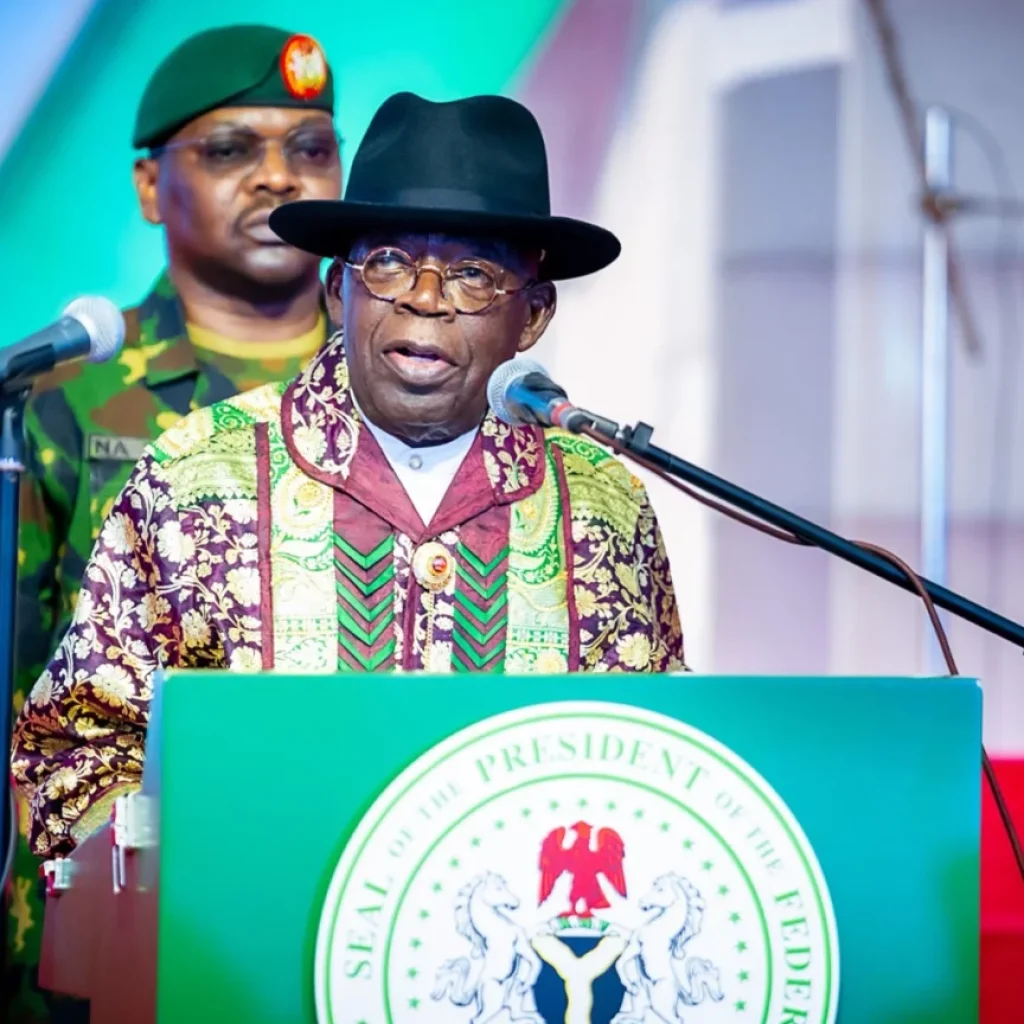
•Tinubu and ADC logo
Concerns over the state of the country’s democracy emerged yesterday as the African Democratic Congress (ADC) called for a frank assessment of the country’s democratic journey, while a nationwide survey revealed that a majority of Nigerians are dissatisfied with governance, citing insecurity, economic hardship and poor leadership.
The ADC called for a Nigeria where citizens live in safety and dignity, declaring that democracy should be measured by its impact on people’s lives rather than by the number of years since the end of military rule.

In an open letter to Nigerians to mark Democracy Day, the opposition party paid tribute to those who sacrificed and struggled for the democratic freedoms the country enjoys today.
The ADC described June 12 as one of the most significant dates in Nigeria’s history, saying it serves as a reminder that Nigerians have always believed their voices matter.
The party, however, argued that Democracy Day should go beyond commemorating past struggles and should also provide an opportunity for a frank assessment of the country’s current realities.
“Our Democracy Day must be more than a celebration of the past. It must also be an honest reckoning with the present.
“This is because democracy is not measured by the number of years since military rule ended. It must be measured by the meaning it has brought to citizenship and the freedoms it has brought to citizens – freedom from fear, freedom from poverty, freedom to participate and freedom to choose.
“It is about whether citizens are safer; whether families live better; whether young people get opportunities; whether institutions command public trust; and whether government remains accountable to the people from whom it derives its authority.”
The party said that 27 years after the return to democratic rule and three years into the administration of President Bola Ahmed Tinubu and the All Progressives Congress (APC), many Nigerians remain dissatisfied with the state of the nation.
“Is your life better today than in the past? Do you feel safer today than you felt in the past? Do you trust the government more than before? The answer to these questions is no doubt painfully clear: a resounding no,” the party asked citizens.
In the letter signed by the party’s National Publicity Secretary, Mallam Bolaji Abdullahi, the ADC said insecurity continues to affect large parts of the country, casting a shadow over the daily lives of many Nigerians.
The party maintained that democratic governance must translate into tangible improvements in citizens’ welfare, security and opportunities, stressing that the true test of democracy lies in its ability to improve the quality of life of the people.
72% of Nigerians dissatisfied with democracy, poll reveals
ALSO, a new public opinion survey conducted by NOIPolls has revealed widespread dissatisfaction with democratic governance in Nigeria, with 72 per cent of respondents expressing discontent with the country’s democratic system.
According to the survey, 46 per cent of Nigerians said they were “not satisfied at all” with democracy, while 26 per cent said they were “not satisfied”. In contrast, only 21 per cent expressed satisfaction, comprising nine per cent who were “very satisfied” and 12 per cent who were “satisfied”.
The poll showed that dissatisfaction was most pronounced in the South-East and South-South geopolitical zones, where 58 per cent and 56 per cent of respondents respectively expressed discontent. The North-East recorded the lowest level of dissatisfaction at 33 per cent.
NOIPolls said the findings suggest that citizens’ perceptions of democracy are influenced by local experiences relating to governance, security and service delivery.
The survey identified increased insecurity as the leading reason for dissatisfaction among respondents, cited by 31 per cent. This was followed by poor dividends of democracy at 20 per cent, economic hardship at 19 per cent and poor governance at 17 per cent.
Among respondents who expressed satisfaction with democracy, freedom of expression emerged as the most significant factor, cited by 26 per cent. Other reasons included preference for democracy over military rule at 13 per cent, improved security at 11 per cent and good governance at 11 per cent.
The poll also highlighted the major obstacles to democratic progress in the country. Insecurity and poor governance or leadership were jointly identified as the most critical challenges, each cited by 25 per cent of respondents. The poor state of the economy accounted for 11 per cent, while corruption was cited by nine per cent.
According to the survey, the findings indicate that many Nigerians believe democracy has fallen short of delivering security, economic well-being and accountable leadership.
The poll further assessed public perceptions of government performance across key sectors, with security receiving the poorest rating. Seventy-two per cent of respondents rated performance in the security sector as “very poor”.
Electricity followed with a 57 per cent “very poor” rating, while foreign policy and the economy recorded 49 per cent and 48 per cent respectively.
Education recorded the highest positive assessment, with 22 per cent of respondents rating government performance in the sector as “good”. Infrastructure and science and technology followed with 21 per cent each.
The survey noted that while Nigerians acknowledge some progress in education and infrastructure, dissatisfaction remains high in areas directly affecting personal safety and livelihoods, contributing to declining confidence in democratic governance.
Nigeria remains import-dependent despite democratic reforms, says CPPE chief
In a related development, Chief Executive Officer (CEO) of the Centre for the Promotion of Private Enterprise (CPPE), Dr Muda Yusuf, urged the Federal Government to move Nigeria beyond an economy driven largely by consumption and import dependence towards one anchored on production, value addition and industrial competitiveness, noting that industrialisation cannot flourish in an environment of structural inefficiencies and policy uncertainty.
He regretted that, 27 years after the return to democratic governance, Nigeria’s manufacturing sector remains largely trapped in a low-growth equilibrium, with the sector’s contribution to GDP hovering around 9–10 per cent for most of the period, underscoring the absence of a decisive industrial transformation despite successive policy pronouncements and reform initiatives.
“Industrialisation is the engine room of economic transformation. It creates quality jobs, deepens value addition, strengthens export competitiveness and reduces vulnerability to external shocks. Yet, Nigeria’s democratic journey has delivered only modest industrial outcomes, leaving the economy heavily dependent on primary commodities and imports,” he said.
Lamenting the progressive erosion of industrial capacity across several sectors, he said the collapse of the nation’s public refineries remains perhaps the most striking example of institutional dysfunction and the loss of a critical pillar of industrialisation.
“The story is similar across several manufacturing subsectors. Textile mills that once employed hundreds of thousands of Nigerians have disappeared. The tyre industry collapsed. Battery manufacturing faded. Automobile assembly plants lost momentum. Many industrial clusters that once drove economic activity have either contracted significantly or vanished altogether. The consequence has been a gradual weakening of Nigeria’s industrial base and a growing dependence on imports for products that were once manufactured domestically,” he said.
Amid these challenges, however, he noted that a few sectors have demonstrated remarkable resilience, including the cement, food and beverage sectors, which have managed to survive despite an increasingly difficult operating environment.