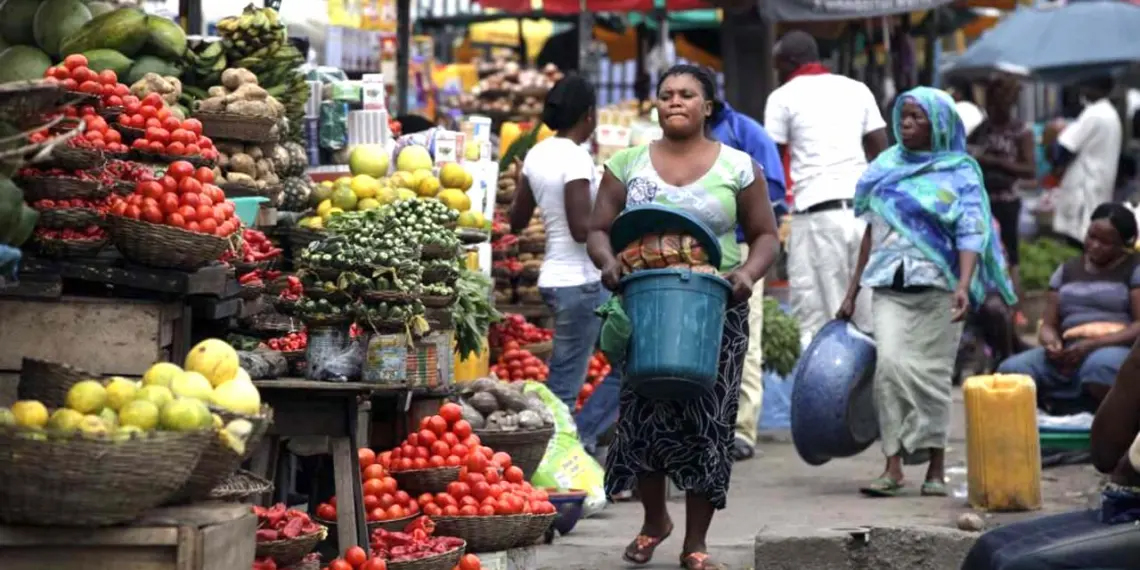
•Food market in Nigeria
Three years after Nigeria embarked on major economic reforms that included the removal of petrol subsidy and the liberalisation of the foreign exchange market, consumers say they are still grappling with one stubborn reality: their money no longer buys what it used to.
While the National Bureau of Statistics (NBS) reported that headline inflation eased marginally to 15.91 per cent in June 2026 from 15.93 per cent in May, households say the figures provided little comfort. Food inflation, the indicator that most directly affects everyday living, rose to 17.52 per cent from 16.96 per cent, a rise consumers say underscores the continuing pressure on family budgets.

Across markets in Lagos, Abuja, Kano, Port Harcourt and other commercial centres, shoppers and traders say consumers are adjusting not because they want to, but because they have little choice, reports Daily Independent.
The result, according to them, is a dramatic shift in spending habits, consumption patterns and lifestyles.
Shoppers say monthly shopping has become a luxury for many families. Instead, they said, daily purchases have become the norm as households buy only what they can afford.
According to consumers, items such as tomatoes, yam, garri, beef and cooking ingredients now consume a larger share of disposable income than they did three years ago.
Consumers who once bought bags of rice, cartons of noodles and gallons of vegetable oil said they now settle for smaller quantities, often purchasing food in portions sufficient for just a day’s meals.
Retailers said they have responded by breaking products into smaller units to match consumers’ shrinking purchasing power.
According to traders, the “buy-small” culture, from cooking oil sold in tiny bottles to cereals and detergents packaged in sachets, has become firmly entrenched in Nigeria’s consumer market.
More Money, Less Value
Workers and economists describe the contradiction facing many Nigerians as striking. Salaries may have increased in nominal terms for some workers, but the value of those earnings has declined significantly, they said.
According to various economic literature, household expenditure has risen substantially in naira terms over recent years.
However, when adjusted for inflation, the actual volume of goods and services households consume has declined sharply, illustrating how inflation continues to erode purchasing power.
This, economists say, explains why many Nigerians earn and spend more money today, yet return home with fewer groceries.
Changing Diets and Consumer Choices
Perhaps nowhere is inflation’s impact more evident than on the dining table, consumers said.
Many middle and low-income households said premium protein sources like beef, chicken and fish have gradually become occasional purchases rather than regular staples. Families increasingly substitute these with beans, eggs, local fish and other relatively affordable alternatives, they added.
Shoppers also said fresh fruits and vegetables are being rationed more carefully as prices fluctuate due to transportation costs, seasonal shortages and supply chain disruptions.
Food now accounts for more than half of Nigeria’s Consumer Price Index (CPI), according to the NBS, leaving households with less money for healthcare, education, transportation, clothing and housing.
Logistics Keep Prices Elevated
Industry stakeholders argue that high transportation costs remain one of the biggest drivers of persistent food inflation.
Although agricultural production has improved in some parts of the country, moving produce from farms to urban markets remains expensive due to fuel costs, poor road infrastructure and security challenges along transport corridors, stakeholders said.
Speaking on the issue previously, Kabir Ibrahim, President of the Nigeria Agribusiness Group (NABG), noted that while government interventions have offered some relief to farmers, high production and logistics costs continue to keep food prices elevated.
The consequence, traders said, is that consumers in major cities continue to experience volatile prices, even during harvest seasons.
Experts Urge Structural Reforms
Economic analysts believe inflation can only moderate sustainably if structural bottlenecks are addressed.
Muda Yusuf, Chief Executive Officer of the Centre for the Promotion of Private Enterprise (CPPE), has repeatedly argued that inflation in Nigeria is driven largely by supply-side constraints rather than excessive consumer demand. According to him, improving security, lowering logistics costs, stabilising exchange rates and boosting local production remain essential to easing pressure on consumers.
Similarly, analysts say expanding transport infrastructure, supporting agriculture and improving energy supply would help reduce production costs across the economy.
Living With Inflation
Three years of sustained inflation have reshaped the Nigerian consumer, according to shoppers and business owners interviewed.
Shopping lists are shorter, consumers said. Bulk purchases have become rare. Luxury items have quietly disappeared from many household budgets, they added, while spending decisions are increasingly driven by necessity rather than preference.
Businesses, too, said they have had to adapt by introducing smaller product sizes and more flexible pricing strategies to retain customers whose purchasing power continues to weaken.
Although headline inflation appears to be moderating gradually, consumers said their experience tells a different story.
Analysts warn that as long as food prices continue to outpace income growth, consumers will remain trapped in a cycle of buying less while paying more.
For millions of households, inflation is no longer just an economic statistic released every month, consumers said. It is the daily reality of standing in front of market stalls, calculating what can be left behind so that the family can still afford dinner.
That, more than any percentage, is the true story of Nigerian consumers after three years of inflation.