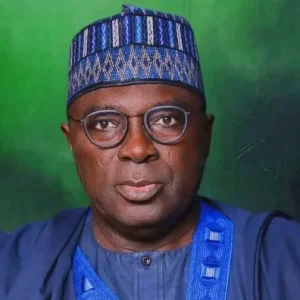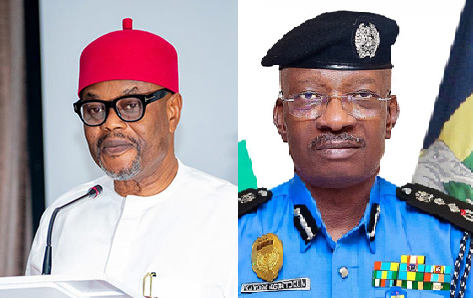
•Ex-Minister Uche and IGP Kayode Egbetokun
In recent months, Nigeria has witnessed yet another episode of moral implosion in public service.
The resignation of Uche Geoffrey Nnaji, the former Minister of Innovation, Science and Technology, over certificate forgery has once again thrown a harsh spotlight on a cancerous culture eating deep into the nation’s political fabric the reckless falsification of academic and professional credentials by people entrusted with leadership.
Nnaji’s scandal, which followed a painstaking two-year investigation, has stirred both outrage and reluctant admiration, reports Saturday Independent.
Outrage because a sitting minister, someone who once swore to uphold integrity and excellence was found to have presented fake credentials to the Presidency and the Nigerian Senate.
This brought about a reluctant admiration because, in a rare show of conscience, Nnaji did what many in his position never dared; he resigned.
While the shame of his act cannot be washed away by a simple letter of resignation, it marked an unusual moment of accountability in a country where impunity has long been normalised.
Human rights lawyer Dele Farotimi captured this irony succinctly when he wrote on X, “I don’t know him, and I no send am. BUT this guy is more honorable than every other person in the cabinet from which he has ‘honorably’ resigned.”
The investigation revealed that Nnaji forged the degree and National Youth Service Corps (NYSC) discharge certificates he submitted during his ministerial screening in 2023.
The documents, according to the report, were not issued by the University of Nigeria, Nsukka (UNN), nor by the NYSC. The forgery was described as deliberate, sustained, and intended to deceive the highest authorities of the Nigerian state.
Barely three days after the publication, Nnaji tendered his resignation, a move swiftly accepted by President Bola Tinubu.
His decision came amid public uproar and renewed calls for a moral cleansing of Nigeria’s political class.
Yet, Nnaji’s exit is not an isolated incident. His case merely joins a long list of scandals that have plagued the corridors of power from governors to lawmakers, ministers to heads of agencies where forged certificates have been used as keys to the treasury of political privilege.
In 2019, former Minister of Finance, Kemi Adeosun, resigned after it was exposed that her NYSC exemption certificate was fake.
Before her, Salisu Buhari, the first Speaker of Nigeria’s Fourth Republic House of Representatives, was forced to step down in 1999 after admitting he forged a University of Toronto degree certificate.
And more recently, controversies over questionable academic claims have dogged even those at the highest rungs of leadership, turning public office into a stage for deception rather than service.
Under Nigerian law, forgery is not a light offence. It is clearly criminalised under both the Criminal Code Act (applicable in the South) and the Penal Code (applicable in the North). Section 465 of the Criminal Code Act defines forgery as making a false document “with intent that it may in any way be used or acted upon as genuine.” Section 467 goes further to prescribe a punishment of up to three years imprisonment upon conviction.
However, when forgery involves a public seal, such as those of a university, NYSC, or government agency; the law treats it as a “special case.”
According to Section 467(1)(a) and (b) of the same Act, offenders are liable to life imprisonment if found guilty of forging any official seal or document bearing the authority of the state.
The Penal Code, which covers Northern Nigeria, prescribes up to 14 years imprisonment for forgery.
The Miscellaneous Offences Act goes even further, stating in Section 1(2)(c) that anyone who “utters or makes any forged document” for use as genuine is liable on conviction to 21 years imprisonment without the option of a fine.
Legal practitioners have maintained that the weight of these provisions reflects the gravity with which the law views forgery — not just as an act of dishonesty, but as a direct assault on public trust and the integrity of governance.
The tragedy, however, lies not in the existence of the laws, but in the selective enforcement of them. While ordinary citizens have been jailed for forging simple academic transcripts, politicians and high-ranking officials often escape justice through technicalities, political cover, or institutional compromise.
Dele Farotimi’s description of Nnaji as “more honourable than every other person in the cabinet” was not praise for deceit, but a stinging indictment of a government and indeed a society where resignation in the face of guilt has become so rare it now appears heroic. In truth, Nnaji’s resignation should be the beginning of a criminal process, not its end.
Lawyer Bulus Atsen echoed this view, stressing that the former minister’s action constituted “proven forgery.” He noted that the certificates “were fraudulently, dishonestly and presented to the highest legislative body in Nigeria, which acted on them believing they were genuine.”
He called for the police and security agencies to thoroughly investigate and, where necessary, prosecute.
But beyond the courts lies a deeper rot, one of systemic moral decay. In Nigeria, education has become less about knowledge and more about political symbolism. Degrees and certificates are no longer markers of competence; they are props for legitimacy in a country where leadership has been severed from merit.
Every time a public official is caught with fake credentials, the damage extends beyond personal disgrace. It corrodes public confidence, undermines institutions, and sends a dangerous message to the youth that corruption pays, that deceit can be rewarded, and that the surest path to power is through manipulation rather than merit.
For a nation already struggling with unemployment, brain drain, and decaying educational standards, this culture of credential forgery is particularly toxic. It delegitimises the struggles of hardworking students who burn midnight oil to earn authentic degrees, while elevating impostors who fabricate success.
The impact on the international stage is equally damning. Each forgery scandal diminishes Nigeria’s reputation before the world, casting doubt on the authenticity of its academic institutions and the credibility of its leaders. It explains, in part, why foreign employers and universities increasingly subject Nigerian certificates to rigorous scrutiny, a humiliation that honest citizens must now endure because of the sins of their leaders.
The epidemic of forgery in high office is, at its root, a crisis of character. It is a symptom of a broader societal erosion where the appearance of success has become more valuable than the substance of it.
Political parties often prioritise popularity and loyalty over integrity and qualification. Appointments are made to satisfy ethnic or political quotas, not competence. In such a climate, forgery thrives because honesty has little reward.
The irony is that many of the politicians, once exposed, are neither prosecuted nor permanently disgraced. They resurface in another administration, appointed to a new office, or rewarded with political protection. This cycle of impunity not only emboldens others but normalises criminal conduct within government.
To break this cycle, experts say, Nigeria must strengthen its vetting and screening processes. Background checks must go beyond paper credentials to include verification directly from issuing institutions. The Senate, security agencies, and the Office of the Secretary to the Government of the Federation must coordinate to ensure that no nominee assumes office under false pretence.
But even more importantly, there must be consequences. The law must not distinguish between the rich and the poor, the connected and the forgotten. If a sitting minister can forge a document and walk away with a resignation letter, then the law is reduced to a joke. The rule of law must bite — not just bark.
As Nnaji’s name fades into the footnotes of Nigeria’s long list of disgraced public officials, the question remains: what legacy are we leaving for the next generation? What moral compass will guide the young when their leaders forge their way to power and still claim to serve in the name of the people?
Dele Farotimi’s sarcastic applause for Nnaji reflects the tragic state of a nation where ethical conduct is so rare that even a resignation born of guilt looks like integrity. Nigeria’s crisis is no longer just economic or political — it is profoundly moral.
Until truth becomes the minimum qualification for leadership, Nigeria will continue to be governed by the forged and the fraudulent and each scandal will only remind us how far we have fallen from the ideals we once professed.