•Dangote
By IRVING ZULU
Nigeria woke up once again to the unsettling drama of the Dangote Refinery. First, the company abruptly suspended the sale of petrol in naira, citing “unsustainable volumes” that supposedly exceeded its crude allocation. So, he wanted to sell his fuel in American dollars! to Nigerians, in Nigeria. Very strange. Thank God, some patriotic Nigerians made them see the flip side of their decision.
Then, in another jarring move, it announced the sack of 800 Nigerian workers, citing a vague charge of “sabotage” that is yet to be substantiated.
But these are not mere corporate decisions. They are in stark terms, the caprices of a monopoly in motion.
When a single player is allowed unchecked dominance in a critical sector such as energy, the entire nation becomes hostage to its whims. Today, it is suspending sales in local currency, undermining the fragile confidence in the naira. Tomorrow, it is mass layoffs with unclear justification, throwing hundreds of families into economic distress.
But the deeper issue is what this signals for Nigeria’s economic security and sovereignty.
The Petroleum Industry Act (PIA) and anti-monopoly edicts were created precisely to prevent such a chokehold on the nation’s lifeblood — our oil. By controlling production, distribution, pricing, and even labour, Dangote is steadily centralizing power in such ominous ways that sideline competition, weaken institutions like NUPENG, and place workers, marketers, and citizens at the mercy of a private empire. This, in plain lingo, is danger.
The Dangote refinery was hailed as a symbol of national pride and Dangote seen as the long-awaited oil and gas messiah. But its operations are fast turning into a looming national liability. A single company cannot be allowed to dictate terms on fuel, currency, jobs, and distribution without consequence. If the government does not act decisively, the cost will be mortally felt not just in higher pump prices but in weakened institutions, shrinking jobs, and the erosion of national economic independence.
Yet there is a disturbing silence in the land. A silence that grows louder by the day. While applause echoes for Aliko Dangote’s latest move to flood our highways with fuel tankers, few dare to ask the necessary, burning questions. This is because beneath the noise of celebration lies a dangerous drif; one that imperils our national security, undermines competition, and edges Nigeria closer to the jaws of monopoly.
The Petroleum Industry Act (PIA), a landmark reform painstakingly crafted to liberalise our downstream oil sector, was built on the foundation of competition, transparency, and market freedom. It was designed to dismantle cartels, end monopolistic practices, and give every marketer, big or small, the right to buy and distribute fuel without discrimination. But today, with Dangote’s refinery and his expanding fleet of distribution tankers, we are witnessing a creeping breach of this law and an ominous concentration of power in the hands of one man and one company.
Even Nigeria’s Federal Competition & Consumer Protection Commission , FCCPC, has raised red flags. In its filing before the courts, it warned that “a favourable judgment for Dangote Refinery could result in excessive concentration of import rights, contravening Nigeria’s competition legislation and restricting market access for other players.” That statement alone captures the essence of the threat. It translates to a single refinery dictating who gets fuel, when, and on what terms, while other players are locked out of the marketplace. This is colonization of energy business by one organisation. The end result will inevitably be exploitative and self serving.
It must be stressed that what is at stake is not just economics. It is sovereignty. No nation with its eyes open surrenders such a strategic sector, the lifeblood of its economy, to a single business empire. History is replete with examples of how monopolies strangle competition, weaken institutions, and ultimately hold governments and citizens hostage. Nigeria cannot afford this path.
The alarm is not coming only from regulators. The associations that live daily in the market are crying out. Billy Gillis-Harry, President of the Petroleum Products Retail Outlets Owners Association of Nigeria, PETROAN, warned bluntly: “We’re not against Dangote’s success. But no single company should control refining, supply, distribution and retail all at once. It’s a monopoly in the making, and it puts thousands of independent operators at risk.”
Likewise, the Independent Petroleum Marketers Association of Nigeria, IPMAN , cautioned that “this level of vertical integration … by a single company will cripple competition.”
Senator Shehu Sani, a deeply respected towering figure in the field of human rights while appreciating Dangote and his refinery feat still stressed that every working Nigerian “has a right to belong to a union”. He can reach an agreement with the union. He has other companies with staff that belong to a union. He needs to understand that workers must belong to a union.
Even more troubling is the chorus of unlikely supporters, highly dignified Nigerians, professors, and technocrats coming on television and social media to speak stridently in favour of one man’s empire. This indeed should trouble every patriotic Nigerian. Because it signals a coordinated attempt not just to dominate the supply chain but also to capture and subdue the workforce that sustains it.
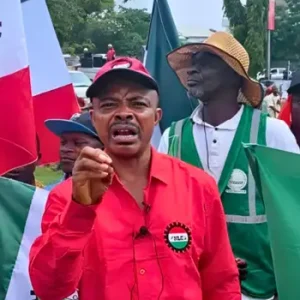
This is why NUPENG has been categorical. Its National Secretary, Olawale Afolabi, lamented: “Tanker drivers travel night and day to serve, and suddenly they are being discarded … We’ve been asking him to even unionize, to allow us to unionize those refinery workers. They’ve been resisting us.”
When a corporate behemoth not only seeks to monopolise markets but also resists constitutional guarantees of workers’ rights, the danger is twice compounded.
And the warning bells are not just rhetorical, they are also judicial.
In a recent legal flashpoint, a Federal High Court in Abuja dismissed the objections of the state-owned NNPCL Ltd to a lawsuit filed by Dangote Oil Refinery. At stake was the right to import and allocate fuel in Nigeria. By pressing its case in court, Dangote signaled an unambiguous ambition to tilt the legal and regulatory landscape in its favour, no matter the national consequences. That courtroom drama laid bare the scale of the battle ahead, between a private conglomerate’s quest for dominance and the Nigerian state’s obligation to uphold the spirit of the PIA.
We must not be blind. A monopoly in oil distribution is both an economic risk and a national security threat.
The power to decide who gets fuel, at what price, and in what quantity is the power to choke industries, cripple transport, and bring a nation to its knees.
Civil society voices such as the Workers’ Rights Campaign,WRC, have already warned : “Instead of lowering costs for Nigerians, the Dangote monopoly exploits scarcity and control of distribution to raise prices, thereby deepening poverty and hardship.”
Do we want to hand such power to a private conglomerate ?
This has become a negative culture and character of the Dangote industries and examples abound.
Dangote has built a reputation for muscling his way into industries and ruthlessly edging out competitors. In the sugar sector, he bulldozed every other producer until he stood as the lone dominant player. He repeated the same pattern in cement, crushing every company in sight — including Ibeto Cement, which had invested billions of naira in the business, leaving only BUA Group, the one competitor that refused to be subdued. The CEO of BUA, Abdulsamad Rabiu, has publicly recounted the outrageous, oppressive, and devastating tactics Dangote deployed in his desperate bid to force them out of the market.
This aggressive playbook extended to the noodles business, where Dangote, in his characteristic style, attempted to dominate through intimidation and market manipulation. But unlike in sugar and cement, he failed spectacularly with his Dangote Noodles and ultimately selling off the struggling venture to Dufil Prima Foods, a stronger competitor he had once tried to bully .
History shows what happens when nations fail to check such dominance. In Mexico, Pemex once held a state-backed oil monopoly that crushed private players and left the country with inefficiency, corruption, and crippling fuel shortages for decades.
In Russia, oil oligarchs captured the energy market, concentrating wealth and power in ways that eventually destabilised both the economy and politics of the country.
Even in the United States, it took the government’s antitrust war against John Davison Rockefeller Snr’s Standard Oil to break up a monopoly that had swallowed up 90% of the American oil market.
Each case proves a simple lesson, and it is that unchecked oil monopolies become political monsters. They weaken nations, not strengthen them.
Nigeria must not repeat these mistakes.
Government must act and act decisively. The principles of the PIA must be defended, not betrayed. Regulators must ensure open access, fair competition, and a level playing field for all marketers. Distribution channels must remain free from capture, for it is competition, not monopoly, that guarantees efficiency, innovation, and fair pricing.
Let us be clear. This is not an attack on Dangote’s success, or a dismissal of his refinery’s potential contribution to our energy security. But when ambition crosses into domination, when national law is bent to suit private interest, and when applause drowns out caution, then patriots must speak.
The choice before us is stark. Either Nigeria remains a nation of free enterprise, guided by law and equity or it becomes hostage to a private oil empire that answers to no one.
The government must choose wisely. The people must not be silent. For silence, in this moment, is consent. And consent to monopoly is consent to economic ruin.
*Irving Zulu , a journalist, writes in from Abuja.