•JOHESU on protest
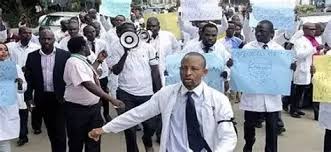
The Joint Health Sector Unions (JOHESU) has issued a strongly worded warning to the National Assembly, urging lawmakers to halt proposed amendments to key health sector laws.
JOHESU contended that the proposed law, if enacted, would create what it described as an “apartheid-like” regulatory structure, placing medical practitioners in a position of dominance over other health professions in Nigeria’s healthcare system.

In a statement jointly signed by its National Chairman, Kabiru Ado Minjibir, and General Secretary, Martin Egbanubi, JOHESU accused medical practitioners of attempting to monopolise regulatory oversight across multiple health professions. The union argued that such amendments would undermine the multidisciplinary nature of healthcare, which relies on collaboration among diverse professional groups, each with legally defined areas of competence.
“It has become imperative to alert Nigerians and the National Assembly in particular about the inordinate ambition of medical practitioners in Nigeria to impose an inglorious apartheid regime of regulatory control and practice in the Nigerian health sector,” the statement declared.
Defence Of Multidisciplinary Healthcare
JOHESU emphasised that the healthcare sector is inherently multi-professional and multi-disciplinary, thriving on interdependence and collaborative teamwork. The union stressed that each profession has its own body of knowledge, skill set, and regulatory framework, designed to protect patients and ensure ethical practice.
“The healthcare sector relies and thrives on the interdependence and collaborative teamwork of all professions for the greatest benefit of society and patients,” JOHESU stated.
“Each profession has its regulatory and practice framework prescribed by laws and statutory instruments to ensure protection of society and adherence to standards.”
Allegations Of Resistance To Oversight
The union alleged that doctors had repeatedly resisted inspections by statutory agencies such as the Pharmacy Council of Nigeria (PCN), the Medical Laboratory Science Council of Nigeria (MLSCN), and the Radiographers Registration Board of Nigeria (RRBN). According to JOHESU, these disputes often escalated into litigation, where courts consistently upheld the authority of the respective councils to regulate their professions.
JOHESU cited several legal precedents, including a 2007 Federal High Court ruling in Lagos which affirmed the powers of the PCN to regulate pharmacy practice in both public and private sectors. “Physicians had resisted inspectorate teams of the PCN, MLSCN, and RRBN, stopping them from performing their legitimate functions,” JOHESU stated.
“The courts have always validated the right and authority of other healthcare professions to regulate their practice in the best interest of society and patients.”
The union also recalled a 2018 suit filed by the Medical and Dental Consultants Association of Nigeria (MDCAN), which sought judicial declaration that the Medical and Dental Council of Nigeria should regulate clinical laboratory practice and allied professions.
The Federal High Court struck out the case for lack of evidence, a decision JOHESU said underscored the independence of non-medical professional bodies.
Executive Push For Amendments
JOHESU alleged that some government officials were now pursuing similar objectives through executive amendment bills. It claimed that Cabinet Ministers and advisers within the Federal Ministry of Health & Social Welfare and other ministries in President Bola Tinubu’s administration were attempting to insert clauses into the Medical and Dental Council law that would override the statutory powers of other regulatory bodies.
“They have regrouped through their colleagues in government to unilaterally propose executive amendment bills for all health professions,” JOHESU warned.
“These bills seek to centralise regulatory authority under medical practitioners, undermining the autonomy of other professional councils.”
Pharmacy Regulation Under Threat
On pharmacy regulation, JOHESU argued that the governing board of the Pharmacy Council must reflect professional expertise rather than “community interest” representation.
The union emphasised that the council regulates education, training, licensing, inspection, and discipline across the pharmaceutical value chain. Weakening its autonomy, JOHESU warned, could undermine drug safety and public health.
The union pointed to longstanding legislation governing pharmacy practice dating back to the early 20th century, stressing that professional independence in pharmacy is essential to safeguarding patients and ensuring ethical standards.
Laboratory Practice And Judicial Precedents
Addressing laboratory practice, JOHESU referenced a 2016 judgment of the National Industrial Court involving the Obafemi Awolowo University Teaching Hospitals Complex and the Association of Medical Laboratory Scientists of Nigeria. The court held that medical laboratory science is an independent profession whose practitioners cannot be subordinated to another discipline in areas of competence.
JOHESU argued that attempts to subordinate laboratory scientists to medical practitioners would not only contravene judicial rulings but also destabilise the healthcare system. “Medical doctors are seeking to redefine and subjugate the profession of medical laboratory science in Nigeria, to suit their parochial fancy,” the union declared.
“It would be resisted as apartheid was resisted in South Africa.”
Reject Proposed Medical And Dental Practitioners Bill 2026
JOHESU strongly criticised provisions in the proposed Medical and Dental Practitioners Bill 2026, particularly Section 42 subsections 3 and 4 of HB 2695. The union argued that the bill, which seeks to repeal the Medical and Dental Practitioner Acts, Cap M8 LFN 2004, and enact a new law, failed to define what constitutes a prescription in Nigeria.
The union warned that the bill undermines the Community Health Practitioners Act by expressly forbidding Community Health Extension Workers (CHEWs), trained by government to prescribe in Primary Healthcare facilities, from performing their duties.
JOHESU further noted that the bill obstructs emerging global practices where pharmacists and other trained professionals are authorised to prescribe certain medicines to reduce waiting times in healthcare systems.
“In more specific terms, this section becomes a stumbling block to global trends of pharmacists and other cadres of health professionals lawfully charged to prescribe certain categories of drugs,” JOHESU stated.
“This continues to expand for efficiency, particularly with regards to reducing waiting time in health systems worldwide.”
Call For Legislative Rejection
JOHESU argued that the National Assembly should not legislate on issues already before the courts. It noted that litigation related to earlier disputes remains on appeal, making legislative action premature and potentially contrary to parliamentary rules.
The union referenced the case instituted by MDCAN (FHC/ABJ/ CS/559/2018), which was dismissed but is presently subject to litigation at the Court of Appeal in Abuja.
“It would be in contravention of the rule of the National Assembly to legislate on a matter before a court of competent jurisdiction,” JOHESU warned.
“Medical and dental practitioners are seeking to deceive the Federal Executive Council and the National Assembly to amend these laws to secure what they could not prove in court.”
JOHESU urged the National Assembly to reject any amendment that would centralise regulatory authority under one profession. The union insisted that such a move would spell doom for the health sector, destabilising the delicate balance of multidisciplinary collaboration.
“The attempt to foist an apartheid regime in the Nigerian health sector by imposing medical and dental practitioners over the regulatory control of other healthcare professions will spell doom. The National Assembly is called upon to reject the bills in the greater interest of peace and stability in the Nigerian health sector,” the statement read.
Broader Implications For Healthcare
The union’s warning highlights broader concerns about governance in Nigeria’s healthcare system. At stake is not only the autonomy of professional regulatory bodies but also the integrity of patient care. By attempting to centralise authority under medical practitioners, JOHESU argues, the proposed amendments risk undermining the collaborative framework that ensures effective healthcare delivery.
The healthcare system, JOHESU stressed, is inherently multidisciplinary. From pharmacists ensuring drug safety, to laboratory scientists providing diagnostic accuracy, to radiographers delivering imaging expertise, each profession contributes uniquely to patient outcomes. Subordinating these professions, the union warned, would erode trust, compromise standards, and destabilise the sector.
JOHESU’s strongly worded intervention underscores the intensity of professional rivalries within Nigeria’s healthcare system. By invoking judicial precedents, historical legislation, and global practices, the union has sought to frame the proposed amendments as both legally unsound and socially dangerous. Its warning of an “apartheid-like” regime reflects the depth of opposition to any attempt to centralise regulatory authority under medical practitioners.
For JOHESU, the matter is not just about professional autonomy but about safeguarding the integrity of Nigeria’s healthcare system. The union strongly called the National Assembly to reject the amendments, preserve multidisciplinary collaboration, and protect the future of healthcare in Nigeria.