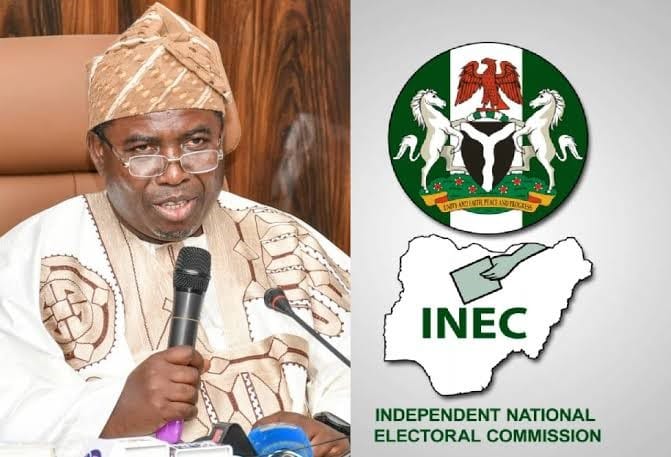
•INEC chairman, Prof Joash Ojo Amupitan (SAN)
The Independent National Electoral Commission (INEC) has appealed the Federal High Court judgment which nullified its revised timetable and schedule of activities for the conduct of the 2027 general elections.
INEC, in a notice of appeal dated and filed on May 25 through its lawyer, Alex Izinyon, SAN, filed a motion for stay of execution of the judgement, pending the hearing and determination of its appeal at the Court of Appeal, reports NAN.
The electoral umpire, which gave nine grounds for its appeal, argued that the trial judge, Justice Mohammed Umar, erred in law when he failed to pronounce on the jurisdictional issue of the suit being hypothetic and academic which failure occasioned denial of fair hearing to the Commission.
It argued that the trial judge’s interpretation of Section 29(1), 82 and 84 of the Electoral Act, 2026 did not permit the restricted narrow interpretation accorded by the court.
INEC further argued that the trial court misdirected itself in law when it failed to apply the provision of Section 151 of the Electoral Act, 2026 to the appellant’s case, among other grounds.
INEC, the appellant, had named Youth Party (YP) as respondent in appeal.
The Commission sought two orders, including an order allowing its appeal and setting aside the judgement delivered by Justice Umar on May 20 in suit marked: FHC/ABJ/CS/517/2026 between Youth Party and INEC.
It also sought an order striking out the suit as the respondent (YP) lacked the locus standi to institute and maintain same and that the suit is academic.
In a related development, INEC, in a motion on notice also filed on May 25 at the FHC, sought an order staying the execution and/or further execution of the judgement pending the hearing and determination of the appeal filed by it.
Justice Umar of FHC in Abuja had, on May 20, voided the 2027 election timetable issued by INEC.
The judge, in a judgment delivered on a suit brought by YP, held that INEC’s action imposed restrictive timeframes on political parties for the conduct of primaries and other pre-election activities contrary to the provisions of the Electoral Act, 2026.
He held that INEC lacked the statutory power to fix or prescribe the timeframe within which political parties must conduct their primaries for the nomination of candidates for the 2027 general elections.