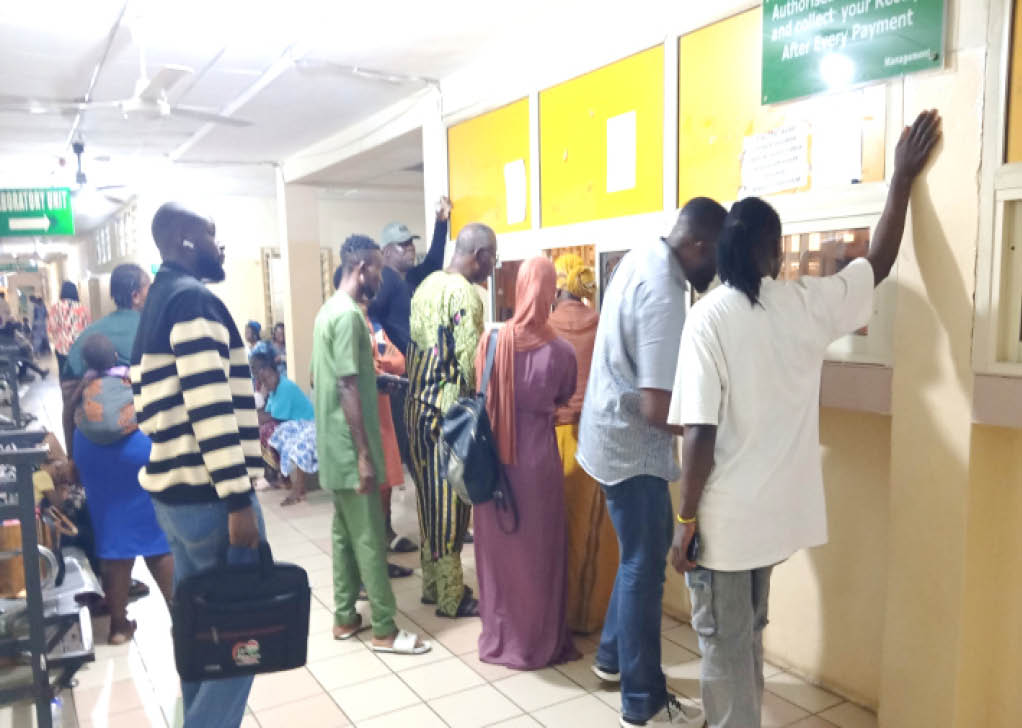
•People waiting to purchase drugs at the Wuse District Hospital in Abuja
Patients across Nigeria are waiting long hours or even days before they can see a doctor in general hospitals, as inadequate manpower and rising workloads overwhelm public healthcare facilities, findings have shown.
Across major public hospitals in Abuja, Kano, Rivers and Lagos, findings by our correspondents reveal that patients spend an average of five to seven hours before seeing a doctor, often losing an entire workday to a single hospital visit.

In more severe cases, particularly in rural and semi-urban facilities, the wait can stretch into days, with appointments repeatedly deferred due to a shortage of doctors.
The implications of prolonged waiting times extend far beyond inconvenience. For many Nigerians, particularly those in the informal sector, spending five to seven hours in a hospital translates into a full day’s lost income. For those in paid employment, it may mean taking time off work, risking pay cuts or disciplinary action.
In rural areas, where delays stretch into days, the economic impact is even more severe, as patients and their relatives may have to make repeated trips to healthcare facilities.
Beyond economic losses, delayed access to medical care can worsen health conditions, particularly in cases requiring urgent attention.
At the heart of this crisis is a combination of inadequate manpower, weak primary healthcare systems and the steady migration of health workers abroad; factors that continue to stretch Nigeria’s healthcare system to its limits.
At least, 18,627 doctors left Nigeria in search of greener pastures between 2015 and 2024, according to data from the Nigerian Association of Resident Doctors and the Federal Ministry of Health.
The doctor-to-population ratio in the country currently stands at 3.9 per 10,000 – a far cry from the World Health Organization’s minimum benchmark of 10 doctors per 10,000 people (or 1 doctor per 1,000).
The Nigerian Medical Association has also expressed concern over the shortage of medical doctors in Nigeria, identifying poor working conditions and inadequate remuneration as major factors pushing doctors to leave the country.
But the Federal Ministry of Health said the government has designed the National Policy on Health Workforce Migration to manage the valuable health workforce in ways that benefit Nigerians.
At Kubwa General Hospital in Abuja, the strain is visible from the early hours of the morning. By 7:30 a.m., the waiting areas are already filled to capacity, with patients lining corridors and sitting on any available surface as they wait to obtain consultation cards. Some arrive even earlier, hoping to beat the crowd.
“I got here before 6 a.m., but it’s past 12 noon and we are still waiting,” said Grace Folusho, clutching her child as she waited her turn.
“Sometimes, if you don’t come very early, you may not see a doctor at all. It’s exhausting, especially with a sick child.”
Her experience reflects a broader pattern observed during visits to the hospital, where patients routinely wait between four and eight hours before seeing a doctor.
For many, the process begins with securing a card, followed by hours of waiting before their names are called.
Onyekachi John described how overcrowding sometimes forces patients to abandon the process altogether.
“There was a day I waited from morning till around 2 p.m., and they told us the doctors had closed for the day. I had to come back the next day. It’s frustrating, but many of us don’t have alternatives because private hospitals are expensive,” he said.
Despite the delays, some patients acknowledge the effort of medical staff working under pressure.
Sani Rofiat, who attends antenatal clinic at the hospital, said that while the waiting time is long, the quality of care remains reassuring.
“Yes, the waiting time is long, but when you finally see the doctor, they are thorough. The nurses are also supportive despite the crowd. You can tell they are trying their best,” she said.
Hospital staff, who spoke on condition of anonymity, attributed the situation to a high patient load and limited personnel. A doctor disclosed that on the average, a physician may attend to between 25 and 30 patients in a day, depending on the unit.
“We are overstretched. You want to give each patient adequate attention, but the number keeps increasing. Sometimes you barely have time to rest between consultations,” the doctor said.
The workload, according to the doctor, often extends beyond official hours.
“There are days we leave very late. After work, most of us just go home to rest. Some try to unwind with family or light exercise, but honestly, fatigue is a constant challenge.”
Kano scenario
In Kano, similar scenes play out daily at major government hospitals, where patients spend long hours waiting to be attended to.
At Murtala Muhammed Specialist Hospital, Malam Jibrin Khalid, said he arrived early in the morning, only to find a large number of patients already in queue. After about five hours of waiting, he finally saw a doctor, but the ordeal did not end there.
“I still spent another hour at the pharmacy, and not all the prescribed drugs were available,” he said.
According to him, the high number of patients means that those who arrive late risk being turned back.
Khalid also recalled a troubling experience in February when his pregnant daughter was rushed to the hospital at night, only to find no doctor on duty.
“She was left in prolonged labour because there was no doctor to attend to her immediately,” he said.
At Aminu Kano Teaching Hospital (AKTH), the pressure on available personnel is equally intense. Investigations showed that in the General Outpatient Department (GOPD), attendants often collect cards for about 50 patients who arrive as early as 6 a.m., to be attended to by just three or four doctors during the morning shift.
Patients who arrive after the quota is filled are typically asked to return later in the day or come back the next day. On weekends, the situation is even more strained, with sometimes only one doctor available to attend to patients.
Ummi Kabir narrated how she was initially turned away after arriving at about 7 a.m. because the day’s quota had already been met.
“I was told to come back the next day. My son had to contact a colleague in the hospital before I was eventually allowed to see the physiotherapist after a long wait,” she said.
For many, these long waiting hours translate directly into lost income and productivity.
Muhammad Murtala, a heavy-duty vehicle driver, said he avoids public hospitals because he cannot afford to lose an entire working day.
“I once took my mother to AKTH and saw the long queue. I immediately decided to go to a private hospital,” he said.
Hours become days in Rivers
In rural communities, the situation is even more severe, with waiting times stretching beyond hours into days. At Ahoada General Hospital in Rivers State, Chiman Kelechi said he spent nearly a week trying to keep an appointment for his wife due to a shortage of doctors.
He explained that after obtaining a card at the outpatient department, his wife was given an appointment for Wednesday, two days after the initial visit. However, when they returned, they still had to wait several more days before seeing a doctor.
“We kept going back and forth before she was finally attended to,” he said.
Kelechi also highlighted the poor state of infrastructure at the hospital, noting the absence of basic amenities such as water and reliable electricity.
“My wife was admitted later, but there is no water supply. We go far to fetch water. There is no power supply except in a few offices that use solar power. Even mosquitoes can expose patients to other illnesses,” he said.
He raised concerns about emergency care, noting that many doctors reside outside the community.
“What happens if there is an emergency at night? There may be one or two doctors on duty, but if more are needed, what happens?” he asked.
Another patient, Mrs Gladys Meta, said she visited the hospital for three days but could not see a doctor due to the large number of patients, adding that she was forced to seek temporary relief from a patent medicine vendor.
“I had to get drugs elsewhere to manage my condition until I could see a doctor. If there is any level of hospital that needs more manpower, it is the general hospital. This is where most people go. Many cannot afford private hospitals,” she said.
Findings by our correspondent indicate that similar challenges exist in other general hospitals across Rivers State, including Elele and Abonnema, where patients face prolonged waiting times due to a shortage of medical personnel.
A nurse at Ahoada General Hospital, who spoke in confidence, said the few available doctors are overwhelmed by the number of patients.
“It is not that the doctors are not working, but the number of patients is too much for them,” she said.
Administrative bottlenecks in Lagos
In Lagos, the challenges extend beyond waiting times to include complex administrative processes that further delay access to care.
At Gbagada General Hospital, patients and their relatives described the admission and discharge process as stressful and time-consuming.
Tope Oluwo, who cared for a relative admitted at the hospital, said navigating the system required moving between multiple departments.
“You have to go through a whole new level of stress. From accounts to laboratory, kitchen, theatre; you keep moving from one place to another,” she said.
She added that the process becomes even more frustrating in emergency situations.
“Imagine someone at the verge of dying, and you are being asked to run around departments. It is too much,” she said.
She also criticised what she described as a lack of empathy among some staff.
“The government has to do better. The system is not smooth. You have to beg for bed space,” she said.
At Igando General Hospital, patients reported similar challenges, including a lack of bed space for emergency cases.
Anike Adeyemi said she witnessed situations where patients were left unattended due to the absence of available beds.
“There was no bed for emergencies. People were dying, and the response was slow,” she said.
Doctors stretched thin due to brain drain
Healthcare professionals say the challenges stem largely from manpower shortages due majorly to brain drain and increasing patient demand.
Lagos, with an estimated population of 20 million, had 7,385 doctors as of 2023, representing 1physician per 2,708; Kano, with an estimated population of 17 million, had 1,477 doctors at a ratio of 1:11,509; Rivers, with roughly seven million population, had 2,194 physicians, representing 1 doctor per 3,190 and the FCT, estimated at 4 million, had 4,453 doctors at a ratio of 1:898.
At Kubwa General Hospital, a doctor said physicians often attend to between 25 and 30 patients daily, sometimes more, depending on the unit.
“We are overstretched. You want to give each patient adequate attention, but the numbers keep increasing,” the doctor said.
In Kano, Professor Isa Sadeeq Abubakar, a consultant at Aminu Kano Teaching Hospital, described the workload as excessive and unsustainable.
Doctors, he said, often work long hours in public hospitals before moving to private facilities to supplement their income.
“They work from morning till late afternoon and then continue elsewhere until night. They sleep late and wake early to repeat the cycle,” he said.
Beyond clinical duties, doctors also engage in continuous professional development, attending seminars and workshops to keep up with evolving medical knowledge. The demanding schedule leaves little room for rest, increasing the risk of burnout.
Stakeholders say the migration of healthcare professionals, popularly referred to as the “Japa” phenomenon, has worsened the manpower shortage.
Dr Ajibowo Ismail, principal medical officer at Alimosho General Hospital, said the departure of younger doctors has placed additional pressure on the remaining physicians.
“A lot of our colleagues, especially younger ones, are leaving. This puts more pressure on the few that are left,” he said.
While he maintained that doctors continue to discharge their duties professionally, he acknowledged that the heavy workload can heighten tensions between patients and healthcare workers.
“Sometimes patients become impatient and frustrated, which can lead to conflicts,” he said.
He added that despite the challenges, many doctors go beyond their duties to assist patients, including contributing personal funds to support those who cannot afford treatment.
FG, NMA’s stance on migration of doctors
The Coordinating Minister of Health and Social Welfare, Prof Muhammad Pate, at the seventh annual capacity building workshop of the Association of Medical Councils of Africa in Abuja, last year, acknowledged the medical brain, noting that 16,000 doctors had left Nigeria in the past five to seven years.
He, however, said the phenomenon offers an opportunity to rethink and reshape the policies, to manage the valuable health workforce in ways that benefit Nigeria.
He said, “Under the Renewed Hope Agenda, and within the framework of the Nigeria Health Sector Renewal Investment Initiative, we have embraced a new path—combining strategic realism with visionary ambition.
“The National Policy on Health Workforce Migration is a cornerstone of this path. It is designed to address health workforce migration with dignity — dignity for health workers, for the country, and the profession. It is data-driven, evidence-guided, and signals a clear direction. This is not a restrictive policy, nor is it one born out of resignation. We understand that the global health workforce shortage is at 18 million, and countries in the Global North face their human resource crises due to demographics and other factors. But our response is based on stewardship —balancing the rights of health professionals to seek opportunities abroad with our duty to protect the integrity and viability of our national health system.”
The NMA, in its communiqué at the end of its Annual Delegates Conference and General Meeting, 2025, held in Katsina State, called for better remuneration and welfare for doctors to address the brain drain.
The NMA President, Bala Audu, said, “The recommended doctor-to-patient ratio is 1:600 but due to the continuous exodus of medical doctors, the ratio has risen tremendously. If you divide the estimated population of 240 million by the number of practicing doctors, which is 30,000, it will give you the doctor-patients ratio of 1:8000.
“There are difficulties pushing the doctors to leave the country, one of which is poor working conditions and remuneration. The NMA is also advocating the universal implementation of the Consolidated Medical Salary Structure (CONMESS) across all health sectors as a measure to curb the brain drain.”
Implications of long wait, excessive workloads
Medical experts warn that long waiting times may also encourage self-medication, as patients seek quicker alternatives outside formal healthcare systems. They also caution that excessive workloads can affect patient safety.
A consultant physician at a general hospital in Abuja, who requested anonymity, noted that attending to a high volume of patients daily increases the risk of fatigue, which can affect clinical judgment.
“When doctors are overworked, fatigue sets in. While it does not automatically lead to errors, the risk increases if there is no adequate support system,” the expert said.
He stressed the need for improved patient-to-doctor ratios and structured rest periods to ensure quality care.
Despite the challenges, healthcare workers insist they remain committed to their duties.
Dr Ismail of Alimosho General Hospital said doctors are guided by professional ethics and strive to provide the best possible care under difficult conditions.
“We are trained to care for patients, and that is what we do. We give our utmost best,” he added.
He also noted that conflicts sometimes arise due to misunderstandings or what he described as an “entitlement mentality” among some patients, but stressed that such cases are in the minority.
Experts say addressing long waiting times in Nigeria’s general hospitals will require a comprehensive approach which includes recruiting more healthcare workers, improving working conditions to retain staff and strengthening primary healthcare centres to reduce pressure on secondary facilities.
Investments in infrastructure, including digital systems for patient management, could also help streamline administrative processes and reduce delays, they advise.
For patients like Grace Folusho and many others across the country, the need for reform is urgent. “No one should have to spend a whole day just to see a doctor,” she said.