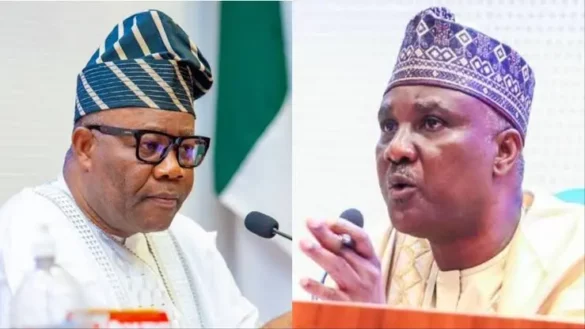
•Akpabio and Abbas
As SERAP’s seven-day ultimatum expires, Senate President Godswill Akpabio and House of Representatives’ Speaker, Abbas Tajudeen, face mounting scrutiny over alleged procurement breaches and missing funds in a National Assembly project flagged by the Auditor-General.
The controversy over the alleged mismanagement of ₦18.6 billion earmarked for the National Assembly Service Commission (NASC) office-complex project has placed the leadership of the National Assembly under growing public pressure, reports Sunday Independent.
The Socio-Economic Rights and Accountability Project (SERAP) last week issued a seven-day ultimatum to Akpabio and Tajudeen to publish details of how the funds were spent or face legal action.
According to the 2022 report of the Office of the Auditor-General of the Federation (AuGF), the NASC paid over ₦11.6 billion to an undisclosed construction firm in 2020 for the building of a new office complex, followed by another ₦6.9 billion in 2023 for “conversion of a roof garden to office space.”
The audit query stated that the payments were made without advertisement, competitive bidding, or approval from the Bureau of Public Procurement (BPP) — violations of Nigeria’s procurement laws.
The Auditor-General further observed that there was no record of a contract agreement, needs assessment, or certificate of completion, raising fears that the entire ₦18.6 billion allocation “may be missing.”
In its petition dated October 18, 2025, SERAP demanded the immediate release of key information, including the name of the contractor, the company’s directors and shareholders, and the current status of the project.
The group warned that failure to respond would leave it with no choice but to seek judicial intervention to compel disclosure.
“The National Assembly cannot continue to operate in secrecy while demanding accountability from other arms of government,” SERAP said, adding that transparency in parliamentary finances is vital to restoring public confidence.
A DAMNING AUDIT TRAIL
The AuGF’s report revealed that the NASC awarded the multi-billion-naira contract without documentation of bidding processes, tender board approvals, or due diligence.
The payment schedule also raised eyebrows: over ₦11 billion disbursed within two years, and another ₦6.9 billion paid for what auditors described as an “inflated variation” that lacked any technical or cost justification.
More troubling, the Auditor-General noted that the project site could not be verified, suggesting that either construction was abandoned or that payments far exceeded work done.
Investigations show that the project, first conceived in 2018, was meant to provide a purpose-built secretariat for the NASC, which supervises the recruitment, training, and welfare of staff in the National Assembly bureaucracy.
However, the project has repeatedly appeared in successive budget cycles without any corresponding physical progress.
“Every year, we see allocations for this same project in the budget, but nothing seems to change on ground,” said a legislative aide familiar with NASC operations who requested anonymity.
“It has become a recurring decimal in the Assembly’s capital spending.”
At the heart of the scandal is a fundamental question: Where did the money go?
Neither the Senate President’s office nor that of the Speaker has provided clarity. Officials approached by our correspondent declined to comment, saying the issue “concerns the Service Commission and not the Legislature itself.”
Yet civil-society observers argue that the presiding officers, as heads of the National Assembly, have an obligation to explain.
Under Nigeria’s fiscal structure, the National Assembly Service Commission operates as an agency under the legislature, funded through the Assembly’s own budget. The NASC is therefore directly accountable to the National Assembly leadership, which approves its expenditure and provides oversight.
SERAP’s insistence that Akpabio and Abbas respond directly stems from that relationship.
“Accountability cannot be delegated,” the organisation said.
“The funds were appropriated for a National Assembly project, not a private venture. The legislature must lead by example.”
CALLS FOR TRANSPARENCY
Ironically, while the leadership of the National Assembly grapples with this ₦18.6 billion controversy, the Senate Committee on Public Procurement last week reaffirmed its commitment to strict compliance and transparency in Nigeria’s public contracting process.
Speaking at a two-day retreat organised by LeadBold Resource Consulting in Abuja, the Committee Chairman, Senator Olajide Ipinsagba (Ondo North), emphasised that the goal of procurement oversight is to ensure “value for money” and prevent leakages.
“Public procurement is not merely a technical or administrative activity; it is the mechanism through which government policies are transformed into tangible services, infrastructure, and development outcomes,” Ipinsagba said.
He noted that procurement accounts for a significant portion of national expenditure, and therefore demands the highest standards of integrity, efficiency, and accountability.
While acknowledging the progress made since the passage of the Public Procurement Act 2007 and the creation of the Bureau of Public Procurement (BPP), the Senator admitted that more still needed to be done to reform and strengthen compliance systems.
“Public Procurement is not a one-time event; it is a continuous process of evolution, adaptation, and learning,” he said. “The Senate Committee remains committed to legislative oversight, policy advocacy, and institutional reforms that strengthen integrity and compliance in the procurement system.”
Ipinsagba further urged alignment with global best practices, saying transparency in public spending is essential to achieving President Bola Tinubu’s Renewed Hope Agenda.
“By aligning our practices with international standards and embracing innovation, we can ensure that every naira spent translates into better schools, safer roads, improved healthcare, and a more prosperous nation,” he stated.
Observers say the juxtaposition of the Senate’s public call for transparency and the ongoing ₦18.6 billion scandal exposes the moral dilemma facing Nigeria’s legislature.
“The optics are terrible,” said Dr Abdul Rahman Bala, a political scientist at the University of Abuja. “When the same Senate preaching transparency is struggling to explain missing billions under its watch, it sends mixed signals to Nigerians.”
For Akpabio and Abbas, the unfolding controversy represents more than a reputational challenge; it is a test of political will. Their response will determine whether the 10th National Assembly can restore public trust in an era of economic austerity.
Civil society organisations like BudgIT and the Transparency Advocates Network have urged full disclosure of all contract documents and the invitation of independent engineers to verify project execution.
“Parliament must not wait to be dragged to court before doing the right thing,” said Kolawole Olawoyin of BudgIT.
“Openness should be voluntary, not coerced.”
Experts argue that true reform will require both internal discipline and public scrutiny. “Autonomy should not mean secrecy,” said Ezenwa Nwagwu of the Partners for Electoral Reform.
“If the legislature cannot model transparency, then the entire idea of checks and balances collapses.”
As SERAP’s ultimatum lapses and the Senate Committee on Public Procurement preaches reform, the contrast between rhetoric and reality has never been starker.
Whether the ₦18.6 billion project turns out to be a case of inflated cost, incomplete delivery, or outright diversion, it will likely define the 10th Assembly’s public image.
In a nation still battling poverty, unemployment, and public distrust, ₦18.6 billion represents more than a line in an audit report — it is a mirror reflecting how governance either works or fails.