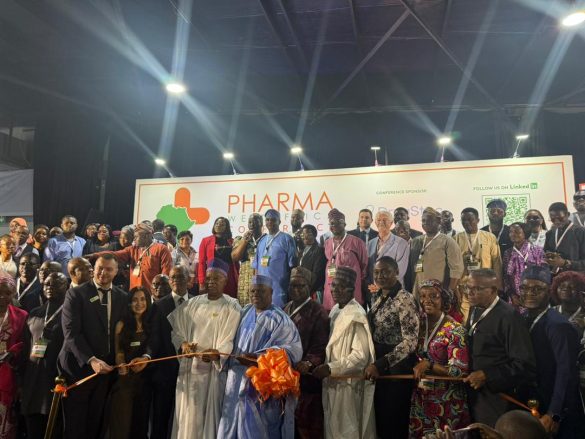
The third edition of Pharma West Africa Exhibition & Conference 2026 opened on Tuesday, with a strong call for West African nations to strengthen pharmaceutical supply chains and reduce dependence on imports to achieve medicine security.
The conference, held in Lagos, brought together policymakers, manufacturers, researchers, investors, and health professionals to discuss strategies for achieving medicine security and self‑sufficiency across the region.
Specifically, the speakers urged the region to move beyond donor dependency and build sustainable pharmaceutical financing systems that can underpin self‑sufficiency, reports Daily Independent.

Delegates emphasised that sovereignty in health supply requires sovereignty in health financing, warning that fragmented procurement pipelines and reliance on external funding are no longer viable.
The theme of this year’s gathering, ‘Pharmaceutical Supply Chain Strengthening for Self‑Sufficiency in West Africa,’ was described by organisers as more than a discussion point. It was presented as a call to action, reflecting lessons learned from the COVID‑19 pandemic, which exposed vulnerabilities in global supply chains and left many African countries struggling to secure essential medicines.
Pharm. Ahmed Yakasai, Chairman of the Planning Committee and former President of the Pharmaceutical Society of Nigeria, emphasised the urgency of building resilient systems.
“We have seen the vulnerabilities during COVID‑19. We have witnessed the disruptions. Dependence on external systems puts our nations at risk. Today, we gather not to lament but to build – to build industries that are competitive globally and systems that endure,” he said at the opening ceremony.
Yakasai highlighted that the conference is not only about exhibitions and networking but about people. “It is about the mother who deserves access to safe medicine. It is about the child whose future depends on a reliable health care system. It is about collective responsibility to build something stronger than what we inherited,” he added.
A Regional Call To Action
The event drew participants from across West Africa, including Liberia, Sierra Leone, and Ghana, underscoring the regional nature of the challenge. Delegates were urged to move beyond conversations and commit to actionable outcomes such as strengthening local manufacturing, embracing innovation, aligning regulatory frameworks, and unlocking investment.
Prince Julius Adelusi‑Adeluyi, former Minister of Health and immediate past President of the Nigeria Academy of Pharmacy, served as Special Guest of Honour. He reminded participants of the critical role pharmacists played during the pandemic.
“When COVID came without warning, governments looked for a global response. The solution came from pharmaceutical industries. Pharmacists must be proud that in times of severe tests, they are called upon to save the world,” he said.
Adelusi‑Adeluyi challenged professionals to practise with nobility and resist materialism, urging them to contribute meaningfully to productivity in the region. He called on delegates to take the message of self‑sufficiency back to their home countries and begin practical steps, however small, towards pharmaceutical sovereignty.
Financing and Predictability: The Missing Links
Delivering a keynote address, Dr Olamide Okulaja, Chief Growth Officer at Maisha Meds International, posed a critical question: “We have the medicines, the pharmacists, and the factories. So why are we still importing over 70 percent of what we consume?” He illustrated the problem with the example of a mother seeking care for her child at a patent medicine vendor, where transactions remain invisible to national health databases and procurement systems.
“This woman is the system, and until we treat her invisibility as a failure of governance, we will continue to convene conferences and write the same strategy documents,” he said.
Okulaja noted that 70 to 95 percent of medicines across Africa are imported, despite existing factories and scientific expertise. He pointed out that 30 to 60 percent of pharmaceutical manufacturing capacity lies idle due to the absence of reliable demand signals.
“Self‑sufficiency is not a manufacturing problem. It is an integration problem,” he argued, identifying three critical layers that must be connected: the service layer, where patients seek care; the capital layer, where investment flows; and the production layer, where local manufacturers operate below capacity.
He warned that the era of external donor funding sustaining internal systems is ending. Funding for HIV, tuberculosis, and malaria programmes is flattening, while co‑financing requirements are rising. Countries are being asked to own their systems, yet procurement pipelines remain fragmented and manufacturers struggle with uncertain offtake. “A system funded externally cannot produce internally. Sovereignty in health supply requires sovereignty in health financing,” he said.
Okulaja stressed that manufacturers need predictability – systems that can forecast volumes, payments, and standards. Insurance, he argued, is a veritable source of financing demand, transforming need into structured, reimbursable, and bankable flows. When demand is pulled and verified, manufacturers can produce against guaranteed offtake, lenders can finance predictable cash flows, and pharmacies can stock quality medicines with confidence. Governments would then move from subsidy to strategic purchasing, creating more sustainable systems.
Towards a Connected Architecture
Okulaja outlined that a self‑sufficient system requires three connected flows: insurance and risk‑pooling mechanisms to convert need into structured demand; affordable credit for pharmacy networks to enable compliance and digitisation; and long‑term capital for manufacturers to scale capacity against verified demand. Without these flows working together, he warned, the system fails.
“What we have today are isolated flows. What we need is a connected financing architecture,” he said.
He proposed that harmonising drug quality standards would unlock the African Continental Free Trade Area pharmaceutical trade, creating a market of 1.3 billion people. He urged governments to integrate private pharmacy networks into national health insurance schemes, ensuring coverage of the majority of patient contacts that occur outside public facilities.
He also called for local pharmaceutical manufacturing to be treated as a national security priority, with free trade zone pharma clusters designated as strategic health infrastructure. He explained that a harmonised framework gives local factories a continental market beyond WHO pre qualification and the African Medicines Agency (AMA) had the mandate, so the moment is now.
Finally, he pressed for the building of national pharmaceutical purchasing power through ring‑fenced budgets, prioritising locally manufactured medicines in formularies, and linking reimbursements to verifiable data.
“The infrastructure exists. The pharmacists exist. The manufacturers exist. The data exists. The policy levers exist. West Africa has everything it needs to end medicine import dependency within a decade. All we have ever been missing is the decision to connect them,” Okulaja concluded.
Regulatory and Policy Perspectives
Registrar of the Pharmacy Council of Nigeria, Babashehu Ibrahim Ahmed, said the theme of this year’s conference resonates strongly with the region’s current needs. He emphasised that building a resilient and self‑reliant supply chain is both timely and essential, recognising the pivotal role the pharmaceutical industry plays in advancing healthcare across West Africa.
Professor Akin Abayomi, Honourable Commissioner of Health for Lagos State and Guest of Honour, appealed to the pharmaceutical sector to align with government policy on diagnostics. He noted that while government promotes a “test before treat” approach, many pharmacies and patent medicine vendors lack rapid diagnostic tests. He urged the industry to embrace diagnostics as a first line of investigation, ensuring patients receive appropriate treatment beyond anti‑malarials and antibiotics.
“If your test is positive, please go ahead and treat the patient with an anti‑malaria. If the test is negative, then the patient requires further investigations, but the patient will come back to you with a prescription for something else,” he explained.
A Decade To End Dependency
The conference underscored that Africa does not have a supply problem but a purchasing architecture problem. By shifting from donor‑driven procurement to domestically financed markets, and by integrating financing, service delivery, and production into one system, West Africa could achieve pharmaceutical self‑sufficiency.
Delegates agreed that the challenge is not resources but political will and commitment to act.
The conference stressed that West Africa must act decisively to secure its pharmaceutical future. The pandemic revealed the risks of dependence on external supply chains. The challenge now is to build resilient, competitive, and integrated systems that ensure medicine security for millions across the region.
With harmonised standards, predictable financing, and integration of private networks, the region has the opportunity to set a ten‑year target to end medicine import dependency and establish sovereignty in health supply.