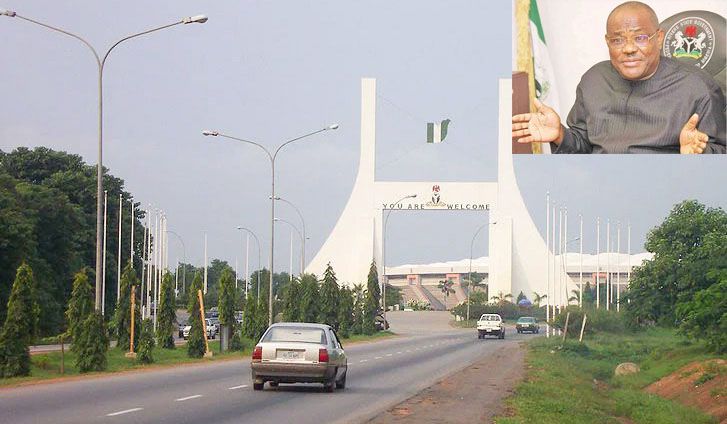
•Federal Capital City gate and Minister Nyesom Wike
As infrastructure spending accelerates and FCT borrowing climbs sharply, questions are mounting over the sustainability of Abuja’s development model, the future cost of debt and who ultimately bears the burden, reports Daily Independent.
Abuja is undergoing a major infrastructure transformation, with roads, interchanges, bridges, rail infrastructure, satellite-town connections and urban renewal projects reshaping the Federal Capital Territory under Minister of the FCT, Nyesom Wike.

For businesses, the investment promises better connectivity, lower logistics costs, rising property values and new commercial opportunities. For government, it offers the prospect of expanding the economic base and revenue of a rapidly growing capital.
But beneath the construction boom is a growing financial concern: the cost of financing Abuja’s development.
According to Debt Management Office (DMO) figures cited by Daily Independent, FCT domestic debt rose from N88.51 billion in September 2023 to N389.88 billion by March 2026 — an increase of N301.37 billion, or 340.5 per cent.
The surge was particularly dramatic in the final months of the period. Debt rose from N78.93 billion in September 2025 to N188.86 billion in December, before more than doubling to N389.88 billion by March 2026.
The issue, therefore, is not whether Abuja should borrow. Productive borrowing can accelerate infrastructure, unlock new districts, attract investment and expand the revenue base.
The critical question is what the borrowing is financing, at what cost and whether the resulting assets can generate sufficient economic value to justify the liabilities.
The scale of the infrastructure ambition is evident in the FCT’s N2.285 trillion 2026 budget, of which N1.741 trillion, or 76.19 per cent, is earmarked for capital projects.
There are also encouraging revenue signals. The FCT has significantly improved its internally generated revenue, while its 2026 budget projects revenue of about N2.385 trillion.
But rising revenue alone does not guarantee debt sustainability. What matters is the relationship between revenue, borrowing, debt servicing and future expenditure obligations.
This is where the FCT’s exit from the Treasury Single Account (TSA) becomes relevant.
The TSA exit cannot, on available evidence, be blamed for the debt surge. Indeed, FCT domestic debt declined substantially during much of the period after the exit.
However, the decision changed the financing environment by giving the territory greater control over its revenues and, potentially, greater capacity to leverage them for infrastructure financing.
Wike has argued that the previous arrangement restricted the FCT’s ability to deploy internally generated revenue and access financing.
In other words, financial autonomy can accelerate development — but it can also accelerate borrowing.
The FCTA’s publication of a 2025 Debt Sustainability Analysis and Debt Management Strategy provides an important benchmark for assessing whether the current trajectory remains within the territory’s capacity.
For Abuja’s business community, this is far from an academic issue.
Debt sustainability affects taxes and charges, land costs, public infrastructure spending, government payment capacity and the wider investment climate.
Infrastructure can create a virtuous cycle: better roads and connectivity attract investment, generate jobs, increase property values and expand economic activity, which in turn strengthens government revenue.
But there is another possibility.
Infrastructure can drive land speculation and higher property values without corresponding improvements in household incomes, leaving tenants and small businesses facing rising rents and operating costs.
For residents, the debt story will therefore not be experienced as a figure on a government balance sheet. It could eventually be felt through stronger revenue mobilisation, land-related charges, business costs and, indirectly, higher consumer prices.
The real test of Abuja’s infrastructure programme must consequently go beyond the number of roads or projects delivered.
How much does new infrastructure reduce business and transport costs? How many jobs does it create? How much investment does it attract? And how much additional revenue does the resulting economic activity generate?
These questions become more urgent as borrowing rises.
Debt incurred today will be inherited by future FCT administrations and residents. That can be a sensible bargain if the infrastructure generates economic benefits for decades. It becomes a poor one if debt service crowds out essential spending or expected economic returns fail to materialise.
The absence of successive publicly available financial statements and detailed budget-performance reports also makes independent assessment more difficult.
Ultimately, N389.88 billion in domestic debt is not, by itself, proof of a debt crisis. The determining factor is whether Abuja’s revenue and economic growth can support its obligations.
The capital clearly needs infrastructure. The bigger question is whether its financing model is sustainable.
For Abuja’s business community, the issue is no longer simply how much the capital is building, but how much it can afford to build — and who will ultimately pay for it.