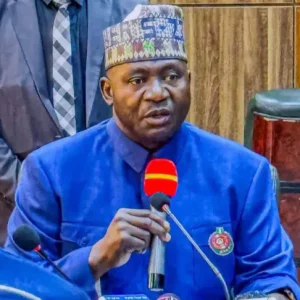


•Prof. Mobolaji Aluko
Professor of Chemical Engineering at Howard University and Commissioner for Infrastructure and Public Utilities in Ekiti State, Prof. Mobolaji Aluko, has blamed Nigeria’s prolonged military rule for worsening the country’s economic and political challenges, arguing that successive military regimes treated the nation’s oil wealth as “spoils of war.”
Aluko made the assertion on Inside Sources with Laolu Akande on Channels Television on Friday while reflecting on Nigeria’s political and economic history, particularly the impact of the oil boom and prolonged military intervention in governance.

He said the discovery and expansion of oil revenues gave the military access to enormous resources at a time when coups and counter-coups had become a recurring feature of Nigeria’s political system.
“We had the oil boom. And money came in the hands of the military who are by nature looters. It’s not against them. Soldiers fight wars. And when they win, it’s the spoils of war,” Aluko said.
He argued that the military’s mindset towards the country’s resources contributed to the mismanagement of Nigeria’s oil wealth, as successive military administrations gained control of revenues that could have been deployed to build stronger institutions and infrastructure.
“So, many of them saw what they met on the ground as spoils of war,” he said.
According to Aluko, the military’s intervention, which was initially justified as an attempt to address political instability and poor governance, ultimately compounded the problems it was expected to solve.
“And there were far more coups against each other than against the civilians than they took over from. It was really, the problem they came to solve became even more difficult,” he said.
He noted that military leaders increasingly became embroiled in struggles for power among themselves, creating a cycle of instability that prevented the country from developing consistent democratic institutions.
“And they were fighting each other. They themselves became a problem unto themselves,” Aluko said.
Nigeria experienced its first military coup in January 1966, followed by a series of counter-coups and changes in government. Military rule continued for much of the period between 1966 and 1999, with only a brief return to civilian government between 1979 and 1983.
Aluko also argued that the influence of the military did not necessarily disappear whenever power was formally transferred to civilians.
He said successive civilian administrations often operated within political arrangements shaped or approved by the military leadership that preceded them.
“No civilian regime came that was not approved by the outgoing military regime. So they were really still working in the shadows,” he said.
He cited the Second Republic under President Shehu Shagari as an example of the fragility of civilian rule during the period.
“From 1979 to 83, Shagari came in, within a short time, he was gone,” Aluko said.
The Second Republic lasted from October 1979 until December 1983, when the military overthrew the Shagari administration in a coup by senior military officers led by the late General Muhammad Buhari (rtd).
Aluko’s comments come amid renewed debates over the management of Nigeria’s natural resources and the extent to which the country has converted its oil wealth into sustainable economic development.
For decades, crude oil has remained a major source of Nigeria’s foreign exchange earnings and government revenue. However, the country has struggled with infrastructure deficits, weak institutions, economic volatility and heavy dependence on crude oil revenues.
The professor’s argument was that Nigeria’s oil boom, rather than becoming a foundation for long-term national development, coincided with a period of political instability and military dominance.
His assessment also suggests that the consequences of military rule extended beyond the years when soldiers directly occupied political offices, influencing the institutions, political culture and economic structures inherited by subsequent civilian governments.
Aluko said the challenge for Nigeria is therefore not simply to return power to civilians but to build institutions capable of preventing the recurrence of the patterns that allowed political power and national resources to be concentrated in the hands of a few.