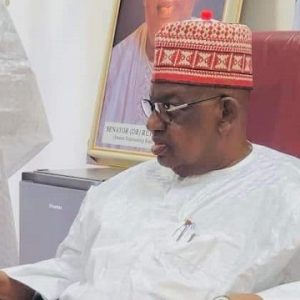
•Deputy Speaker Benjamin Kalu
Deputy Speaker of the House of Representatives, Benjamin Kalu has advocated review of the death penalty law in the country, while creating equitable, effective and respectful justice system.
Kalu said he has sponsored a bill to amend the 1999 constitution aimed at abolishing the practice, saying opposition against removal of death penalty was declining on a daily basis, hence the need to align the nation’s laws with global practices, reports The Nation.
Speaking when he received a delegation from Death Penalty Project led by officials of the British High Commission in Abuja, Kalu said as further discussions are held, the goal is not to diminish the seriousness of capital offenses, but to create a justice system that is equitable, effective, and respectful of human rights.
According to him: “We owe it to our citizens to ensure that their rights are protected and that our laws reflect the highest standards of justice. I urge you all to support us as we take significant steps towards reforming our criminal justice system towards creating a Nigeria that embodies fairness, respect for human rights, and a commitment to justice for all”.
The deputy speaker said the issue of death penalty in Nigeria has been a contentious topic, drawing opinions from various sectors of society, adding that there is a growing trend toward the abolition of the death penalty, with over 130 countries having abolished it in law or practice.
Overtime, he said, laws in the country have taken into cognizance, the temperature of the environment and the current legal framework allows for capital punishment for offenses such as murder, armed robbery, and treason.
He stressed that the figure of inmates on the death row in the country underscores the pressing need for reform in the criminal justice system.
According to him, the Constitution Review Committee has thoroughly examined the implications of the death penalty, considering not only the moral and ethical dimensions but also its practical effects on society.
Kalu added: “The Constitution Review Committee has thoroughly examined the implications of the death penalty, considering not only the moral and ethical dimensions but also its practical effects on society.There is now a proposed bill to alter the Constitution of the Federal Republic, 1999 (as amended).
“The bill aims to amend Section 33 (1) of our Constitution by deleting the second part of the subsection which legitimizes the deprivation of life by the State and enshrines and retains the early part of the subsection which provides as follows:“Every person has a right to life, and no one shall be deprived intentionally of his life”. The amendment will effectively delete the second part of the subsection that states “…save in execution of the sentence of a court in respect of a criminal offence of which he has been found guilty.
“This amendment which I am sponsoring will align with international best practices. Internationally, there is a growing trend toward the abolition of the death penalty, with over 130 countries having abolished it in law or practice. This shift reflects a global understanding that justice must incorporate rehabilitation and restorative practices rather than solely punitive measures.
“In November 2024, the UN General Assembly’s Third Committee approved a resolution for a global moratorium on executions, aiming for full abolition, which was adopted on December 17, 2024, marking the tenth resolution since 2007 advocating for a moratorium, with support increasing from 104 states in 2007 to 130 in 2024, while opposition has declined.
“Notably, Nigeria abstained from the recent vote among 22 abstaining states. This trend indicates a strong movement towards the universal abolition of the death penalty. Within the African Union, 48 of 55 countries are now abolitionist in law or practice, with only Egypt and Somalia carrying out executions in 2023.
“The African continent is advancing towards the abolition of the death penalty more rapidly than any other region, with six countries having eliminated the death penalty for all crimes or for ordinary crimes in just the past four years (since July 2021).
“We are willing to collaborate with you and have further engagements as we know that aligning our laws with international best practices enhances Nigeria’s reputation on the global stage. We are positive that our willingness to engage further on this discussion will send a clear message that we are committed to upholding human rights and ensuring that our criminal justice system reflects fairness and proportionality.”
Leader of the Delegation, Saul LeurFeund who is the Co-founder and Co-Executive Director of the Death Penalty Project, told the Deputy Speaker that they visited to seek the parliament’s collaboration on potential abolishment of death penalty in Nigeria.
He said: “We’ve been working in this continent for some 30 years, we’ve seen great progress, Zimbabwe abolished death penalty on new year’s eve. I had the pleasure of being here last August on the invitation of the British high commission. It will be helpful to have conversation around death penalty in Nigeria.
“It will be helpful to bring partners together to discuss potential abolishment, to see if we can change discussion around death penalty. So we want to bring our experience and to discuss with you, the possibility on how the Constitution can be amended and anything we can do to provide technical support.”