•Dilapidating school
Pupils in many public schools in Delta State are forced to learn in dilapidated classrooms, while seated on bare floors. This sad development persists despite rising yearly budgetary allocations to education in the oil-rich Niger Delta State, reports The Guardian.
Across Delta communities, public schools lie in near-abandoned conditions, exposing glaring lapses in the management of education funds and raising fresh concerns over government oversight in the sector.
Under normal circumstances, Delta State’s rising education spending over the past three years should signal progress, but the reality on the ground tells a different story altogether.
From N46.55 billion in 2024 to N105.086 billion in 2026, the state has more than doubled its investment in the sector, signalling a strategic pivot toward building a more inclusive, technology-driven education system.
But beyond the impressive figures, visible signs of neglect, decay, dilapidation and obvious lack of care show that funding has yet to translate into meaningful change in classrooms, a development that simply adds to Nigeria’s long record of underperforming public education spending.
Indeed, the Delta State budget reflects a clear upward trajectory. In 2024, the state allocated N46.55 billion to education out of a total budget of N725 billion, with a focus on expanding access and improving learning environments. In 2025, the allocation rose to N67.42 billion within a N979 billion budget outlay.
The 2026 budget, however, marks a dramatic leap. With a total state budget of N1.73 trillion, education now commands N105.086 billion, its highest allocation in recent times.
Under the “Budget of Accelerating the MORE Agenda,” the funding is aimed at constructing new schools, upgrading facilities, and advancing technology-based learning, among other initiatives.
Sadly, across Delta, many public schools still grapple with teacher shortages, insufficient desks, substandard classrooms, dilapidated buildings, and limited access to modern teaching tools.
The 2026 allocation explicitly targets these gaps, with plans for new school construction and upgrades to existing facilities.
Studies have consistently shown that better infrastructure – adequate classrooms, laboratories, libraries, and sanitation facilities – directly impacts student performance and retention.
For Delta, the challenge will not only be building more schools but also ensuring that they are durable, well-equipped, and equitably distributed in terms of manpower and other necessities across urban and rural communities.
In some schools, pupils reportedly refuse to attend classes due to the absence of chairs and desks, forcing them to sit on bare floors. In other cases, classrooms have become overrun by bushes, shrubs, and reptiles, with parents expressing fears that students could suffer snake bites while in school.
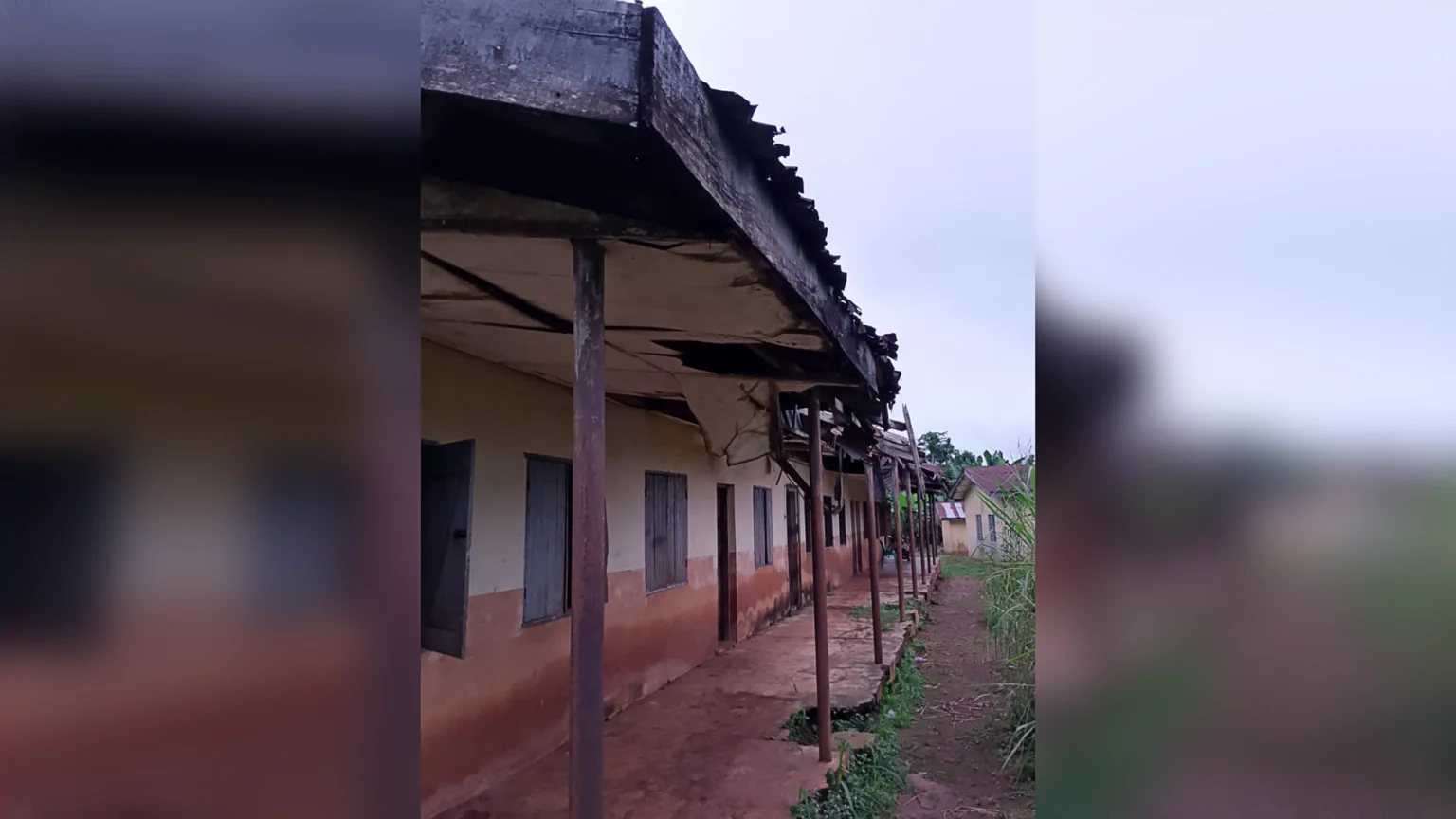
One of the most troubling examples is Ejedinka Primary School, located in Aniagbala, Ubulu-Uku, in Aniocha North Local Council. The school has deteriorated to what residents describe as an “eyesore,” with broken structures, roofless classrooms and virtually no learning facilities.
The road leading to the school is almost impassable, and the premises, surrounded by thick bushes and lacking any fencing, are unsafe for pupils.
A visit to the school shows classrooms without roofs, shattered walls and almost no furniture. In some cases, a single teacher handles two different classes simultaneously due to an acute shortage of teaching staff.
Community members say the situation has persisted for years despite repeated appeals to authorities.
A community member, Dr Jude Iyitor, lamented the deterioration of the school, noting that it once served as a centre of quality learning.
“In our days, the school used to be an attractive environment, sought after by anyone willing to acquire a sound education,” Iyitor said. “But today the condition of the school has deteriorated to the extent that it scares people away. There are no seats, not enough teachers, no proper road to the school, nothing to write home about.”
According to him, community leaders are now exploring ways to engage the state government to revive the school.
“We are trying to meet with the government to renovate it and breathe life into the school again,” he added.
Another concerned resident, who pleaded anonymity, described the situation as heartbreaking, noting that pupils are forced to sit on bare floors in overcrowded classrooms.
“The school is completely dead,” he said.
“The pupils are all sitting on the floor. How can they learn properly as leaders of tomorrow? In some classrooms, you see only two chairs, and in others, none at all.”
He added that the community has repeatedly appealed to government authorities without success.
“We have been crying and still crying for government intervention, but nobody listens. Nobody cares about our plight. Our school is going into oblivion. Our children’s future is being ruined before our very eyes. It is a shame and a disaster.
This pathetic situation is not limited to Ejedinka Primary School. At Obi Ezeamaka Primary School in Nsukka, Aniocha South Local Council, residents say the story is largely the same: poor infrastructure, inadequate furniture and neglected facilities.
Similarly, Isioma Onyeobi College, located near Mammy Market in Asaba, is also struggling with poor infrastructure and declining learning conditions.
Parents say the state of these schools reflects a broader crisis in Delta’s public education system.
The Executive Director of Global Peace Development (GPD) Nigeria, Mr Ebruke Esike, during a stakeholders’ roundtable and inception meeting of the Local Rights Programme (LRP) in Asaba, expressed concern over some public Schools in five rural communities – Oter-Iyede, Erawha, Uro-Irri, Idheze and Ukpude – from Isoko North and South Local councils.
Esike cited Ukpude Primary School, which reportedly operates with only a headmistress, one teacher and a non-academic staff member, in Erawha Community.
He noted that although there are five well-constructed classrooms, only four desks are available for pupils, while Uro-Irri Primary School faces comparable challenges.
Idheze Primary School, Ozigbe Primary School, Erawha-Owhu, and Aka Primary School, Ukpude are facing similar, if not worse, challenges – begging for government attention.
Aka Primary School, in Ukpude Community, Isoko South Council- an area that contributes to Nigeria’s oil wealth, is experiencing a silent struggle.
According to the former Financial Secretary of Ukpude Community, Samuelson Atamu, the school represents a painful contradiction: a region rich in natural resources, yet impoverished in basic educational infrastructure.
“When you come here, what you see is not a school that should exist in an oil-producing community,” Atamu lamented with his voice heavy with frustration.
“Our children are learning under conditions that make education almost impossible.”
At Aka Primary School, classrooms are bare, stripped of even the most basic furniture. Pupils sit on the floor during lessons; their exercise books balanced on their laps. There are no doors; no windows; no desks, and no chairs – just empty spaces where learning should thrive.
The shortage of teachers further compounds their problems. With only a handful of educators struggling to manage multiple classes, effective teaching has become a daily uphill task. Aka Primary School remains cut off, stuck in a cycle of deprivation.
For parents in Ukpude, the situation is both disheartening and infuriating. Many had hoped that the community’s status as an oil-producing area would translate into development, particularly in critical sectors like education. Instead, they are left grappling with a system that appears to have forgotten them.
“We have written, we have appealed, we have cried out,” they say. But it feels like nobody is listening.”
However, Atamu and other community members are hoping for a better and more conducive environment for their pupils:
“We are not asking for too much; just give our children a school that they can be proud of.”
An educationist who spoke on condition of anonymity blamed the crisis on alleged corruption and mismanagement within the education sector.
“Politicians are funny human beings,” the educationist alleged, adding that, “they squander money with reckless abandon. Huge funds are budgeted for education every year, but the money often ends up in private pockets, leaving pupils at the receiving end.”
Such allegations have intensified public scrutiny of the state’s education administration, particularly amid ongoing complaints about decaying school infrastructure.
Reliable sources within government circles told our correspondent that Governor Sheriff Oborevwori has expressed frustration over the deteriorating condition of many public schools despite investments in the sector.
The development reportedly contributed to a recent reshuffle within the state’s education ministries.
Under the changes, Mrs Rose Ezewu, who served as Commissioner for Secondary Education, was redeployed to the Ministry of Primary Education, while Kingsley Ashibuogwu, previously Commissioner for Primary Education, was moved to oversee secondary education.
The reshuffle, which took immediate effect, was announced earlier this year in a statement signed by the Secretary to the State Government, Kingsley Eze Emu.
Government insiders say the move was designed to strengthen oversight within the ministries and serve as a warning against inefficiency or alleged financial mismanagement.
The redeployment of Ezewu has been linked by some observers to allegations of poor management of education funds, particularly in light of the deteriorating condition of several schools across the state.
Sources say the governor has shown a strong commitment to improving the education sector and is unhappy about the condition of public schools.
According to insiders, Ezewu was tasked with “breathing life” into the decaying infrastructure in primary schools following her redeployment.
Attempts to obtain official responses from the state government were unsuccessful.
When contacted, Commissioner Ezewu neither responded to calls nor to WhatsApp messages seeking clarification on the condition of schools across the state.
Education stakeholders warn that if urgent action is not taken, the decay of public schools could worsen the already troubling learning crisis facing many Nigerian states.
For parents and pupils in affected communities, the crisis goes beyond infrastructure; it is about the future of the children. Until decisive intervention comes, many in Delta State will continue to learn in classrooms without roofs, desks, or basic safety.