

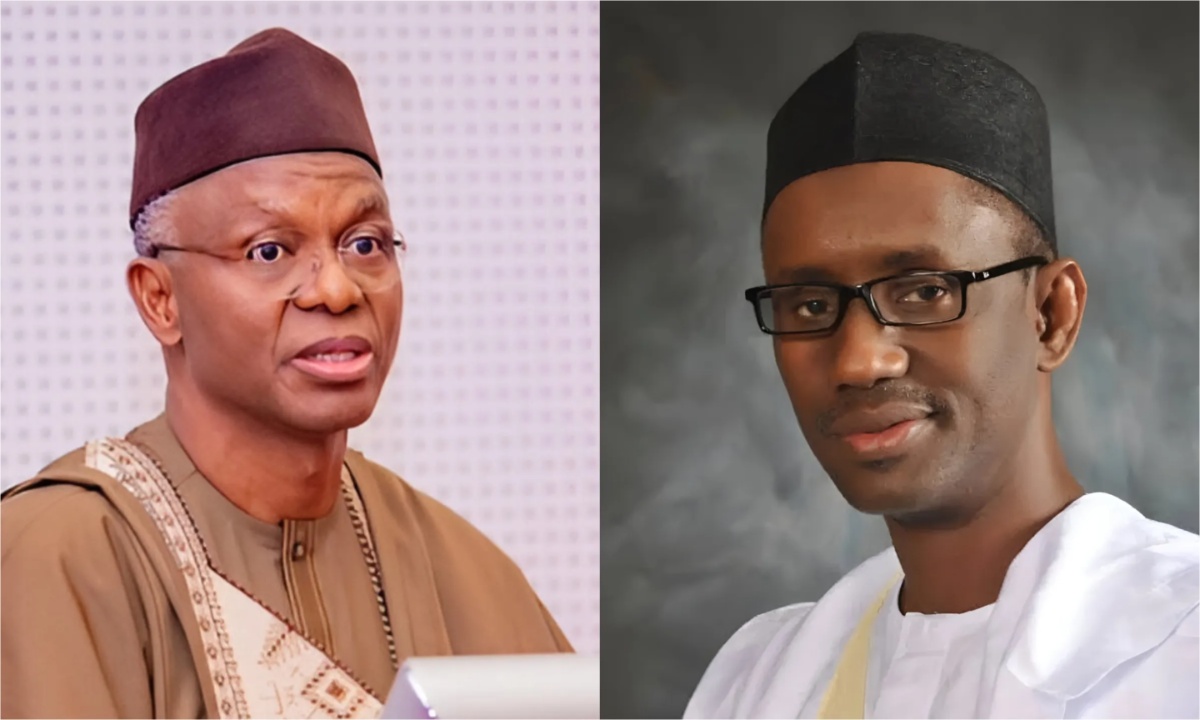
•El-Rufai and Ribadu
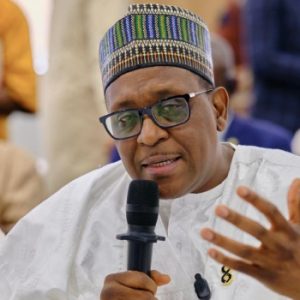
Former Kaduna State governor, Nasir El-Rufai, has ignited a political and security firestorm after publicly disclosing that he and unnamed associates had access to intercepted telephone conversations allegedly involving National Security Adviser (NSA) Nuhu Ribadu — a revelation that has triggered calls for investigation at the highest levels of government and raised profound questions about Nigeria’s security architecture.
The controversy erupted following El-Rufai’s appearance on Arise television’s Prime Time programme, where he spoke about an alleged attempt by security operatives to detain him at the Nnamdi Azikiwe International Airport, Abuja.
During the interview, the former governor claimed that he became aware of a purported order for his arrest through information obtained from what he described as a tapped phone conversation involving the NSA.
“Someone tapped his phone and told us that he gave the order,” El-Rufai said during the broadcast.
“The government thinks they are the only ones that listen to calls… but we also have our ways.”
Pressed by the interviewer on the legality of such interception, El-Rufai acknowledged that phone tapping without lawful authorisation is illegal but suggested that surveillance of that nature happens frequently within government circles.
His comments, delivered calmly but pointedly, immediately sparked widespread debate across political, legal and security circles, reports Daily Independent.
Within hours of the broadcast, the presidency reacted strongly.
Bayo Onanuga, Special Adviser on Information and Strategy to President Bola Tinubu, described the former governor’s remarks as deeply troubling and potentially self-incriminating.
In a public statement, Onanuga argued that if El-Rufai benefited from an unlawful interception of the NSA’s communication, the matter must not be treated lightly.
According to Onanuga, Nigeria’s laws are clear on the illegality of unauthorised wire-tapping and electronic surveillance.
He insisted that no individual — regardless of status or political history — is above the law.
The presidential aide called for security and law enforcement agencies to thoroughly investigate the claim, determine whether an offence was committed, and take appropriate action.
Temitope Ajayi, Senior Special Assistant to the President on Media and Publicity, echoed similar sentiments. He said any suggestion that the communications of the nation’s top security adviser were intercepted without lawful authority raises grave national security concerns.
Ajayi noted that such an incident, if true, would represent not just a personal violation but a breach of institutional security.
Legal analysts who spoke with our correspondent say the issues at stake extend beyond political rivalry.
Under Nigeria’s Cybercrime (Prohibition, Prevention, etc.) Act and other telecommunications regulations, unauthorised interception of private communications can attract significant penalties.
Even possession or dissemination of unlawfully obtained communications could potentially fall within the ambit of prosecutable offences.
Senior advocate and constitutional lawyer, who requested anonymity due to the sensitivity of the matter, explained that the law distinguishes between lawful interception carried out by authorised agencies under judicial oversight and clandestine interception by private actors.
“If the former governor’s statement is taken at face value,” the lawyer said, “it suggests that someone outside lawful authority accessed a secure line belonging to the NSA. That is not a minor matter.”
Security experts warn that the implications could be even more serious.
The National Security Adviser occupies one of the most sensitive offices in the country, coordinating intelligence and security strategy across multiple agencies.
Communications involving the NSA frequently relate to classified matters including counter-terrorism operations, internal security assessments and diplomatic engagements.
“If the NSA’s line can be tapped by non-state actors or political associates, then we are dealing with a systemic vulnerability,” a retired intelligence officer told this reporter.
“It suggests either a breach in telecommunications security or insider compromise. Both scenarios are dangerous.”
The controversy has also assumed a political dimension, particularly given El-Rufai’s evolving relationship with the current administration.
Once considered a key ally within the ruling political establishment, the former governor has in recent months been seen as increasingly critical of certain policy directions and power alignments.
His claim that NSA Ribadu allegedly ordered his arrest has not been officially confirmed. The NSA’s office has so far refrained from issuing a detailed public response to the allegations.
However, government insiders say the security establishment is reviewing the statements carefully.
Meanwhile, El-Rufai’s son, Bashir El-Rufai, sought to clarify his father’s remarks on social media.
He insisted that the former governor did not personally carry out any phone tapping, arguing instead that information was relayed to him by a third party.
According to Bashir, commentators were misrepresenting the interview in a manner that could distort its meaning.
Despite the clarification attempt, the central issue remains unresolved: how did the alleged information about the NSA’s phone conversation reach El-Rufai, and was it obtained legally?
Opposition figures and political commentators have seized upon the episode as evidence of deepening fissures within Nigeria’s political elite.
Reno Omokri, a former presidential aide, criticised the former governor’s statement and called for accountability if any laws were broken.
He argued that public office holders and former officials alike must exercise caution when making admissions that could implicate national security processes.
Civil society organisations have also weighed in. A digital rights advocacy group based in Abuja released a statement urging transparency.
The group emphasised that while unlawful surveillance by private actors is unacceptable, so too is unlawful surveillance by state agencies without due process.
The organisation called for a broader national conversation about privacy rights, oversight mechanisms and intelligence accountability.
For many observers, the episode highlights a deeper tension within Nigeria’s security ecosystem — the delicate balance between intelligence gathering and civil liberties.
Nigeria’s security agencies have long faced accusations of operating expansive surveillance systems without adequate judicial oversight.
At the same time, unauthorised interception by political actors presents an entirely different threat.
Telecommunications analysts point out that intercepting high-level government communications would typically require either advanced technical capacity or insider cooperation.
Nigeria’s telecom infrastructure is regulated, and lawful interception systems are usually embedded within networks for use by authorised security agencies under court order.
“If someone outside authorised channels accessed such communication, that would imply either a breach of telecom safeguards or collaboration from within,” said a Lagos-based cybersecurity consultant. “Both scenarios demand investigation.”
The political timing of the controversy is also significant. With the 2027 general elections on the horizon, alliances are shifting and power blocs are recalibrating. Analysts say episodes like this could intensify internal rivalries and deepen distrust among elite actors.
“El-Rufai’s comments may have been intended to demonstrate political resilience or insider knowledge,” a political scientist at the University of Abuja observed.
“But they have inadvertently opened a Pandora’s box about the security of state communications.”
For now, it remains unclear whether formal charges will be pursued or whether the matter will be handled quietly within the security establishment. Sources indicate that agencies may first conduct internal assessments to determine whether there was indeed any breach involving the NSA’s communication devices.
The stakes are high. Beyond personal accountability, the controversy touches on Nigeria’s global reputation. International intelligence cooperation depends heavily on trust and the assurance that sensitive exchanges will remain secure. Any perception that top-level communications are vulnerable could affect collaborative efforts.
As Abuja watches closely, the broader public debate continues to unfold.
On radio talk shows, social media platforms and policy forums, Nigerians are grappling with questions about privacy, power and political rivalry.
Was El-Rufai exposing a culture of mutual surveillance among the elite, or did he inadvertently reveal a dangerous security gap?
Whatever the ultimate outcome, the episode underscores the fragile intersection of politics and national security in contemporary Nigeria. Words spoken in a televised interview have cascaded into a national conversation about legality, accountability and institutional integrity.
In the coming days, attention will focus on whether investigative agencies move beyond rhetoric to concrete action. If they do, the process could test both the robustness of Nigeria’s legal framework and the independence of its enforcement institutions.
Until then, the former governor’s remarks remain at the centre of a storm that shows little sign of abating — a storm that has thrust questions of surveillance, secrecy and political power into the national spotlight and left the country awaiting answers.