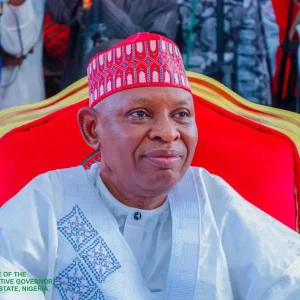
•Governor Umo Eno (C)
By EKAETTE OKON JOSEPH
I remember growing up in Uyo when palm oil production wasn’t just an economic activity, it was a way of life.
My family, like many others, joined during the seasonal palm oil tapping and harvesting period. Palm tree tappers would climb tall trees to cut ripe fruit bunches, which we sorted at home before taking them to the local mill for processing. We would bottle the deep red oil and sell it at the village market.
That experience taught me two things: the power of enterprise and the enduring value of agriculture.

Today, that same trade has evolved. Many families no longer just produce for household use, they now buy palm oil in bulk, store it, and sell during peak demand, often earning significant profits.
Large companies such as Okomu Oil Palm Plc and Presco Plc show that agriculture, once overlooked, is now rivaling traditional industries in revenue and profitability.
From Global Leader to Lost Ground
In the early 1960s, Nigeria was the world’s largest palm oil producer, accounting for about 43 percent of global output, according to the Food and Agriculture Organisation (FAO). Palm oil powered homes, local industries, and exports from the old Eastern and Mid-Western regions. But the discovery of crude oil in 1956 shifted national attention, and agriculture suffered neglect.
By the 1970s, Malaysia and Indonesia, had imported palm seedlings from West Africa, particularly Nigeria but invested in research, plantation expansion, and refining technology. By 1971, Malaysia overtook Nigeria as the world’s leading palm oil producer. Today, Malaysia and Indonesia control over 80 percent of global palm oil exports, generating billions annually.
The Malaysian Palm Oil Council reported that export revenues rose by 15.1 percent in 2024 to RM 109.3 billion, contributing about 3.7 percent to GDP and supporting over 3 million jobs. Singapore, though not a producer, has become a major global trading hub, refining and exporting more than US$120 million worth of palm oil annually, according to OECD data.
This Southeast Asian success story is built on policy consistency, research-backed investment, and value-chain integration, principles that Nigeria can adapt for its own agricultural renewal.
Nigeria’s Slow Comeback
Nigeria’s share of global production now hovers below 2 percent, but growth is returning. The National Bureau of Statistics (NBS) notes that agriculture contributed over 24 percent of Nigeria’s GDP in Q2 2025, with palm oil emerging as a key driver of agribusiness growth.

Corporate performance tells a compelling story. Okomu Oil Palm Plc recorded ₦75.1 billion in 2023 revenue, up 27 percent year-on-year, with ₦33.8 billion profit before tax, according to AfricanFinancials. By 2024, turnover surged to ₦130.2 billion, while net profit rose 94 percent to ₦39.9 billion. In the first half of 2025 alone, Okomu reported ₦129.8 billion turnover and ₦67 billion pre-tax profit, according to Proshare Nigeria.
Presco Plc mirrored this trend, posting ₦117 billion in 2024 revenue and a 61 percent year-on-year rise in profit before tax, as reported by Nairametrics. These figures highlight the profitability of tree crops and signal the rebirth of palm oil as Nigeria’s “new crude.”
Akwa Ibom’s Tree-Crop Revolution: Vision Meets Value
Governor Umo Eno’s Tree-Crop Revolution, launching in November 2025, is designed to revitalise Akwa Ibom’s heritage in palm oil, cocoa, and rubber.

The initiative, managed by the Akwa Ibom State Agriculture and Food Security Committee chaired by Professor Okon Ansa, will:
– Distribute high-yield palm seedlings across all 31 local government areas.
– Deploy two agricultural extension officers per farm for technical support.
– Establish a State Oil Palm Board to coordinate production and offtake.
– Guarantee market access through a government-backed purchase system.
– Strengthen AKADEP (Akwa Ibom Agricultural Development Programme) as an autonomous agency under the Secretary to the State Government.
The state has committed ₦1 billion per local government area in the 2026 budget to support the scheme.
As Governor Umo Eno noted during his inspection of the AKADEP facility in Uyo:
“We are building an agricultural system that will outlive this administration. This is not a project; it’s a generational investment.”
Professor Ansa reinforces this vision, “We are not just planting trees; we are planting generational wealth. Each palm seedling will provide income for decades, not just for the farmer but for their community.”
Agriculture as the New Crude Oil
Beyond cooking oil, palm oil drives industries from pharmaceuticals to biodiesel, cosmetics, and food manufacturing. As global energy markets transition away from fossil fuels, the World Bank projects that agricultural commodities will outperform extractive sectors through 2030, particularly in developing economies that invest in agro-industrial value chains.
In Akwa Ibom, the Tree-Crop Revolution aligns with the ARISE Agenda, which focuses on Agriculture, Rural development, Infrastructure, Security, and Education, ensuring that smallholder farmers, cooperatives, and youth entrepreneurs are part of the value chain.
From Smallholder to Investor
When I was a child, a bottle of palm oil was a household staple; today, it’s an investment commodity. Traders now buy and store palm oil in bulk, reselling during high-demand months at margins exceeding 20–30 percent. This shift mirrors global commodity trading trends and reflects a maturing agricultural marketplace.
The Akwa Ibom model formalises this transformation, connecting smallholders with processors, cooperatives, and financiers to ensure sustainability and consistent supply.
A Blueprint for Other States
The lessons are clear. Subnational governments can replicate Akwa Ibom’s approach by ensuring:
– Policy stability that encourages investor confidence.
– Financing access for cooperatives and youth farmers.
– Guaranteed offtake systems for smallholders.
– Infrastructure: rural roads, storage, and energy, to enable market access.
– Technical capacity-building through trained extension officers.
With these in place, agriculture becomes more than subsistence, it becomes enterprise, equity, and empowerment.

Sowing the Future
Agriculture, once dismissed as a relic of the past, is re-emerging as Nigeria’s most reliable engine of growth. In Akwa Ibom, every palm seedling planted represents more than a crop, it is a symbol of resilience, renewal, and shared prosperity.
As someone who once helped bottle palm oil for sale at the local market, seeing that same industry reborn on a grander, structured scale is deeply personal. It’s proof that when vision meets action, prosperity grows, one palm seedling at a time.