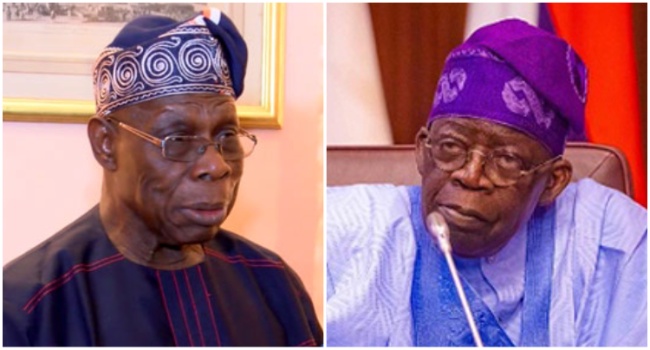
•Obasanjo and Tinubu
The presidency has kept silent on the criticisms of President Bola Ahmed Tinubu’s reforms by former President Olusegun Obasanjo and the International Monetary Fund (IMF).
Obasanjo had, according to a statement by his media aide, Kehinde Akinyemi, alleged that Nigeria is currently under a state capture and that the country’s situation is bad, reports Daily Trust.

The former president was quoted to have said this while delivering in his keynote address at the Chinua Achebe Leadership Forum, Yale University New Haven Connecticut, United States.
On the other side, the IMF, in its latest outlook report for sub-Sahara Africa, said Nigeria is one of the Resource Intensive Countries (RICs) in Sub-Sahara Africa struggling to realise gains of its reforms.
It said while it is cheery news in some countries within the region, it is not looking good yet in Nigeria.
Attempts by our correspondent yesterday to get reactions from the presidency met a brick wall as Tinubu’s media aides declined comment.
The Special Adviser to the President on Information and Strategy, Bayo Onanuga and the Senior Special Assistant to the President on Media and Publicity, Tope Ajayi, could not be reached on their mobile telephone lines and did not reply to text messages sent to them.
The Senior Special Assistant to the President on Print Media, Abdulaziz Abdulaziz, also neither answered calls nor replied messages sent to their phone lines.
However, a source at the State House told our correspondent on condition of anonymity that Obasanjo is a statesman and that the presidency “will not want to join issues with him.”
The National Security Adviser, Nuhu Ribadu, had, last Wednesday, said President Tinubu’s administration had achieved significant progress in tackling insecurity and creating conducive environment for business.
What Obasanjo said
Obasanjo, in his address titled “Leadership Failure and State Capture in Nigeria”, described Nigeria’s situation as bad.
The former leader also alleged that Nigeria’s failing status under President Bola Ahmed Tinubu was “confirmed and glaringly indicated and manifested for every honest person to see.”
He alluded to a World Bank and Transparency International’s definition of what a state capture was, saying it was described, “as one of the most pervasive forms of corruption, “a situation where powerful individuals, institutions, companies, or groups within or outside a country use corruption to shape a nation’s policies, legal environment, and economy, to benefit their own private interests.”
He noted that state capture is not always overt and obvious as it can also arise from the more subtle close alignment of interests between specific business and political elites through family ties, friendships, and the intertwined ownership of economic assets.
He said: “What is happening in Nigeria – right before our eyes – is state capture: The purchase of national assets by political elites – and their family members – at bargain prices, the allocation of national resources – minerals, land, and even human resources – to local, regional, and international actors. It must be prohibited and prevented through local and international laws.
“Public institutions such as the legislature, the executive, the judiciary, and regulatory agencies both at the federal and local levels are subject to capture. As such, state capture can broadly be understood as the disproportionate and unregulated influence of interest groups or decision-making processes, where special interest groups manage to bend state laws, policies, and regulations.
“They do so through practices such as illicit contributions paid by private interests to political parties, and for election campaigns, vote-buying, buying of presidential decrees or court decisions, as well as through illegitimate lobbying and revolving door appointments.
“The main risk of state capture is that decisions no longer take into consideration the public interest, but instead favour a specific special interest group or individual. Laws, policies, and regulations are designed to benefit a specific interest group, often times to the detriment of smaller firms and groups and society in general.
“State capture can seriously affect economic development, regulatory quality, the provision of public services, quality of education and health services, infrastructure decisions, and even the environment and public health.”
Obasanjo also alleged that Nigeria’s failing status under President Tinubu was “confirmed and glaringly indicated and manifested for every honest person to see.”
He was quoted to have stated, “As the world can see and understand, Nigeria’s situation is bad.
“The more the immorality and corruption of a nation, the more the nation sinks into chaos, insecurity, conflict, discord, division, disunity, depression, youth restiveness, confusion, violence and underdevelopment.
“That’s the situation mostly in Nigeria in the reign of Baba-go-slow and Emilokan. The failing state status of Nigeria is confirmed and glaringly indicated and manifested for every honest person to see through the consequences of the level of our pervasive corruption, mediocrity, immorality, misconduct, mismanagement, perversion, injustice, incompetence and all other forms of iniquity. But yes, there is hope.”
Obasanjo while copying from a short, classic treatise published in 1983, called ‘The Trouble with Nigeria’ by Chinua Achebe admitted that, “The trouble with Nigeria is simply and squarely a failure of leadership. There is nothing basically wrong with the Nigerian character. There is nothing wrong with the Nigerian land or climate or water or air or anything else. The Nigerian problem is the unwillingness or inability of its leaders to rise to the responsibility, to the challenge of personal example which are the hallmarks of true leadership.
“In hindsight, this forty-one-year-old prescriptive analysis on the root causes of Nigeria’s leadership crisis is quite moderate and appropriate. It is at least not as desolate as the diagnosis provided by Robert Rotberg and John Campbell, two prominent US intellectuals – the latter a former United States ambassador to Nigeria to boot: ‘Nigeria has long teetered on the precipice of failure,’ they argue.
“Unable to keep its citizens safe and secure, Nigeria has become a fully failed state of critical geopolitical concern. Its failure matters because the peace and prosperity of Africa and preventing the spread of disorder and militancy around the globe depend on a stronger Nigeria.”
Nigeria’s reforms not looking good – IMF
Presenting the IMF’s report at the Lagos Business School on Friday, IMF Deputy Director, Catherine Patillo, said the economic growth is expected to remain stagnant in Nigeria this year.
The report urged Nigeria to close gender gap in a bid to improve its Gross Domestic Product (GDP), saying that could grow the GDP by 30 per cent.
The report said: “Resource-intensive countries (RICs) continue to grow at about half the rate of the rest of the region, with oil exporters struggling the most.
“Second, both domestic and external financing conditions remain tight. Third, the region has recently witnessed several episodes of political fragility and social unrest. Political and social pressures are making it increasingly challenging to implement policy adjustments and reforms.”
The IMF projected “significant increases” in Ghana, Botswana, Senegal and others, but said Nigeria was confronted with “adjustment fatigue” citing the double-digit inflation which is not backing down anytime soon.
“Inflation is still in double digits in almost one-third of countries, including Angola, Ethiopia, and Nigeria, and above target in almost half of the region, particularly where monetary policy is not anchored by exchange rate pegs.
“Significant increases are anticipated in Ghana, as it continues reestablishing macroeconomic stability; Botswana and Senegal, reflecting rising resource exports (diamonds, oil, and gas); and Malawi, Zambia, and Zimbabwe, as they recover from drought. Growth is also expected to improve in South Africa, given positive post-election sentiment and a reduction in power outages,” the report said.
It added, “In the face of popular frustration, there is also an opportunity to work to mobilize support for large, deep reforms, of the sort that, for instance, Ethiopia, Ghana, Kenya and Nigeria are pursuing.
“Realising this opportunity requires rethinking reform strategies, to build and maintain pro-growth coalitions among constituent leaders and the general public. This will require greater attention to communication and engagement strategies, reform design, compensatory measures and rebuilding trust in public institutions.”
The report said the average economic growth rate in the region would remain at 3.6 per cent for the full year 2024, but Nigeria’s growth rate, put at 3.19 per cent, was below the average.
The IMF report also touched on the rising debt burden, saying debt service capacity is generally low.
“In almost one-quarter of countries, interest payments exceed 20 per cent of revenues, a threshold statistically associated with a high probability of fiscal stress. And rising debt service burdens are already having a significant impact on the resources available for development spending.
“The median ratio of interest payments to revenues (excluding grants) currently stands at 12 per cent. Some three-quarters have already witnessed an increase in interest payments (relative to revenue) since the early 2010s (comparing the 2010–14 average with the 2019–24 average). In Angola, Ghana, Nigeria, and Zambia, this increase in interest payments alone absorbed a massive 15 percent of total revenue,” the report stated.