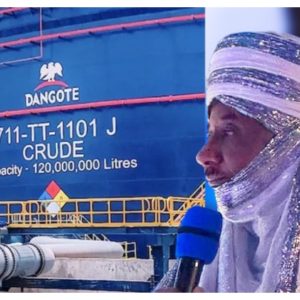



A deepening aviation fuel crisis is threatening flight operations across Nigeria as the local gantry acquisition cost of Jet A-1 from the Dangote Refinery continues to trade at a significant premium above international benchmarks, according to marketers.
They said this has forced a major oil marketing company to issue formal letters to airline operators and warned foreign carriers to make alternative fueling arrangements before flying into Nigeria, reports Daily Independent.
The marketers said the gap between the Dangote Refinery’s current pump price for aviation fuel and the globally recognised Platts benchmark has widened to approximately N265 per litre – a variance that industry insiders describe as unsustainable and operationally crippling for both domestic and international carriers.
As of the week ending May 31, 2026, the Platts-based benchmark places the all-in acquisition cost at roughly N1,385 per litre.
The Dangote Refinery, however, is currently pricing its Jet A-1 product at N1,650 per litre – a figure, according to a new statement by the Aviation Safety Roundtable Initiative (ASRTI), can rise as high as N2,037 per litre depending on the marketer and location, leaving a yawning differential that the industry says it can no longer absorb.
‘We Have Written To The Airlines – The Situation Is Critical’
An insider at one of Nigeria’s prominent jet fuel marketing companies, who spoke to Daily Independent on condition of anonymity owing to the commercial sensitivity of the matter, confirmed that formal correspondence had already been dispatched to airline clients alerting them to the pricing impasse.
“We have written letters to the airline operators explaining what is happening. This is not a situation we took lightly. The price coming out of the refinery simply does not reflect what the global market says jet fuel should cost at this point in time.
“There is a gap of N265 per litre, and no serious marketer can sustain operations at that margin, especially when our clients – the airlines – are benchmarking us against international prices,” the source said.
The insider revealed that the situation had escalated to the point where foreign airlines were being counselled ahead of their scheduled operations.
“Some of the foreign carriers flying into Nigeria have already been contacted. We have told them, quite plainly, to sort out their fuel arrangements before coming. If they are expecting to uplift fuel here at a competitive rate aligned with the Platts benchmark, the current refinery pricing makes that impossible. They need to plan accordingly – whether that means tankering fuel from their home base or making arrangements in neighbouring countries.”
Pricing Structure Under Scrutiny
Beyond the headline differential, industry sources say the full pricing architecture emanating from the Dangote Refinery remains opaque and difficult to reconcile with standard international practice.
The N1,385 per litre benchmark figure – itself already above the raw Platts number – incorporates regulatory levies including a 0.5 percent charge to the Nigerian Midstream and Downstream Petroleum Regulatory Authority (NMDPRA) and an equivalent 0.5 percent levy under the Midstream and Downstream Gas Infrastructure Fund (MDGIF), in addition to a refinery premium whose basis has not been fully disclosed to the market.
“What is troubling is that even at N1,385 – which already includes the NMDPRA fee, the MDGIF fee, and what I would call an unexplainable refinery premium – you are still N265 below what the refinery is charging. So that N1,650 number is not just above Platts. It is above Platts plus taxes plus premium. Nobody has been given a clear breakdown that justifies it,” the source told this newspaper.
ASRTI Calls Out Government’s N60 billion “Hollow Largesse”
The pricing crisis has drawn sharp condemnation from the Aviation Safety Roundtable Initiative, which issued a strongly worded statement on June 1, 2026, describing the situation as “a profound and protracted crisis” that is rendering air travel unaffordable for ordinary Nigerians.
In the statement signed by its president, retired Air Commodore Ademola Onitiju, ASRTI noted that jet fuel now accounts for nearly half of total airline operating expenses – a burden that has compelled domestic carriers to raise fares to levels beyond the reach of most passengers.
The group pointedly criticised the federal government’s decision to extend N60 billion in invoice discounts to airlines, arguing that the intervention had produced no tangible relief.
“Jet A-1 prices have remained unchanged. Airline debts have not reduced. Neither have passengers enjoyed cheaper fares. The cargo logistics, tourism and hospitality sectors have not experienced growth,” ASRTI stated, adding that the aviation ecosystem as a whole – airlines, agencies, concessionaires and ground handlers alike – had received no structural benefit from what it called a “hollow N60 billion largesse.”
In place of what it characterised as piecemeal intervention, ASRTI proposed a Fuel-for-Stability Programme that would allocate crude oil directly to local refiners.
The initiative, the group argued, would eliminate the wasteful subsidy model, reduce the government’s cost exposure, and create a stable, predictable fuel pricing structure capable of transforming the economics of Nigerian aviation.
“Whether the final feasible fuel price is N300 or slightly above is not the issue,” the statement reads. “The grand strategy is to emplace a stable, predictable supply of crude to local refiners in order to dramatically lower operating costs, enable lower fares, higher passenger traffic, more profitable airlines, stronger aviation agencies, and a healthier fiscally backed ecosystem.”
The current standoff did not emerge overnight. Nigeria’s aviation fuel supply chain has been under mounting strain for well over a year, periodically triggering flight cancellations, operational disruptions, and emergency regulatory interventions.
The Dangote Refinery’s entry into the aviation fuel market was initially welcomed as a stabilising force – a domestic alternative to the expensive business of importing Jet A-1 whilst navigating foreign exchange volatility.
However, its pricing has, at least in the near term, introduced fresh complexity rather than resolving the underlying cost pressure.
Foreign exchange dynamics compound the problem further: with the naira having undergone substantial devaluation, airlines are effectively caught between an expensive domestic option and a costly import route.
Foreign Carriers Adjusting Operations
For domestic carriers already operating on thin margins, a N265 per litre premium over benchmark represents a material cost increase difficult to pass on without triggering a sharp drop in load factors.
International airlines, meanwhile, operate under strict fuel cost management frameworks and are acutely sensitive to above-benchmark pricing at any station in their network.
Several carriers have in recent months quietly reduced their frequency into Nigerian airports or switched to smaller, longer-range aircraft capable of carrying sufficient fuel uplift from cheaper stations abroad – a practice known in the industry as tankering.
“The foreign airlines are not stupid. They have been watching this market very closely. Some have already adjusted their operations to minimise how much fuel they buy here. Others have been waiting to see if the refinery pricing corrects. But we cannot wait indefinitely, and that is why we have told some of them directly: plan your fuel outside Nigeria for now,” the source said.
Learning From India, Turkey And Brazil
ASRTI’s statement situates Nigeria’s crisis within a broader global context, pointing to countries that successfully transformed their aviation sectors through structural reform rather than targeted subsidies.
India achieved some of the lowest domestic fares in the world through fuel supply stabilisation and structural policy reform. Turkey, Indonesia and Brazil similarly expanded their aviation markets by prioritising affordability, volume growth and ecosystem-wide efficiency.
“A nation of over 220 million people should not continually operate an aviation market accessible only to a narrow segment of its population,” ASRTI’s statement declared, arguing that lower fares are not merely a consumer benefit but a catalyst for market expansion, higher load factors and the economies of scale that underpin sustainable commercial aviation.
The group acknowledged recent government efforts to restore international aircraft lessors’ confidence in Nigeria and initiatives aimed at localising aircraft maintenance, but maintained that deliberate, market-shaping policy reform remained conspicuously absent.
“Nigeria’s overall national interest and economic survival should supersede other considerations by the political leadership,” the statement concluded.
As of the time of going to press, neither the NMDPRA nor the Dangote Refinery had issued a formal public statement addressing the pricing gap or the timeline for resolution.
Industry stakeholders say they are hopeful that the regulatory authority will convene an emergency pricing review, as it has done in previous supply crises, to broker a formula that bridges the gap between refinery economics and airline viability.