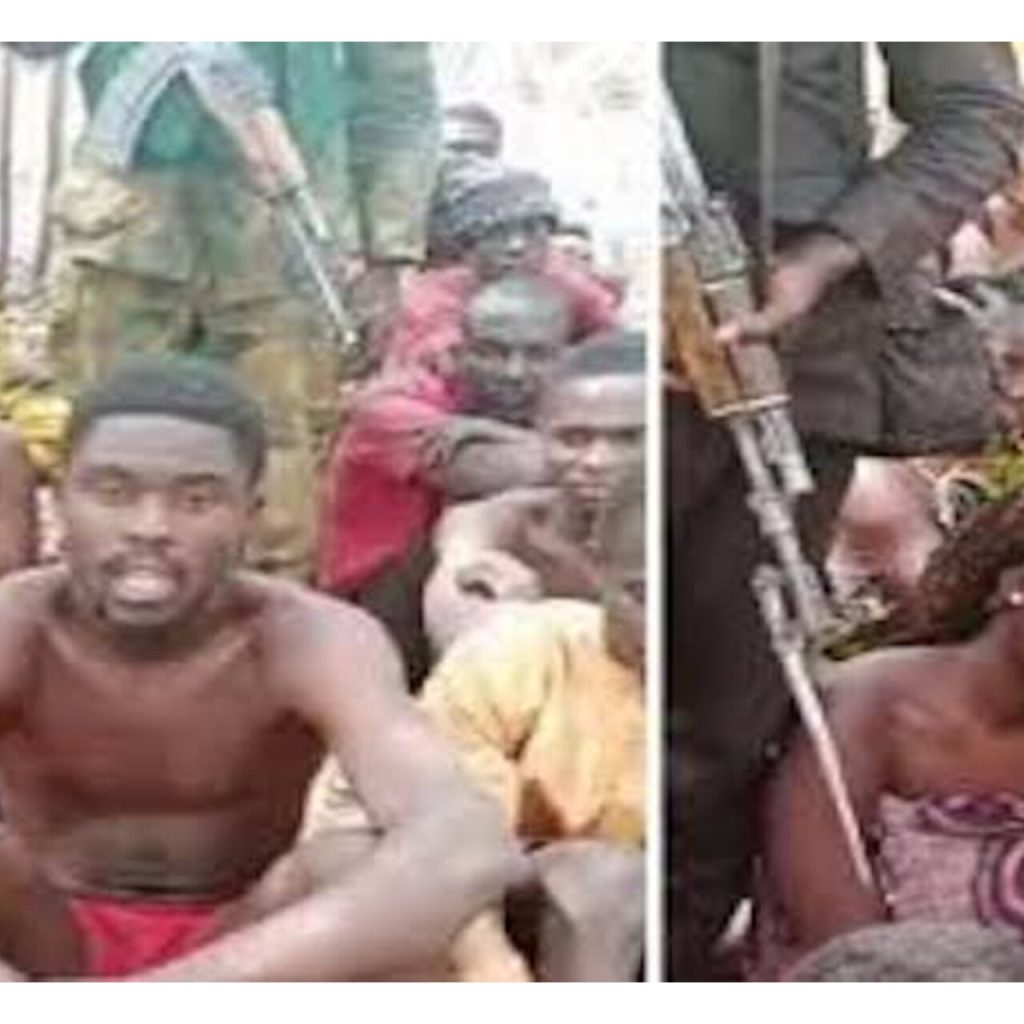
•Repentant terrorists
Retired military officers, human rights activists, lawyers and other concerned Nigerians have expressed outrage as they condemned the reintegration of repentant terrorists into the society by the federal government after undergoing six months of de-radicalisation and vocational training.
The government announced last Thursday that 744 former terrorists will be reintegrated following their graduation from the De-radicalisation, Rehabilitation and Reintegration Camp under Operation Safe Corridor, reports Saturday Vanguard.

While the military authorities described the exercise as a strategic intervention to dismantle extremism, concerned Nigerians have warned that the programme may be a ploy for insurgents to gather intelligence, infiltrate security agencies, and escape justice.
The 744 beneficiaries, drawn largely from the North-East, with 597 from Borno State alone, underwent months of rehabilitation, including psychosocial therapy, vocational training, civic education, and religious reorientation.
There were also foreign nationals from Niger, Chad, Cameroon, and Burkina Faso, an indicator of the transnational nature of the insurgency Nigeria has battled for over a decade.
But almost immediately after the report, there was a deluge of criticisms against the policy.
‘Deradicalised or just disengaged?’ – Rear Admiral Olisemelogor
Among the more structured criticisms came from Rear Admiral Dickson Olisemelogor, a retired naval officer who drew a sharp distinction between disengagement and true de-radicalisation, warning that the programme could be a ploy to gather intelligence and infiltrate security agencies.
According to him: “The idea of reintegrating de-radicalised deviants into society is good. However, what I see in our own case is disengagement rather than deradicalization. The boys are pulled out of their groups and given some soft landing by engaging them in various government agencies without addressing the causes of their anger. To me this is a big mistake.
“Deradicalization entails changing the person’s ideology and must be seen over a period of time that the person has actually changed. Additionally, the person’s grievances must be addressed like issues of unemployment, land dispute, religious intolerance, etc. As far as I am concerned, most of the so-called repentant Boko Haram boys are not de-radicalised because they come out when military pressure or hunger knocks hard on them. Some are purposely sent to gather intelligence and infiltrate security agencies. This is the reason they return to their old group or even form a new terror group once they have the opportunity. This has been observed in those who were absorbed into our security agencies; they often surreptitiously turn against their unit during operations or even abscond to form kidnapping groups.”
To change the narrative, he proposed the following measures: “The Federal and state governments should engage the National Orientation Agency to do proper grassroots awareness campaigns in the North. Non-radical religious leaders and musicians could be used to preach against radical ideologies.
“Mandate all media organisations in the affected states (radio and TV) to educate and win the hearts and minds of the people using Hausa/Arabic language. They could use radio frequencies like the BBC.
“Mandate all religious leaders in mosques and churches to understand the concept of national security and pass it on to their followers, and use public-private partnerships to re-industrialise the North to provide employment to the teeming unemployed youths”.
We criticised it – Serving Major General
A serving Major General who spoke anonymously said: “I was among those who criticised the so-called ‘safe corridor.’ I couldn’t really understand it. How would they integrate? Take Jilli market where the Air Force bombed recently, it was a Boko Haram supply hub. Terrorists came openly to buy fuel and food. They have a community around them. After all that, you want to reintegrate them into the society where they have their former members?
“Some people don’t even understand the ideology, they just have a soft spot for Boko Haram. To be candid, we even have senior officers who sympathise with them. They have infiltrated the system.”
He went further, questioning the very foundation of the Nigerian state: “I have served as defence attaché in many countries, and I have come back to realise that Nigeria is not a nation. We are just a group of people thrown together, coexisting. A Hausa man never likes a Yoruba man. Some Yoruba don’t hide their dislike for the Igbos. What connection do the Niger Delta have with the Hausa? None! At a time, the military was given an express directive not to stop Chadian citizens from entering Nigeria because they were bringing cows. Can you imagine that?”
It is wrong — Amb. Mary Abyomi-Fatile
Ambassador Mary Abyomi-Fatile, Convener of Prayer and Support for Nigerian Armed Forces and other security agencies, offered an uncompromising view.
She stated unequivocally: “I am not in support of the Operation Safe Corridor approach. To me, it is very wrong. We have not finished dealing with those behind the insecurity bedeviling our nation, yet we are trying to reintegrate culprits who claim they are truly repentant, or who may simply be pretending for self-interest.
“There must be a price for such crimes. If the cost is not high enough, others will see it as a loophole rather than a warning. Justice must be visible and firm otherwise, what deters the next recruit?”
It is unfair to those killed —Kano-based businesswoman
A Kano-based businesswoman, Aminat Saudi, who said six of her relatives were killed in Borno state by terrorists, questioned the moral balance of the programme.
She said: “Aside from fears that this repentant approach could be part of the terrorists’ strategy to infiltrate sectors of the economy, no one is talking about the victims of their wicked act.
“What happens to the families of those killed by the repentant terrorists? What happens to the houses burnt, farmland destroyed and those who are living with parts of their bodies dismembered? Who refunds the ransom paid by victims of these so-called repentant terrorists? Until these questions are addressed, the Safe Corridor philosophy won’t be seen as anything other than sympathetic to terrorists.”
Approach with caution, transparency — Nwagunma
Human rights advocate Okechukwu Nwagunma framed the issue within a broader moral question: “Can a nation heal without accountability?” He said the reintegration of de-radicalised former Boko Haram members by the federal government is a complex and sensitive issue that must be approached with caution, transparency, and a strong grounding in justice and accountability.
According to him, “in principle, deradicalisation and reintegration are recognised components of modern counterinsurgency strategies. Globally, programmes that encourage defections, disengagement from violence, and rehabilitation can help weaken insurgent groups, reduce cycles of violence, and promote long-term stability. So the idea itself is not inherently flawed. However, in the Nigerian context, several critical concerns arise: First, justice and accountability. Many victims of Boko Haram atrocities, families of those killed, abducted, or displaced feel sidelined when former fighters are reintegrated without clear processes of accountability. Reintegration must not translate into impunity. There should be a transparent framework that distinguishes between those who committed grave crimes and those who were coerced or played non-combat roles, with appropriate legal consequences where necessary.
“Second, lack of transparency. Programmes such as Operation Safe Corridor have been criticised for operating with limited public scrutiny. Communities receiving these individuals are often not adequately informed or consulted, which fuels fear, resentment, and distrust. Reintegration cannot succeed without community buy-in.
“Third, recidivism and security risks. There have been reports and fears, whether fully substantiated or not, that some ‘rehabilitated’ individuals may relapse or act as informants for insurgent networks. This underscores the need for rigorous risk assessment, monitoring, and post-reintegration support.
“Fourth, neglect of victims. There is a perceived imbalance where ex-combatants receive rehabilitation packages, while victims, especially internally displaced persons remain in dire conditions with inadequate support. This creates a moral and policy contradiction that undermines public confidence in the programme.
“Fifth, community-based reintegration challenges. Successful reintegration requires structured psychosocial support, livelihood opportunities, and sustained engagement with host communities. Without these, reintegration efforts risk deepening local tensions rather than fostering reconciliation”.
What should be done?
According to Nwagunma, “the government needs to anchor reintegration efforts within a broader transitional justice framework, one that includes truth-telling, reparations for victims, community dialogue, and accountability mechanisms. There should also be independent oversight, possibly involving civil society, to ensure credibility and transparency.
“While reintegration can be a useful tool in ending insurgency, its legitimacy and effectiveness in Nigeria depend on whether it balances security objectives with justice for victims, transparency, and community trust. Without these, the programme risks being seen not as a path to peace, but as a reward for violence,” he declared.
Reintegration of terrorists a big fraud —Legal Practitioner •Threatens lawsuit
A legal expert, Dr Maxwell Opara, has vowed to seek a federal court order to halt the Federal Government’s de-radicalization, rehabilitation and reintegration programme for terrorists, describing the release of 744 former insurgents back into society as an “epitome of fraud” and mockery of the justice system and the victims of terrorism.
Opara made the declaration yesterday during an appearance on Arise TV’s morning programme, monitored in Abuja. He was reacting to the graduation of 744 former terrorists and victims of violent extremism from the Federal Government’s Operation Safe Corridor camp in Gombe, where they had reportedly undergone 24 weeks of vocational training.
“By next week, I shall be approaching a federal high court to stop this madness. We can’t continue like this,” he said.
Opara argued that the programme, anchored on a United Nations framework, bypasses the fundamental requirements of Nigerian law — which demands investigation, prosecution, conviction and only then the possibility of a presidential pardon for those who meet the necessary criteria.
“Once a crime is committed, our laws are there. Once you are investigated, you will be charged to court,” he said, insisting that coercion is not a recognized defence for an adult who commits a crime.
He said the human cost borne by victims and their continued suffering is a sharp contrast to the preferential treatment for perpetrators.
“I have a client that mistakenly murdered somebody through a fight. That young woman has spent over 25 years, as I speak to you now, at Suleja Prison. And then, there is somebody, a particular citizen, who sacked an entire community in the name of terrorism — and after six months, they told us that they had repented and are going to be reintegrated into society.
“Which community? The community that is no longer in existence. Now, who are those that received them? The people who are already in the IDP camp. The victims of this terrorist act are still in the IDP camp, and instead of you thinking about how to rehabilitate them, you are using our hard-earned money to rehabilitate criminals”, he said.
He dismissed the Defence Headquarters’ argument that most of those released were coerced into terrorism, warning that the programme was setting a dangerous legal precedent. “When they force you into crime, or convince you, or pay you money to go into the crime — once you are an adult and you commit a crime, that should not be a defence. I am telling you, saying it on national television, this thing is an epitome of fraud”, he said.
Opara also challenged the Defence Headquarters to provide data showing whether the programme, which has been running since the late Muhammadu Buhari administration, has actually reduced terrorism.
“I challenge the representative of the Chief of Defence Staff — since you applied this particular procedure in Nigeria, tell us the rate of terrorism when you started it and the rate of terrorism now. This is a means by which the government is encouraging people to go into terrorism”, said Opara.
He also called on the Economic and Financial Crimes Commission EFCC to probe the funds expended on the programme, suggesting the cycle would simply repeat itself.
“After this one, in the next six months, they will get another budget. I am inviting EFCC to check how much was spent in carrying out this funny process. How many terror suspects do we have in the whole of the federation? How many are in Abuja? How many are in DSS cells? Now, do you apply this to all of them?”, he queried..
On the presence of eight foreign nationals among those released — including citizens of Burkina Faso, Cameroon, Chad and Niger Republic — Opara said their inclusion only deepened his concerns about the programme’s legality and direction.
While the programme’s defenders, including the UN framework it draws from, argue that prosecution alone is insufficient to prevent re-radicalization and that criminal justice systems can be overwhelmed by the sheer volume of terrorism suspects, Opara maintained that the UN resolution is advisory and not automatically binding on sovereign states.
“The United Nations resolution is not binding. When you have the resolution, you look at your own circumstances, your own law. You don’t do the right thing at the wrong time,” he said.
He pointed to the swift prosecution of Boko Haram financier Hamisu Wadume as a model that should be replicated. “What stops you from following it the way you did that of Nnamdi Kanu? Within the space of two months, they concluded the trial, convicted and sentenced him. Now, what happened to these particular people that wiped entire communities and made Nigeria number four in the terrorism index?” he asked.
It’s unfair to prioritise welfare of former terrorists — Concerned Nigerians
Other concerned stakeholders also condemned the reintegration of repentant terrorists into the society arguing that it’s unfair to prioritise their welfare over that of their victims. Some argued that the move will undermine the morale of serving armed personnel, who put their lives on the line every day while facing relentless attacks from terrorists.
It will create dangerous precedent —— Elder Sunday Oibe, Chairman, Northern States Christian Elders Forum (NOSCEF)
“Granting incentives to individuals who previously took up arms against the state sends the wrong signal to law-abiding citizens and victims of violence. How does one explain a situation where terrorists are rewarded in the guise of repentance? What is the reward for innocent Nigerians, including military personnel, who lost their lives? Such actions could create a dangerous precedent, potentially encouraging others to engage in criminal activities with the expectation of future rehabilitation and benefits. If the government allows this to stand, it risks encouraging more people to take to terrorism in the hope of being gainfully engaged later. It is irresponsible to reward individuals who have killed, maimed, and destroyed properties, while victims — widows, orphans, and affected communities — are left to suffer in pain. The federal government should reconsider any such initiative and prioritise justice for victims, accountability for offenders, and policies that strengthen national security and public trust”.
Northern Youths kick, say it could worsen insecurity
The leadership of the Northern Youth Council of Nigeria, NYCN, has also strongly opposed the Federal Government’s policy of reintegrating former terrorists into society. The National President, Isah Abubakar, in a statement said, “prioritising the rehabilitation and reintegration of former fighters without corresponding justice and compensation for victims undermines trust and could worsen insecurity. While efforts at peace building are commendable, they must not come at the expense of justice for victims. Families who have lost loved ones and livelihoods deserve recognition, support and restitution. The Federal Government should urgently review the policy, any deradicalisation initiative must be balanced with a transparent justice process and comprehensive support for victims of terrorism. Sustainable peace can only be achieved when the welfare and rights of victims are given equal priority alongside any reconciliation efforts. We urge authorities to engage critical stakeholders, including affected communities and civil society organisations, in designing policies that promote justice, healing and long-term stability”.
It’s risky to bring back former terrorists —Mr Walsh
According to Mr. Damien Walsh, a 49-year-old farmer from Barkin Ladi, “It is risky to bring these people back to society. These individuals have committed heinous crimes against the state and its people. Instead of being reintegrated, they should face justice for their actions. I do not consider it as a wise idea”.
Unfair to prioritise welfare of former terrorists —Mrs Yilkur
As for Mrs Alice Yilkur, a 43-year-old trader, “the decision is not wise at all. The government should first help the victims who have suffered greatly before thinking of assisting the killers. It is unfair to prioritise the welfare of former terrorists while many innocent families are still struggling with the pain and loss caused by their actions. This is not fair at all, bringing back these repentant terrorists could expose communities to fresh attacks and create more fear among the people who have already endured so much.
This is not justifiable —Joseph Ambakederimo
In his own reaction, Convener of the South South Reawakening Group, Joseph Ambakederimo, said: “This is not justifiable. I don’t believe the government’s deradicalization and reintegration policy is the strategy we need to stem the wave of terrorism. The position of the Minister of Defence, General Christopher Musa (retd), on this issue of deradicalization and reintegration was well known even before he became minister.
Meanwhile, the Chief of Army Staff finds comfort in the policy. This means the two men are diametrically opposed to each other in the fight against terrorism in the country. So one might ask: what is the policy thrust of this administration in the fight against terrorism? It already seems there is no clear-cut strategy to combat this menace, and if that is the case, then we have a long haul ahead”.
Reintegration of terrorists in order — Comrade Ekujumi
Coordinator, Coalition for Good Governance, CGG, Comrade Nelson Ekujumi said, “The rehabilitation of repentant terrorist is a welcome development, because it’s a means to attract and depopulate the foot soldiers of the terrorists, who may have been forcefully or deceitfully conscripted into the evil group and having seen the damage being done to humanity, have decided on their own to turn their back to the evil agenda by repenting and surrendering. If they see the window of rehabilitation and reintegration being opened for genuine repentant terrorists to explore, it could go a long way to motivate persons willing to give up acts of terrorism and thereby depopulate the number of persons being used to perpetuate the crime against humanity called terrorism. I’m totally in support of rehabilitation of repentant terrorists because they could become a useful weapon to understand and assimilate what goes on in the terrorist camp, their mindset and ideology with a view to drafting a master plan to counter it and reduce terrorism.”
It’s a policy that mock the victims — Chief Iorbee Ihagh, Chairman of Benue State tribal leaders
On his part, the Chairman of Benue State tribal leaders and President General of Mzough U Tiv, MUT, worldwide, Chief Iorbee Ihagh described the development as unacceptable. Chief Ihagh pointed out that the decision could be political saying “this is another plot to help them with the 2027 election. If it is not, how do you explain that people who have killed our loved ones and sacked our communities are forgiven and pushed back into society? What manner of government will do that?These people should face the law for their crimes and not be pushed back into society. It is unacceptable and we certainly cannot live with people who killed our people and forced our people into IDPs camps.
“It is unacceptable and it is condemnable. It is a policy that tends to mock those that have been dealt with by these so called repentant gangs.”