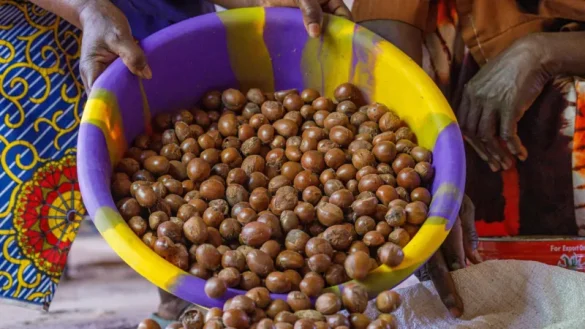
•Shea nuts
The federal government’s temporary ban on raw shea nut exports has led to a sharp decline in income for rural women involved in the shea value chain, with many still unable to sell their produce months after the policy was introduced.
The federal government announced a six-month temporary ban on the export of raw shea nuts on August 26, 2025, and on Wednesday, President Bola Tinubu approved the extension of the ban on the export of raw shea nuts for another year, from February 26, 2026, to February 25, 2027, reports Daily Independent.

According to the President’s Special Adviser on Information and Strategy, Bayo Onanuga, the decision is aligned with the government’s industrialisation objectives under the Renewed Hope Agenda.
The ban was implemented to boost local processing, encourage value addition and prevent the export of raw materials, aimed at turning Nigeria from a raw material supplier to a global hub for refined shea products.
Stakeholders say the restriction, which was intended to encourage domestic processing and value addition, has instead disrupted livelihoods and exposed long-standing structural weaknesses in Nigeria’s shea nut industry.
Yinka Adesola, a major stakeholder in the shea industry said the ban has significantly reduced earnings among rural women who depend on shea nut trading for their livelihoods.
According to her, sales have dropped sharply since the policy took effect, leaving many women with unsold produce and limited access to markets.
“There was a massive decrease in sales, earning and income of rural women. Many still have unsold shea nuts,” she said.
Adesola also noted that expectations that the policy would stimulate local processing have not materialised, as there has been little or no processing activity since the ban was introduced.
She attributed the situation to poor infrastructure in rural areas, particularly unreliable electricity supply needed to operate processing equipment.
“Government should provide enabling environment. Processing machines need electricity. Rural areas don’t have electricity hence no processing,” she said.
Olukayode Oyeleye, an Agribusiness Strategist, said the sector is not properly structured along a clear value chain, making it difficult for policies such as export restrictions to produce meaningful results.
He explained that shea trees grow naturally in the wild rather than in organised plantations, unlike other plantation crops, making production levels difficult to measure since fruits are collected after falling from trees in forest areas.
Oyeleye noted that quality control remains a major challenge at the fruit-picking stage, as poor-quality nuts are sometimes mixed with better ones during processing.
He said the impact of the export ban has therefore been negligible, as local processors were unlikely to experience significant changes in production volumes or income.
“If there was any impact at all of the ban on shea nut export, it would have been negligible,” he said.
He added that the shea industry remains largely unregulated and unmonitored, with many participants operating outside government records.
Oyeleye argued that reviewing or lifting the export ban would likely have little noticeable impact unless the government first addresses fundamental industry challenges.
He called for a census of shea trees and industry participants to provide reliable data for policy planning and support.
According to him, government should identify areas with the highest concentration of shea production and develop operational best practices to improve product quality for both local and international markets.
He also recommended price intervention through guaranteed minimum prices to provide incentives to stakeholders.
For Oyewole Okewole, Senior Associate Consultant at FutuX Agri-consult Limited, the export ban has produced mixed outcomes across the shea value chain, helping processors gain access to raw materials but creating challenges for exporters and farmers.
According to him, although the restriction has improved processors’ access to shea nuts, many lack the capacity to absorb the increased supply.
He noted that constraints faced by exporters have affected foreign exchange earnings and weakened global market relationships within the value chain.
Okewole also said prices of shea nuts have fallen as a result of increased supply and limited access to international markets, creating uncertainty for stakeholders.
Despite the challenges, he said the policy could still support long-term development of the shea industry if properly implemented.
In his view, the government should maintain the ban in a modified form, supported by a clear developmental policy and transition plan that promotes local processing and value addition.
He emphasised the importance of transitioning from exporting raw shea nuts to exporting value-added products such as shea butter to compete in the global market.
However, he warned that maintaining the ban without adequate support measures could worsen the situation for stakeholders.
“Otherwise, if they maintain the ban and all these are not put in place we will go back to the first stance we were,” he said.
Okewole recommended scaling up processing capacity through incentives for private investment such as tax breaks and reduced import tariffs on processing equipment.
He also proposed staggered exports instead of a full ban and called for the development of global markets for shea butter exports.
In addition, he suggested the establishment of an organised marketing board to oversee marketing activities across the value chain and promote Nigerian shea products internationally.
Meanwhile, stakeholders have criticised President Bola Tinubu’s approval of the extension of the ban on the export of raw shea nuts for another year, from February 26, 2026, to February 25, 2027.