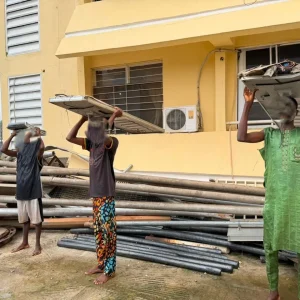
•Nigerian students
Despite the federal government’s hammer on degrees obtained from universities in Togo and Benin Republic, Nigerian youth continue to seek higher education in these neighbouring French-speaking countries. This article reveals why the youths are undaunted by the government’s blacklist of certificates from such universities and why the trend may not cease any time soon, reports The Nation.
One year ago, the federal government blacklisted certificates obtained from institutions in neighbouring French-speaking countries of Togo and the Republic of Benin.
Aside from dismissing the institutions for being substandard, the government also axed civil servants who obtained degrees from the affected schools.
In spite of these stern measures, however, admission seekers from Nigeria have continued to look the way of these neighbouring countries to actualise their dream of acquiring higher education.
Although there is no official data on the number of Nigerian students enrolled in various institutions across these countries, a source estimates no fewer than 15, 000 Nigerian students are currently studying in the Republic of Benin and Togo.
So, what drives students to prefer these schools?
A 300-level student at École Supérieure de Management in Porto-Novo, Republic of Benin, who gave her name simply as Ihuoma, said she looked beyond the shores of Nigeria because of her frustrations with the Joint Admissions and Matriculation Board (JAMB) among other issues.
“I chose to study in the Republic of Benin because of the challenges in Nigeria’s education system, including ASUU strikes, admission difficulties and overcrowded universities,” she explained.
Ihuoma finds the admission process more straightforward and believes students can complete their studies without delays.
She also recalled her experience with admission in Nigeria, saying: “I applied for Mass Communication with a JAMB score well above the cut-off mark and also had good grades in my O’ Level subjects, yet I was not admitted and did not receive any course option.
“I applied for the Joint Universities Preliminary Examination Board (JUPEB) but fell short by just one point. They required 11 points while I got 10. Others with the same grades were lucky enough to be offered different courses while I was not.
“These experiences took a toll on me.”
She also believes that her international exposure has helped her to develop valuable skills that would enhance her career prospects.
Also reliving her experience, Fashola (other names withheld), a third-year student, echoed similar sentiments, saying that she sought admission in a French-speaking neighbouring country for international exposure, better educational resources and the chance to experience a new culture.
While he would not discourage anyone from following this path, he acknowledged the potential for culture shock, such as the language barrier, different food options and slower pace of life.
Nevertheless, he concluded, “I would recommend studying in Benin for students looking for opportunities.”
The story is not different with Joseph, who schools in ESM University, Republic of Benin. He said he opted to study abroad “due to Nigeria’s corrupt and unfair educational system” with emphasis on the strike rate, cultism and insufficient basic school amenities.
He, however, admitted that the news about the ban on the certificates of some institutions in Togo and Benin Republic caused a panic.
“I must say I wish I’d just schooled in a non-West African country,” he said.
Even with some of the challenges, Joseph said he would recommend the school to any student who wishes to attend “due to the affordable fees and the fast school calendar.”
Unlike others, he said he was not rattled when the news broke that the Nigerian government would no longer recognise degrees from the Republic of Benin.
He said: “Well I was not moved at all because I have had to deal with worse situations. The school was on lock down for a while. Many students were afraid, so they started running around, changing institutions and thinking they were going for greener pastures, but they were only complicating things for themselves.
“I stood my ground since I was already in the last semester and I was not going to let anything stop me from acquiring my BSc even if it is not recognised in Nigeria. After all, there are other countries where I could work with the certificate.”
Despite the misgiving about some institutions in Togo and Benin Republic, it was gathered that the federal government recognises eight universities in Togo and Benin Republic.
They include the Universite De Lome, Universite De Kara and the Catholic University of West Africa.
Others are the Universite D’Abomey-Calavi., Universite De Parakou, Universite Nationale Des Sciences, Technologies, Ingenierie Et Mathematiques, Universite Nationale D’Agriculture and Universite Africaine De Developpement Cooperatif.
Frustration, uncertainties
Ihuoma expressed the frustration of some of the students in these foreign varsities. She also expressed regrets over the limited recognition of some universities in Benin Republic.
According to her, “the difference in academic prestige between Nigerian and Beninese universities makes it harder to get certain job opportunities back home.”
For a fast and strike-free education, said Ihuoma, the two French speaking countries are the place to go.
“But they (prospective students) should be careful to choose an accredited university to avoid future recognition issues, adding that the experience has been enriching.”
The government’s decision not to recognise some graduates from universities in the Republic of Benin, dealt a big blow to the Nigerian students schooling in the two neighbouring countries.
Ihuoma said: “It was devastating because many of us worked hard to earn our degrees. The decision created panic, especially for those who were close to graduating.
“It felt it was unfair that students who genuinely studied had to suffer because of fraudulent schools. I felt concerned and uncertain about my future prospects.
“The decision created anxiety among many students, and we hoped for a resolution that would recognise our qualifications.
“It raised questions about the value of our education and future opportunities.”
To make matters worse, it was gathered that some undergraduates in Nigerian universities treat those from Togo and the Republic of Benin with scorn.
According to Ihuoma, “Some mock us, saying we bought our degrees, while others respect the fact that we took a different path. It can be frustrating, but I remind myself that my education is valid.”
She pleaded with the Nigerian government to take another look at the decision, noting that many students choose to study abroad because of the failures of Nigeria’s education system.
“If Nigerian universities were more efficient, fewer students would seek alternatives. I urge the Nigerian government to reconsider its decision and recognise degrees from reputable universities in the Republic of Benin.
“This would help alleviate the uncertainty and anxiety faced by students like me. I would like to convey to the Nigerian government the importance of recognising foreign qualifications and ensuring that students have equal opportunities, regardless of where they study.”
Ihuoma is uncertain about what the future holds regarding job opportunities. “Sometimes I think about job opportunities and the perception of foreign degrees in Nigeria. But overall, I appreciate the uninterrupted learning experience.
“While the challenges and uncertainties have been significant, I do not regret my decision. The experience has been valuable, and I’ve grown both academically and personally.”
Like Ihuoma, the government’s decision not to recognise some graduates from universities in the Republic of Benin did not sit well with Anuoluwapo. She is disappointed and worried about her uncertain future.
She urged the Nigerian government to reconsider its decision and recognise the qualifications of graduates from reputable universities in Benin Republic.
Sophia is also not happy with the government’s decision not to recognise their certificates. She, therefore, pleads with the Nigerian government to lift the ban, saying it would set the students back many years.
“Where would we start from if the government does not lift this ban? All the money we spent on learning would go into waste.
“Please, look into the matter of this ban and lift it. People’s lives and destinies are on hold because of this. Please we need a way forward. Learning in Cotonou is better and less stressful than learning in Nigeria.”
Lending her voice, Gladys, a 200 Level student in another institution in the Republic of Benin said she was excited about her admission to the neighbouring country’s varsity.
According to her, studying abroad can be such an amazing experience. She reckons that it opens so many opportunities for personal growth and cultural exchange, adding that “you get to learn in a different environment, which can really broaden your perspective.”
Gladys described the government’s decision not to recognise some graduates from universities in Benin Republic as “quite concerning.”
According to her, the decision raises questions about the quality of education and the implications for students who have worked hard to earn their degrees. Such a decision, she said, can affect graduates’ job prospects and overall confidence in their educational institutions.”
She agrees, however, that it is important to ensure that all universities maintain high standards so that students can feel secure with their qualifications. But she expressed confidence in the schools, saying “to the best of our knowledge, we have great mentors and professors who have been Impacting unforgettable experience and wisdom. We pray every day for God to ease the government’s heart.”
Alaba, a 300 Level student in another institution, said her inability to gain admission after passing the Joint Matriculation Examination (JME) made her to travel to Port Novo.
She expressed sadness over the Nigerian government’s decision not to recognise certificates from the French speaking varsities.
“I felt so sad not even for myself but for the ones that have graduated before me and those that we heard the rumour of their sack letters. Most of them already have families they are taking care of. What did the Nigeria government expect them to be doing when they stopped them from working? Steal?”
Her message to the Nigerian government: “Please, consider us (foreign students) and reverse the ban on the certificates from Benin Republic and Togo.”
While the students and graduates from the affected institutions have continued to appeal to the government to rescind its decision, whether their pleas will yield any fruit is in the realm of conjecture.
Why Nigerians students continue to study in Togo, Benin Republic
Currently, Nigeria has 270 universities, of which 148 or 54.8% are privately owned. While some experts argue that private institutions are expanding access to education, the demand for higher education still exceeds the available spaces.
It was gathered that lack of space in the Nigerian universities has led many Nigerians to seek admission in countries like Togo and Republic of Benin; a development many stakeholders have expressed reservations about.
Professor Segun Omosule, the Head of the Department of English at Olabisi Onabanjo University, Ago-Iwoye, Ogun State, while sharing with our correspondent his concerns about students who seek admission in Togo and the Republic of Benin, stated that many of the students involved lack the necessary qualifications and might have received assistance to pass their school certificate exams.
“This raises questions about whether these institutions are recognised. Yet many parents continue to send their children there, where they can obtain results without significant effort.”
According to Omosule, a significant number of students prefer enrolling in universities in Lome, Togo, where they can acquire certificates without truly earning them. He described the phenomenon as troubling, adding that the influx of Nigerian students into substandard schools in neighboring countries is partly due to a national attitude that favours short-cut solutions.
Omosule said many students seek certificates without the intention of using them for meaningful employment.
“They simply want to be labeled as graduates. Given the limited job opportunities in the labour market, these individuals find satisfaction in obtaining certificates quickly and effortlessly.”
Omosule wonders why Nigerians would choose to attend higher institutions in these countries when the educational standards are significantly higher in Nigeria.
He noted that this situation led the Nigerian government to decline recognition for certificates from certain universities in West Africa, partly due to issues related to integrity.
He recalled an interaction he had with a student from one of the neighboring countries, who contacted him via Instagram. He said the student asked if she could receive a certificate without attending school, to which he replied that it was not possible. She admitted she already had one from the Republic of Benin.
He also recalled a senior colleague who abandoned his PhD programme due to the academic challenges and chose instead to travel to the Republic of Benin. This colleague later celebrated on Facebook, claiming he had earned his PhD, even mocking those that were still pursuing their degrees.
However, Professor Omosule doubts the long-term value of such a certificate, warning that if this individual wishes to work with it, he will either have to start fresh in a legitimate programme or abandon the idea altogether.
Findings revealed that the prevalence of online fraud among Nigerian youths is linked to the large number of graduates who obtained their certificates from unrecognised institutions abroad because many of these individuals struggle to find jobs and face frustration and psychological distress due to their inability to work with their degrees.
Omosule emphasised that as long as examination malpractice persists and students possess certificates they cannot defend, the desire to attend schools in neighboring West African countries will continue.
To counter this trend, he advised the government to increase awareness within local communities. Unfortunately, many parents lack education and are unaware of the current situation and government policies. Even when informed about the unrecognised status of these certificates, many still insist on sending their children abroad.
He also urged the National Orientation Agency to take action in the matter. According to him, parents, students and agents of foreign universities should be held accountable. These agents often mislead parents and students about the legitimacy of the certificates, claiming that recognition issues are due to political circumstances, such as the administration of President Tinubu.
In order to convince the students and their parents, these shylock agents tell them that if the students do not use the certificate for employment, they might consider other pathways, such as entering politics or leveraging it in their businesses.
Dr. Isaac Oladepo Onigbinde of McPherson University also explained that parents will continue to send their children/wards to institutions of higher learning in Togo and Benin Republic due to lack of confidence in the Nigerian educational system. “Nigerian people believe that anything from the Diaspora is of good quality while home-grown delivery is considered inferior,” he said.
The flip side of this, according to Onigbinde, is that Nigeria would continue to produce graduates that lack global competitiveness and local relevance.
The don therefore said to forestall this, it becomes imperative for the government to build local capacity. “There is a need to instill confidence in the people of Nigeria on the need to believe in the capacity of their country and the enormous resources therein. There is also a need for re-orientation of Nigerian people on the need to believe in the philosophy of Nigeria’s Project,” he said.
Also speaking, Dr. Tesleem Kolawole, a lecturer at Osun State University, confirmed the findings of our correspondent that ignorance fuels the interest of many Nigerian admission seekers to opt for schools in Togo and the Republic of Benin. He said many of the students and the parents are ignorant of the law that bans universities in Togo and the Republic of Benin.
“When they told them about the ban, the new students realised that some of the past students are actually serving, and some of them have gotten employment somewhere, and they were not sacked.”
He said he was not sure whether the law that banned the schools is being enforced.
“I think the best thing the government can do to stop the students from attending these schools is to enforce the law that banned those schools and their graduates so that people will not fall victim again,” he said.
Slim hope
In addition to the government disengaging individuals with degrees from unrecognised institutions abroad, employers are also hesitant to hire graduates from these schools. Many who spoke with our correspondent expressed their unwillingness to employ graduates from neighbouring countries’ institutions.
It will be recalled that the federal government recently terminated the employment of several civil servants and advised the private sector against hiring graduates from these schools.
Like many other employers who expressed reservations about the employability of graduates from these ‘foreign’ institutions, Bayo Bello, a Lagos-based lawyer, stated that he would not hire any graduates from these institutions unless they could prove that they were no longer involved in diploma mills and certificate racketeering.
He commended the government’s decision to ban degrees from these foreign institutions, saying, “The government took the right decision. Based on their operations, it has been proven beyond any reasonable doubt that these institutions do not represent an ideal educational environment.”
Bleak future
To prevent Nigerian students from attending these substandard schools in Benin Republic and Togo, Bello suggested that the government should refuse to recognise any certificates issued by them.
Former Minister of Education, Tahir Mamman, said there was no going back on the decision of the federal government to cancel about 22,700 certificates awarded to Nigerians by some “fake” universities in neighbouring Togo and Benin Republic.
Mamman maintained that the decision to invalidate the certificates was not harsh as Nigerians who obtained degree certificates from such “illegal” tertiary institutions dent the country’s image.
He said: “Most of those parading the fake certificates did not even leave the shores of Nigeria but got their certificates through racketeering in collaboration with government officials at home and abroad.
“The fake universities capitalise on the gullibility of Nigerians who are patronising them.”